- Dipankar Bhattacharya
In the tradition of a Communist Party, the party congress is the highest assembly to chart the course of the party in any given situation. The situation right now in India is the most challenging that the communist movement, indeed post-independence India, has ever faced. Against such a backdrop, the Eleventh Congress of the CPI(ML) in Patna gave a dynamic demonstration of the party’s innate strength, expanding organisation and growing political initiative and intervention to intensify the people’s resistance against the fascist Modi regime and the Sangh brigade. From the 15 February “Save Democracy, Save India” rally on the eve of the inauguration of the Congress to the late evening concluding session on February 20, the Eleventh Congress turned into a weeklong exhibition of the great revolutionary legacy and reassuring strength and potential of the CPI(ML) at today’s crucial juncture.
In its sequence of events and range of resolutions, the Eleventh Congress represented the diverse dimensions of the party’s ongoing praxis and the tasks and priorities of its developing tactical line. The rally on the eve of the Congress not only demonstrated the party’s organisational strength and expanding presence in new areas and growing appeal among newer sections of the people including sections of the middle classes in urban Bihar, it also highlighted the party’s continued commitment to carry forward wide-ranging struggles for people’s rights even as the party plays its role as a constituent of the grand non-BJP alliance in Bihar and supports the government from outside. The strength of the party lies in its close ties with and continuing work among the masses and in the resilient struggles of the people against all odds. Accumulation and assertion of this core strength of the party is the key to the party’s committed role in anti-fascist resistance and the wide-ranging tasks and initiatives that such a line necessarily calls for.
The formal proceedings of the Congress began with the message of closer unity and cooperation within the Left camp. Alongside parties like the CPI(M), CPI, RSP and Forward Bloc, with which the CPI(ML) is associated in an all-India coordination, delegations of communist organisations like the Marxist Coordination Committee of Jharkhand, Lal Nishan Party of Maharashtra, Satya Shodhak Communist Party of Maharashtra and the RMPI of Punjab, long-standing allies of the CPI(ML) on diverse fronts, all addressed this inaugural session with their messages of unity and solidarity.
The Eleventh Congress also witnessed an inspiring expression of international solidarity with the presence of guests from countries as far as Venezuela and Australia as our nearest neighbours Bangladesh and Nepal. The Congress also heard a Ukrainian professor teaching in India and a representative from the Boycott, Divestment and Sanctions campaign against the Israeli occupation of Palestine. There were also several video and written messages from progressive parties and movements in Latin America, Africa, Europe and neighbours like Sri Lanka and Pakistan. Members of the Indian diaspora also enriched the Congress with their experience of developing international solidarity against imperialist aggression and the rise of neo-fascist forces as well as challenging the devious designs of the Hindutva right.
In a possibly first-ever move for a Communist Party Congress, the proceedings were also observed by a number of guests from the civil society including author and activist Arundhati Roy and several members from the worlds of journalism and academia who all took their turns to address the delegates. Some of our guests were present all through the deliberations as the Congress adopted political resolutions and organisational review report, discussed the challenge of climate change and elected the new Central Committee through secret ballot. The presence of seventeen hundred delegates and observers from 27 states and UTs, translation of all speakers in several languages, discussion over comments and amendments received from more than a hundred comrades to finalise half a dozen resolutions and reports and finally election of 76 members (Chairperson of Central Control Commission becomes an ex officio member) from a list of 81 names made the Congress a truly massive exercise in inner-party democracy.
Also unconventional was the hosting of a political convention from the Congress podium involving opposition leaders. The presence of Bihar CM and JDU leader Nitish Kumar, Deputy CM and RJD leader Tejaswi Yadav, senior Congress leader Salman Khurshid and VCK chief and MP Thol. Thirumavalavan from Tamil Nadu in the “Save Democracy, Save India” convention and the message of greetings from Jharkhand CM and JMM leader Hemant Soren underlined the urgent need for determined all-inclusive opposition unity to save India from the clutches of the fascist Modi regime and the rampaging Sangh brigade.
The speeches of Nitish Kumar and Salman Khurshid were predictably marked by some light-hearted exchanges as their respective parties grapple with the challenge of evolving an effective paradigm of opposition unity on the all-India plane. A serious point that however emerged amidst the banters of the speakers concerned the resonance of the Bihar model vis-à-vis the disastrous Gujarat model that the Modi regime desperately seeks to replicate across India.
The contrast between the two models does not merely lie in the fact that while the BJP has been dominating Gujarat for the last three decades, it currently finds itself ousted from power in Bihar. It runs far deeper into the historical evolution of politics in the two states. At the centre of the Gujarat model lies the 2002 Gujarat genocide of Muslims. The centrality of the genocide was underscored for the umpteenth time during the recent Gujarat elections when the perpetrators of the gangrape of Bilkis Bano and the murderers of her family released prematurely to a hero’s welcome right on the 75th anniversary of India’s independence and when Amit Shah described the 2002 genocide as a befitting lesson to ‘rioters’ that brought ‘permanent peace’ to Gujarat.
Bihar too has experienced a series of brutal massacres. From Rupaspur Chandwa in Purnea to Laxmanpur-Bathe in Arwal, Bihar has been periodically brutalised by massacres of Dalits and other oppressed people. The Bhagalpur riot remains one of the most shocking instances of communal carnage in post-independence India. But Bihar has never accepted caste massacres or communal violence as a political model. The resilience with which the CPI(ML) has successfully withstood feudal violence and state repression since its inception in Bihar has been a hallmark of what can really be called the Bihar model. It is also pertinent to remember that the loudest voice of opposition to the communal fascist expedition launched by Advani in the name of replacing the Babri mosque with a grand Ram temple emerged from Bihar. If the horror of genocide has been central to the Gujarat model, in sharp contrast, the Bihar model has grown around the rejection of and resistance to feudal-communal violence.
Building on the horrifying foundations of the 2002 genocide of Muslims, the Sangh-BJP establishment went on to write its Gujarat model script where Modi and Shah emerged as the leaders of the political orchestra and Adani and Ambani grew as corporate giants. 2014 brought this Gujarat model to Delhi and the whole country is now reeling under the economic, political and social disaster unleashed by this fascist model. After nine disastrous years, marketed first as ‘achchhe din’ and now as ‘amrit kaal’, we now see definitive signs of this model imploding with the Adani empire being jolted and the Modi-Adani nexus being exposed and challenged like never before. The holding of the Eleventh Congress in Patna showed the potential of a counter-offensive that the Bihar model could mount against the imploding Gujarat model.
As the Modi regime intensifies the assault on the opposition and on the entire framework of parliamentary democracy and constitutional rule of law, comparisons are constantly made with the Emergency era of the mid 1970s, the only occasion when India had to confront a ‘constitutional’ suspension of democracy. Back then, India had witnessed the rise of two powerful youth movements against corruption and soaring prices. Gujarat and Bihar were the two epicentres of this youth movement. The Gujarat agitation came to be known as the Nav Nirman Movement and the Bihar movement guided by JP became the iconic Sampoorn Kranti Andolan. The RSS student wing ABVP emerged as the main organisation of the movement in Gujarat and in Bihar it played second fiddle to the socialist stream. This was the precursor to the formation of the Janata Party and the rise of the Janata Party government, which gave India the first Prime Minister from Gujarat in Morarji Desai and marked the first big break for the RSS to go mainstream and gain legitimacy and legalised access to hitherto inaccessible levels of state power at the all-India level.
While the RSS managed to tilt the balance in its favour, the communist movement in Bihar suffered an unfortunate marginalisation because of the flawed CPI decision to oppose the Sampoorn Kranti Andolan and join hands with the Congress. From a record tally of 35 seats in the elections to the undivided Bihar Assembly in 1972, the CPI started losing ground. The Janata Party experiment of course proved short-lived with the RSS trying to subvert and dominate the party from within and a section of socialists opposing the continued allegiance of former Jan Sangh members to the RSS. The RSS then used the Janata Party experiment as a launching pad for the BJP while the old socialist movement regrouped as the Janata Dal and secured a relatively lasting political influence and social base with the implementation of the Mandal Commission recommendation on OBC reservation.
Beyond the proliferation of regional parties and identity-based formations in recent decades, historically the political landscape in post-independence India has been marked by the evolution of four key trends – the Congress, socialists, communists and the Hindutva right. During the period of domination of the Congress, the Hindutva right took advantage of the environment of anti-Congressism to emerge as the growing aggressive pole against the Congress. In spite of its political growth, the organisational unity of the socialist camp broke down in the post-Mandal period not only on regional lines but also on the key question of the socialist response to the rise of the BJP. The BJP made it convenient for sections of socialists to join hands with it under the NDA banner by agreeing to defer some of its core issues. By 2014 it became clear that the BJP no longer needed to maintain the early NDA era pretence or tactical restraint, and with Modi’s return for his second successive term in 2019 the fascist regime accelerated its drive to concentrate all power and turn India into an opposition-free republic. BJP leaders now openly proclaim their ambition to turn India into a single-party state and rule for fifty years.
This new juncture has made it necessary and possible for communists, socialists, Ambedkarites, Gandhians and Nehruvians to join hands against the fascists in a concerted resistance. And the Eleventh Congress convincingly highlighted this compelling necessity and the kind of impact it could produce when it is backed by the power of revolutionary ideology, organisation, initiatives and struggles that define the communist legacy in a state like Bihar. It marked a telling contrast between the Bihar of mid 1970s and the Bihar of today. Fifty years ago while Lalu Prasad and Nitish Kumar were leading the student movement of the day in Patna, the CPI(ML) was engaged in militant revolutionary struggles in parts of rural Bihar, especially in Shahabad and Magadh regions close to Patna. Yet the two trends did not converge on the ground. It is another thing that activists of both trends often met in jail and the quest for ‘total revolution’ inspired sections of activists of the JP movement to join the CPI(ML), especially in the wake of the disillusionment triggered by the collapse of the short-lived Janata party and government experiment.
From the 1990s onwards, the CPI(ML) movement started making its presence felt in the electoral arena. As governance passed into the hands of the inheritors of the mantle of the JP movement, with the BJP too turning into a ruling party of Bihar after stitching a rewarding alliance with Nitish Kumar’s JDU, the CPI(ML) continued to champion the interests of the most oppressed and deprived people of Bihar, upholding the banner of the revolutionary opposition in the Bihar Assembly. Today while carrying forward this battle of social transformation and people’s rights, the CPI(ML) is determined to discharge its revolutionary responsibility of defeating fascism which has emerged as the biggest impediment to the onward march of the people. Yesterday’s battle for land, wages and dignity against locally dominant feudal forces has thus grown into today’s battle for saving democracy and saving India from the clutches of the fascist marauders.
The Eleventh Congress has underlined the goals and the way ahead to reach them. It is now for the entire party to rise to the occasion harnessing the full strength and energy of people’s resistance and drawing upon the glorious legacy of India’s communist movement and everything progressive in Indian history.


Comrade President, Comrade Delegates and observers, leaders of various Left parties in India, leaders of fraternal organisations from abroad, friends from the media, assembled citizens of Patna,
It gives me great pleasure to welcome you all to the 11th Congress of the CPI(ML). With more than sixteen hundred delegates and observers attending this Congress from 27 states and Union Territories, this is the biggest Congress in our party history. For this Congress, we have renamed Patna as Vinod Mishra Nagar and the auditorium as Ramnaresh Ram Hall to pay tribute to two of our great leaders. The stage is dedicated to the memory of Comrades DP Bakshi, BB Pandey and NK Natarajan, the three beloved CCMs we lost since our 10th Party Congress held at Mansa, Punjab, in March 2018.
We feel greatly encouraged by the warm support extended to the organisation of this Congress by the justice-loving progressive people of Bihar which was amply reflected in the success of yesterday’s Save Democracy, Save India rally at Gandhi Maidan. We express our deep gratitude to the people of Bihar for their inspiring response.
We are greatly honoured by the presence of leaders of fellow Left parties – Comrade Salim from CPI(M), Comrade Pallab Sengupta from CPI, Comrade Manoj Bhattacharya from RSP, Comrade G Devrajan from All India Forward Bloc, Comrade Haldhar Mahato from Marxist Coordination Committee, Comrade Bhimrao Bansode from Lal Nishan Party, Maharashtra, Comrade Mangatram Pasla from RMPI and Comrade Kishore Dhamle from Satyashodhak Communist Party, Maharashtra – in this inaugural session of the Congress. Your presence means a lot to us and will surely help strengthen our existing spirit of unity and ties of cooperation.
We are inspired by the internationalist solidarity expressed by progressive parties and organisations from our neighbouring countries like Nepal and Bangladesh and also from countries as far as Australia and Venezuela. Comrades from Sri Lanka, Pakistan and Germany could not come because of visa problems, but messages of solidarity have come and are still reaching from all corners of the world. We are greatly thankful to our fraternal guests who have managed to make it to Patna to greet our Congress and to all our comrades who have sent their messages of solidarity. We are committed to strengthening our ties of internationalist solidarity and cooperation to intensify the battle to free the world from the multiple crises inflicted by today’s decaying capitalism – be it the austerity inflicted on the working people, the renewed rise of fascism and authoritarianism, wars of occupation and attacks on sovereignty of smaller and weaker nations or the climate crisis that is endangering the very existence of our planet.
Comrades, even as we hold this inaugural session in Patna, the people are voting in Tripura to elect the next Assembly and government in the state. For the last five years, Tripura has been experiencing daily attacks on democracy, on the offices, activists and supporters of opposition parties and on the people’s right to express their opinions and raise their demands and voices of protest. We hope the people of Tripura are able to cast their votes without any fear and end this reign of terror inflicted by the BJP.
As the fascist character and utter failure and betrayal of the Modi government on all fronts get increasingly exposed, the desperate regime is resorting to more brazen lies and intimidation. The government first invoked Emergency powers under India’s draconian IT Act to block any extracts from the documentaries aired by the BBC on the Modi Question on India’s social media platforms, and then unleashed Income Tax raids on BBC offices in Delhi and Mumbai. The Hindenburg report which accused the Adani group of stock market manipulations, accounting fraud and money laundering and triggered an unprecedented decline in the prices of Adani shares, drastically reducing Adani’s net worth and pulling Adani down from the third richest slot in the global list of billionaires to way below the top ten list, has been met with conspicuous silence and refusal to have any probe into the failure of India’s regulatory system and the Modi-Adani collusive nexus. In Parliament, Modi brazenly avoided answering the Adani question and asked the people to keep quiet because the government allegedly provided cheap food, subsidised gas cylinders, pucca houses and doles to the poor. It is a blatantly mischievous mockery of nationalism to try and portray the BBC documentary as a colonial conspiracy and the Adani expose as an attack on India as the BJP is currently doing.
The latest Oxfam report has once again drawn attention to the mounting economic inequality in India, illustrating the compelling case for the introduction of wealth and inheritance taxes on the super-rich. Yet the government announced further tax cuts for the super-rich in this year’s budget while curtailing the budgetary provision for MNREGA, social security and other public service and welfare expenditure.
While public anger grows against the worsening living conditions of the common people and the monumental failure of the government on the economic front, the Modi government wants to divert the people’s attention and use the social and economic crisis to whip up an ultranationalist fascist frenzy by spreading hate, sharpening communal polarisation and targeting Muslims as a community, progressive intellectuals and all dissenting voices and social groups fighting for justice and transformation as anti-national. Rampaging bulldozers have already replaced all the tall talks of universal housing with assured access to electricity, toilets and drinking water, and calls for genocide are being openly issued from platforms of so-called religious assemblies by toxic hate preachers masquerading as spiritual gurus.
All the institutions of constitutional governance are being systematically subverted with the executive openly coercing the legislature and the judiciary and the Centre reducing the states to glorified municipalities by using the offices of Governors and other appointed institutional heads and various central agencies as instruments of control. The Constitution itself is being hollowed out and undermined from within with changes in citizenship laws, reservation policies and erosion of the existing rights of various sections of people, especially minorities, the working class, farmers, small traders, Dalits, Adivasis, women and youth. This assault on democracy and diversity is being spearheaded to the drumbeats of celebration of India’s assumption of G20 presidency in 2023 and the planned inauguration of Ram Mandir by January 1, 2024 as announced by the Union Home Minister.
To counter this growing fascist frenzy and aggression, we need to strengthen the unity of the fighting people across India. The kind of unity and spirited assertion we saw in the citizenship movement before the Covid19 pandemic and the farmers’ movement that grew defying the harsh conditions of the Covid period and compelled the Modi government to repeal the disastrous farm laws, needs to be carried forward in building multiple powerful struggles against dispossession and privatisation and communal, caste and patriarchal violence, and to secure universal rights to food and housing, education and employment, public health and environmental protection. The popular political will to defeat fascism, save the Constitution and build a progressive and prosperous future for the people of India can only grow and succeed on the foundation of countrywide united assertion of the people.
All of us in the Left have a central role to play in energising and sustaining this popular assertion and advancing the agenda of a secular democratic federal India. Our efforts in 2023 will pave the way for a decisive victory of democracy in 2024. Ending the fascist BJP-RSS reign of communal hate, state terror and extrajudicial violence and corporate loot and plunder is of course a challenge that goes beyond the series of Assembly elections scheduled for 2023 or the Lok Sabha election of 2024 and calls for a sustained and all-out resistance of the people on all fronts. We need closer unity and cooperation among all the forces of the Left and the broader opposition to defeat fascism and win the battle of democracy and we are sure that we will be able to move in this direction.
Our 11th Congress is dedicated entirely to this need of the hour. Apart from deliberations on the political resolution and organisational report, the agenda of our 11th Congress includes two other specific resolutions – one on the perspective, orientation and tasks of anti-fascist resistance and the other on the agenda of environmental protection and climate justice. We sincerely thank all our comrades in the Indian Left movement and the global progressive camp for your support and solidarity and look forward to closer ties of solidarity and cooperation in the coming days. The fascists are drawing their strength not only from the state power in India but the global consolidation of rightwing forces and all the regressive aspects of India’s social structure, cultural customs and political history. We need to build on the progressive legacy of India’s freedom movement and larger battle for justice and equality and international solidarity among the whole range of anti-imperialist and anti-fascist forces to foil this fascist design. We are sure that with your support, the 11th Congress will take us forward in this journey.
More power to the progressive forces of the world!
Let us unite to fight and fight till victory.
Inquilab Zindabad!
Long live revolution!
- by Dipankar Bhattacharya


With the slogan of ‘Defeat Fascism, Save Democracy! Build the India of Our Martyrs’ Dreams!’ the 11th CPIML Party Congress was held in Vinod Mishra Nagar (Patna, Bihar) between February 15 and 20.
For the Party Congress, Patna was renamed as Vinod Mishra Nagar and the auditorium as Ramnaresh Ram Hall to pay tribute to two of our great leaders. The dais was dedicated to the memory of Comrades DP Bakshi, BB Pandey and NK Natarajan, the three beloved CCMs we lost since our 10th Party Congress held at Mansa, Punjab, in March 2018.
The party congress commenced with the ‘Save Democracy, Save India’ rally, a massive rally organised on February 15th at Gandhi Maidan, where tens and thousands of people, including rural poor, peasants and farmers, women, students, youth and members of the working class participated.
The rally began with tributes paid at the Martyrs’ Column at Gandhi Maidan.
The rally was addressed by CPIML General Secretary Dipankar Bhattacharya who said that it was pertinent to build oppositional unity to defeat fascism in the country. “The poorest of the poor need democracy the most. People build democracy on all fronts through struggles and mass movements. We will be able to fight only if there is democracy and democracy for everyone,” he said.
Political resolutions presented by Manju Prakash were adopted at the rally, which resolved to fight against all forms of hate and oppression, as also against the all-out assault of the Sangh Parivar.
Kunal, Bihar state secretary welcomed the participants of the rally while Dhirendra Jha conducted the proceedings. Vinod Singh, politburo member and MLA of Bagodar, Jharkhand, Mahboob Alam, leader of the legislative group of CPIML and MLA of Balrampur, Satyadeo Ram, deputy leader of the CPIML legislative group, Manoj Manzil, MLA of Agiaon, Sandeep Saurav, MLA of Paliganj, Meena Tiwari, general secretary of AIPWA, Shashi Yadav, National Convener of Scheme Workers Federation, among others addressed the rally.
Comrades from fraternal organisations from Nepal, Bangladesh, Australia and United Kingdom were present at the rally.
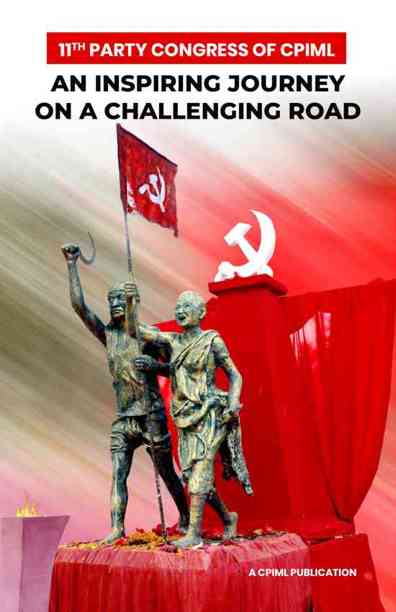
The inaugural session of the 11th CPIML Party Congress was held 16 February at Ramnaresh Ram Hall (SK Memorial Hall, Patna) after the hoisting of the communist flag and paying tributes to our departed leaders and martyred comrades at the Shaheed Vedi (Martyrs’ Memorial) erected at the venue. An eternal flame was lit at the Martyrs’ Memorial representing the sacrifices and the revolutionary legacy of the martyred comrades.
The open inaugural session began with revolutionary songs sung by comrades from the party’s cultural fronts. Rajaram Singh welcomed the delegates and the guests on the dais for the inaugural session. Swadesh Bhattacharya presided over the session which was moderated by Meena Tiwari and V Shankar.
The reception committee for the 11th Party Congress comprised several known public intellectuals like Prof. Bharti S Kumar, Dr. OP Jaiswal and Ghalib Khan among others. Dr. OP Jaiswal welcomed the party congress delegates and guests on behalf of the Reception Committee.
Abhijit Majumdar read out the Condolence Resolution, paying the party’s respects and tributes to all the comrades and progressive personalities from India and abroad who departed since the party’s Tenth Congress held at Mansa, Punjab in 2018. He began by paying tributes to departed party leaders Com. D. P. Bakshi, Com. B.B. Pandey, Com. N K Natarajan, Com. Kshitish Biswal, Com. Ramjatan Sharma, and Com. Pawan Sharma.
After the condolence resolution was presented, Kunal, Bihar State Secretary welcomed the delegates and guests. He welcomed comrades from various fraternal parties of the Indian Left, guests from the international Left and progressive movements, and the delegates, guests, observers, volunteers, citizens and press representatives from across the country. Remembering and celebrating the glorious history of Bihar which has always been a fertile ground for rebellion against conservative philosophical trends and religious authorities and a birthplace for various atheistic sects, he said that “Today’s Bihar is also the birthplace of ancient democracy - Licchvi Republic” and “Freedom, equality, brotherhood and social justice—the struggle to achieve all these democratic values and the fierce resistance to all kinds of exploitation, loot, and oppression is the old identity of Bihar.”
Recalling the contribution of Bihar in the Indian freedom struggle, he said, “names of Peer Ali and Jawahir Rajwar are also recorded among the main heroes along with Veer Kunwar Singh in India’s first freedom struggle and is a golden page in the history of Bihar.” He said this rich historical legacy was witnessed again yesterday at the ‘Save Democracy—Save India’ rally organized at Gandhi Maidan, Patna where a strong voice was raised for the struggle against fascism and concluded by saying that “Bihar has also shown a new path to the whole country in the past. The ‘Mahagathbandhan’ in Bihar gives a new model to keep out the BJP from the state’s power, and we hope that the entire country will move forward on this path in the coming days.”
Dipankar Bhattacharya presented the inaugural address at the session highlighting the tasks before us at this crucial juncture.
The inaugural session highlighted the need for a concerted political ideological challenge to the BJP-RSS during the forthcoming Lok Sabha elections and beyond, more so given the significance of Magathbandhan politics in Bihar, and in framing the oppositional agenda for the upcoming elections.
Md. Salim, Politburo member of CPI(M), who spoke at the inaugural session said that the challenge that the Left is facing from the Hindutva-corporate regime and that the Left has an important role in countering the same, by uniting all democratic forces. “The left alternative is the real alternative to the BJP Hindutva regime,” he said.
Pallab Sengupta of CPI said, “Your party congress is of great significance since it is taking place at a key juncture of world history. We are confronting issues that are challenging the core principles of humanity, and we do believe that the question of communist unity and the greater unification of communist forces is demand of the time.”
Arup Chatterjee, acting Presidentof the Marxist Coordination Committee (MCC), Manoj Bhattacharya, General Secretary of Revolutionary Socialist Party (RSP), G Devrajan from All India Forward Bloc, Mangat Ram Palsa, General Secretary of Revolutionary Marxist Party of India (RMPI), and Bhimrao Bansod from the Lal Nishan Party and other guests were invited to be part of the inaugural session, who addressed the gathering. Also joining the inaugural session was Com. Ishwar Pokhrel, former deputy PM of Nepal and leader of the Communist Party of Nepal (Unified Marxist–Leninist). All the guests were felicitated by the reception committee members.
Rajaram Singh welcomed the guests and also delivered vote of thanks at the concluding moment. With more than 1700 delegates, observers and guests from 27 states and union territories, this was the biggest party congress in the history of CPIML.
In the international solidarity session held on 17 February, fraternal organisations from many countries expressed their solidarity with the ongoing people’s struggles in India and extended their cooperation and support in building a world that is just, democratic and plural.
Ishwar Pokhrel, Senior Vice President of CPN(UML), Nepal, attended inaugural session of the 11th Congress along with a four-member delegation from his party. He addressed the gathering at inaugural session and said that their party has received tremendous support from the people of Nepal, and their victory is reflective of the protracted struggles fought by the party at every stage. He said, “Our responsibility is to defeat the reactionary forces that continue to assault the working class. The demand is to uproot all anti-people structures and institutions. Only socialism guarantees equality and rights to all.”
Jhala Nath Khanal of CPN(Unified Socialist) and former Prime Minister of Nepal, said that Nepal is passing through changes, where even though the communist parties have been able to consolidate and win elections, the right-wing elements are penetrating society and trying to bring back monarchy. He attended the International Solidarity session along with a three-member delegation from his party.
Comrades Bazlur Rashid Firoz, General Secretary, Bangladesh Samajtantrik Dal (Socialist Party of Bangladesh); Saiful Haque, General Secretary, Bangladesher Biplabi Workers’ Party (Revolutionary Workers’ Party of Bangladesh); Sam Wainwright, National Co-convenor Socialist Alliance Australia; Ramon Augusto Lobo, Chairperson of the Parliamentary Friendship Group and member of Unified Socialist Party of Venezuela (PSUV); Apoorva Gautam, Asia-Pacific coordinator of BDS Movement Palestine; representative of Socialist Rukh, Ukraine; Amrit Wilson, Kalpana Wilson and Sarabjit Johal from South Asia Solidarity Group (SASG), UK addressed the International Solidarity session.
The messages of solidarity and congratulations received from Alejandro Simancas Marin, Ambassador of Cuba in India, MLPD Germany, Partido Communista Ecuatoriano (Ecuador), Partido Manggagawa (Labour Party, Philippines), Communist Party of Swaziland, Union of Cypriots (Cyprus), Left Radical of Afghanistan (LRA), Lao People’s Revolutionary Party of Laos, Danish Communist Party and also by Shahd Abusalama, a Palestine activist based in UK, were read out in the 11th Congress.
The Communist Party of Iran; Communist Party of Argentina (Extraordinary Congress); Die Linke (Germany) and Landless People’s Movement of Namibia extended their congratulations to the CPIML party congress.
Video messages were also received from Sivarajan Arumugam, General Secretary, Socialist Party of Malaysia; Swastika Arulingam, President, Commercial and Industrial Workers’ Union in Sri Lanka; Omar Barghouti, Co-founder of BDS Movement Palestine; Arnau Pique, International relations secretary, Communists of Catalonia; and Akhtar Hussein, President Awami Workers Party, Pakistan.
Sarabjit Johal presented an art work painted by her, which represented the idea that with collective struggle we become united and our weaknesses become strength.
On the third day of the 11th CPIML Party Congress, on 18 February a ‘Save Constitution, Save Democracy, Save India’ convention was organised, where the Mahagathbandhan leaders, including Chief Minister of Bihar Nitish Kumar, Deputy Chief Minister Tejashwi Yadav, JD(U) president Lalan Singh, and senior leader of Indian National Congress and former cabinet minister Salman Khurshid and Member of Parliament and President of Viduthalai Chiruthaigal Katchi (Liberation Panthers Party, Tamil Nadu) Thol. Thirumavalavan attended the convention. The convention was held in the context of continuing the larger unity being built in Bihar among the anti-fascist forces. Bihar, which has played a historic role for such struggles, will show the way forward to build a large anti-fascist movement and solidarity. The Convention was moderated by Rajaram Singh.
The keynote speech was addressed by CPIML General Secretary Dipankar Bhattacharya, who welcomed all the leaders and said, “The point of this convention is very clear – if the Constitution and democracy are in danger, there is a need for a decisive struggle to save them from the fascist forces and we need a grand unity for that.” He added that time and again, Bihar has shown how opposition is built both in the streets and electorally. The General Secretary added that the convention being called as part of the 11th Party Congress is a clarion call for resistance and opposition to the emergency-like situation in the country.
Chief Minister of Bihar, Nitish Kumar said that the current regime is working in its own interest, and to fight against this, seven parties joined in in the interest of the country and we came out of the alliance (with the BJP). “The decision we have taken towards the Mahagathbandhan has gone well with the people, so we will continue to work like this together. But we have a responsibility beyond Bihar, and in light of the 2024 elections, we must fight together and get rid of the current regime,” he added. The Chief Minister added, “We have been together with the struggles and the people of CPIML, and we assure that we will be there in the future as well. We will continue to work together.”
Deputy Chief Minister, Tejashwi Yadav, said “We do not have Ambani-Adani to bankroll us. We also don’t misuse the government institutions to crackdown on opposition, yet despite the attacks on us, we came together in Bihar to teach BJP a lesson and establish a unity based on the country’s interest”. He added, “We have said it time and again that in places where regional parties are strong, they should be given the driving seat and where there is two-sided fight between the Congress and BJP, we will support Congress.”
Salman Khurshid, senior leader of the Indian National Congress and former cabinet minister, said, “What we face today are fascist powers. But, they are cowards. Our unity will scare them to retreat.” He said that as against the hate model of BJP, Bihar model of oppositional unity will show the way forward. He assured that he will take forward the message of unity in the Congress party, which is also ready to build oppositional unity.
Chief Minister of Jharkhand, Hemant Soren, sent in a solidarity message to the party congress and said that there is a danger looming on the Constitution today, which is extremely worrisome. “It is important that all who believe in the Constitution, secularism, democracy come together,” he said.
President of Viduthalai Chiruthaigal Katchi, Tamil Nadu, Thol. Thirumavalavan, said “We must oppose bigotry uncompromisingly. Fascism is hitting Indian democracy like tsunami. It wants to make sure that a majority government will function as a majoritarian government.”

Arundhathi Roy, writer and activist, expressed solidarity to anti-fascist struggles and the CPIML’s party congress. She said that anti-caste and anti-capitalist struggles have to come together to resist fascism. She welcomed the coming together of various political groups to form anti-fascist opposition.
Other guests included Urmilesh, an independent journalist, said, “The communists of India have a legacy of immense sacrifice and struggle and if we are to defeat the current regime, the communists must lead the movement for a greater unity of the oppressed.”
Aditya Nigam who addressed the delegates said that alongside bold protests against the fascist offensive we must also focus on building a powerful cultural resistance drawing on the rich legacy of anti-caste anti-patriarchy struggles for social equality and human dignity and strengthening the Indian mosaic of communal harmony, social diversity and cultural pluralism.
Kaustav Banerjee, assistant professor at Ambedkar University in Delhi, said, “CPIML is a party which has a mass base among agrarian workers and especially in the backdrop of the recent farmers’ protest, in pace with the changing times, we need to link agriculture with climate crisis. Farmers protest has shown us a way to see the agrarian programme beyond the bourgeois notion.” The annihilation of patriarchy is a must for revolutionary transformation and to reach out to the masses on a wider scale is to address the linguistic diversity as an equally crucial aspect, he added.
Journalist and writer Bhasha Singh, said that we see that internationally – in Latin America and Europe – people are fighting back oppression under the red flag, and in India too, the red flag will lead the way.
Rati Rao, AIPWA National President, Prof. Vidyarthi Vikas of AN Sinha Institute, Patna and Delhi based journalist Anil Chamaria also shared their views with the delegates and expressed solidarity with the party congress. Leader of Satyashokhak Communist Party, Maharashtra, Kishore Dhamale addressed the party congress on 17th February.

This 11th Party Congress was also a confluence of various cultural teams from different states who presented culture of resistance through songs, dance and other art forms in different languages. The delegates and cultural teams from many states presented many songs and ballads during delegate sessions.
The artists of Paschim Banga Gan Shilpi Parishad led by Nitish and Babuni staged an excellent presentation of a group dance based on popular song ‘Mukt Hogi Priy Matrabhumi’. Priti Bhaskar of Jharkhand expressed women’s aspirations and struggle for freedom in her dance. A group dance by Jharkhand Sanskriti Manch expressed adivasis’ quest for control over their own ‘Jal-Jangal-Zameen’. Some delegates from Assam sang songs depicting the wage struggles of Tea Garden workers in that state.
Popular folk artist, singer and composer Krishna Kumar ‘Nirmohi’ along with Anil Anshuman, Puneet Kumar, Nirmal Nayan, Raju Ranjan and Kamta Prasad, all from Bihar Jan Sanskriti Manch, presented many songs. Hirawal, Patna led by Santosh Jha very artistically presented Dinesh Shukla’s poem ‘Jaag mere man machhandar’ which is dedicated to Gorakh Pandey. This team also gave excellent presentations of ‘Hum Dekhenge’ of Faiz Ahmad Faiz and ‘Shrishti Beez ka Nash Na Ho’ of Maheshwar. The artists from Korus, Patna presented many songs.
Delegates and artists from Andhra Pradesh, Assam, Karbi Anglong, Punjab, Tamil Nadu, and Kerala presented many songs and ballads. Uttarakhand’s Madan Mohan Chamoli, Indresh Maikhuri and Ankit Uchholi’s vivid presentation of ‘Ladna Hai Bhai, Abhi Lambi Ladai Hai’ which was a popular song during Uttarakhand movement days, virtually reenacted the indomitable spirit of people’s struggle in the hills of Himalayas during the decades of seventies and eighties.
The delegate sessions were conducted by a 15-member Presidium comprising of comrades Janardan Prasad, Vinod Singh, Sushila Tigga, Meena Tiwari, Rajesh Sahni, Tripati Gomango, Indresh Maikhuri, Pratima Ingheepi, Abhijit Mazumdar, Gurmeet Singh Bakhtpura, Maitreyi Krishnan, Krishnaveni, PS Ajay Kumar, Aftab Alam and Farhat Banu. The 11th party congress deliberated on several draft documents, including the Perspective, Orientation and Tasks of Anti-Fascist Resistance introduced on behalf of the outgoing central committee by Dipankar Bhattacharya; Draft Resolution On The International Situation introduced by Abhijit Mazumdar; Draft Resolution on The National Situation introduced by Clifton D’ Rozario; Draft Resolution On Environmental & Climate Crisis introduced by Sucheta De; Draft Report on Party Organisation introduced by Manoj Bhakt; Proposed Amendments to the General Programme introduced by Arindam Sen; and the Proposal for Amendments in the Party Constitution introduced by Subhendu Sen. All the draft documents were adopted in respective sessions after deliberations by the delegates. More than hundred delegates spoke in various sessions, while a large number of written suggestions on the drafts were also received. In total around two hundred suggestions/proposals/amendments were received by the Presidium.
The amendment to the party Constitution regarding the formation of Gender Justice and Sensitisation Cell was widely welcomed by the delegates.
The anti-fascist resolution recognised fascism as the main threat to people and democracy in the current juncture of Indian history. Indian democracy is threatened by fascism’s manifestation as a corporate-communal nexus. On the international situation, the CPI(ML) unequivocally condemned the Putin regime in Russia for its aggression towards Ukraine and called for an end to the war. The party recognized NATO as a vehicle of US imperialism and called for its dismantlement. The party also held that the Chinese claim of building socialism with Chinese characteristics is increasingly becoming a euphemism for what should be described as capitalism with Chinese characteristics. It has reduced socialism to basic welfare-ism, where capitalism is kept under control, but there is an acute lack of political freedom. Chinese capitalism’s role in Africa, Pakistan and other countries needs to be seen through a critical lens.
In response to the debate on the anti-fascist resolution and the resolution on national situation, Comrade Dipankar Bhattacharya said that fascism will be spoken about in terms of its political form, as there is no fascist mode of production. “This is politics in command where we do a ‘concrete analysis of concrete conditions’. Democracy is a platform of struggle and fascism must not be generalised in a loose manner,” he said. In response to the resolution on international situation, the General Secretary said that while we uphold the dictatorship of the proletariat on principle, we believe that there is no socialism without democracy. “Socialism in India must function within our multi-party democracy and we must look to create a durable political fabric which will leave the socialist basis intact, despite the coming and going of governments. We certainly do not uphold bourgeois democracy, but believe in proletarian democracy, which will be very different from bourgeois democracy,” he added.
On the last day of the 11th Congress Prabhat Kumar presented the organizational status report as well as the financial status report on behalf of the outgoing central committee. VKS Gautam presented the Credentials Report of the party congress delegates. The report of the outgoing Central Control Commission was presented by Uma Gupta.
The House elected a five-member Election Commission which was presided over by SK Sharma. The Election Commission conducted the process of elections for the Central Committee and the Central Control Commission. A five-member Central Control Commission comprised of comrades Raja Bahuguna, Uma Gupta, Nakshattar Singh Khewa, Dhiraj Das and Krishnaveni was unanimously elected by the House. The CCC in turn elected Raja Bahuguna as its Chairperson.
A total of 1299 delegates took part in the voting for the 76 members of the Central Committee from among 82 candidates, out of which a 76-member panel was proposed by the outgoing central committee and 6 nominations came from among the delegates. The delegates cast their secret ballot on six designated polling booths. The EC was helped by a number of volunteers who assisted in managing the queues and voters’ identification etc. and also in the counting of votes under the supervision of the EC. This whole process took few hours till the Election Commission declared the names of newly elected CC members. The new Central Committee immediately held a brief meeting and elected comrade Dipankar Bhattacharya as the General Secretary. The Chairperson of the Central Control Commission is the ex-officio member of the Central Committee.
New members elected to the Central Committee included comrades Maitreyi Krishnan from Karnataka, Kailash Pandey and Indresh Maikhuri from Uttarakhand, Sweta Raj and Niraj Kumar from Delhi, Farhat Bano from Rajasthan, Indrani Dutta from West Bengal, and Manju Prakash, Kumar Parvez, Naveen Kumar, Prakash Kumar, Satyadev Ram and Sandeep Saurav from Bihar.
The House also passed a resolution for inducting Special and Permanent Invitees to the Central Committee.
Dipankar Bhattacharya, General Secretary briefly addressed the House on behalf of the new CC and congratulated Bihar party comrades for successfully organizing this historic Congress. He called upon to carry forward its message with full vigour and renewed enthusiasm. He felicitated more than two hundred volunteers who toiled for months to make the party congress successful.
In the end, comrade Swadesh Bhattacharya saluted all delegates and guests for making this historic Party Congress of the CPIML a success. He said that our Party Congress has accepted the challenge of building a resistance to fascism and bringing together a broad unity of democratic voices of our country. “We know that the CPIML has withstood all challenges that the march of history and struggle has thrown at us. And in these times, comrades, all of us must push the limits of our capacities in the fight against fascism and the fight for democracy,” he said.
Swadesh Bhattacharya further noted that “we hope that the united struggle against fascism will take the CPIML to new heights and strengthen our party to new possibilities. All of us must translate the message of this Congress into our daily lives and struggles. We must bring together all forces capable of fighting the BJP. May we witness a new wave of people’s movements against fascism, and may we see the red flag of CPIML held high among those movements of the people.”
With this message and a vote of thanks by the Presidium, the 11th Party Congress of CPIML concluded with the singing of the Internationale!
As delegates exited the Congress Hall the whole venue was reverberating with revolutionary slogans.