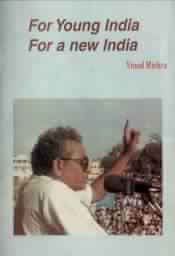
This is a collection of Comrade Vinod Mishra's articles on youth and students that we could gather for the time being.
*************************************************
“India of my dreams is essentially an integral India where a Pakistani Muslim won't have to procure a visa in search of the roots of his evolution; where, likewise, for an Indian the great Indus Valley Civilization shall not fall in a foreign country; and where a Bengali Hindu refugee will finally shed away the bitter memories of Dacca and a Bangladeshi Muslim will not be hounded as a foreign national in India.”
“This India will rank among the first five countries of the world in economic prowess as well es in Olympic tallies.”
“In India of my dreams, glorification of pariahs as harijans will end and dalits will cease to be a category. Castes shall dissolve into classes with each of their members having their individualized expression.”
“India of my dreams is built upon the fundamental processes at work within the Indian society and for whose realization many like we art committed to the last drop of their blood.”

Vinod Mishra is no more among us.
Against the forces of national subjugation and all sorts of reaction, VM was the commander-in-chief of Indian people's battle for a genuine national liberation and consistent democracy.
In an otherwise dark and confused atmosphere prevailing in the wake of saffron offensive, real danger of Congress revival, degeneration of centrist politics and left opportunism, CPI(ML) led by VM emerged as a centre of hope for nation's life, aspirations of the toiling and oppressed masses and expectations of democratic and patriotic intelligentsia.
He was the greatest Marxist thinker of our times. He was the unparalleled theoretician of the Indian path of revolution in the 75 year history of Indian communist movement. Under his leadership the CPI(ML) was emerging as the conscience keeper of the Indian communist movement.
Then he was a shrewd tactician, excellent organiser and an exceptionally popular mass leader too. It was his resolve to establish the Indian left, otherwise limited to the periphery of the national map, at the centrestage of Indian politics by rooting it in the strategic Hindi-Urdu belt. He was heading for making communist movement a real contender for power freeing it from the course of tailing behind the ruling class parties.
Along with the revolutionary peasant movement, he regarded student youth movement as a particular feature of CPI(ML) movement. In the wake of extreme opportunism, impotence and disintegration of the opposition parties, he often used to call on the youth to rise as the force of true revolutionary opposition against the offensive of right reaction. In fact, his deep faith on youth potential was a product of, besides theoretical understanding, his own experience as a youth grown up in a highly momentous phase of Indian history.
Brought up in a worker's colony at Kanpur, the talented son of a clerk, Vinod Kumar Mishra traversed the journey from a rationalist-atheist position to a Marxist one in a short span of time. And then he jumped into the storms of revolutionary struggles giving up his engineering career.
Barbaric repression in jail, police bullets, 22 years of underground political life, when he was almost regularly brushing past the death, nothing could deter him. Though death of Naxalism had already been proclaimed, he picked it from the ashes and established as the revolutionary stream of Indian communist movement on the national political landscape.
His life as a revolutionary student leader is an ideal for the youth. We get its glimpse in his memoirs of Durgapur RE College. He longed to see youth movement full of that revolutionary spirit. Remembering those stormy days he wrote: “On our part we worked for breaking the regimented life of a 'professional' education system and for bringing forth students' voice and their participation in running the college affairs; we did all in our capacity to foster a revolutionary progressive culture among students; we strove for educating in communist ideology and revolutionary politics a specific category of students who had nothing but the individual career as their life-mission; we did our best to integrate students with the life and struggles of workers and working people; we roused them in struggles against injustice, against anti-social activities, and against police atrocities.”
In contrast to romantic revolutionism and careerism, he stood for a firm commitment towards revolution. In his Durgapur memoirs he again noted, “We neither advocated nor practised Che's theory of urban guerilla actions, nor did any 'Kaka'-style super hero emerge from among us. We always remained loyal to the Party mainstream.”
He witnessed the same ideal in the life and martyrdom of Comrade Chandrashekhar. Inaugurating the third national conference of AISA, he said, “Chandrashekhar was not a romantic revolutionary but a vanguard conscious of his mission.”
He was very serious about ideological tasks of student youth movement, particularly in its post-Soviet collapse phase. Against social-democratic and fashionable postmodernist ideas he very much emphasized deep study of Marxism, grasping its revolutionary essence and defending it through its enrichment.
He always attacked caste-based manipulations. In his address to the AISA convention in Allahabad, he said, “Many people say that even among students one has to take recourse to caste-based mobilisation so as to win union elections. This has been called social engineering. If student movement becomes dependent on such caste equations it will lose its vanguard role. You have to fight against all such negative tendencies existing in the society and take new light into the society.”
In 'India of my dreams', he wrote, “In India of my dreams, glorification of pariahs as harijans will end and dalits will cease to be a category. Castes shall dissolve into classes with each of their members having their individual identity.”
For student youth movement, he always emphasized the need to adapt to the changing circumstances. He persisently advocated for autonomy to youth movement. Addressing the second national conference of AISA in Delhi, he said, “Our party believes in pointing out only the general course that the student-youth movement should take. Owing to their distinguished features, their youthful dynamism, students and youth shall traverse this course in their own peculiar way. It is neither possible nor desirable to dictate every step in advance.”
In the same conference he said, “A proper combination of the revolutionary spirit of 70's and the tactical expertise of today provides the key to your advance; and this you shall never forget.”
In the parallel student youth assembly held in Patna, in a different context, he said, “present movement is continuation of the positive legacy of JP Movement.”
But he regarded integration with the toiling masses for social change as the touchstone of revolutionary character of student youth movement. In the Delhi conference of AISA, he said, “Just as the revolutionary character of a youth is determined by his integration with the toiling masses, so also the revolutionary credentials of a student-youth organisation depend very much on its active role in the struggles for social change.”
Again he wrote in the introduction to Bhagat Singh's “Why I am an Atheist”: “Bhagat Singh advised the youth political activists to study Marx and Lenin, work among the working class and peasantry and impart class consciousness to them.”
He repeatedly underlined the crucial role of students in democratic movements. Addressing the 3rd conference of AISA, he said, “AISA must stand in solidarity with all democratic struggles and oppose all anti-people policies irrespective of whether the colour of the government is saffron, green or even red.”
Again, in his last call, he wrote: “All our mass organisations, particularly the youth front, should take bold initiatives on all issues of people's concern and strive to march ahead of all others. The days of closed-door conferencing are over. This is the time for all round initiatives. In history the issues of major significance are only resolved on the streets.”
And above all, he laid much stress on the vanguard role of student and youth in struggle against the increasing imperialist onslaught on our sovereignty.
Addressing the Patna Conference of AISA he said, “Despite Swadeshi rhetoric the pace of mortgaging the country's economy to the multinationals has only become faster. It is the foremost duty of AISA to mobilise students in anti-imperialist struggles.”
Vinod Mishra was a great patriot. On special request from 'The Telegraph', he wrote a magnificent article laying down the foundations of progressive nationalism. It is unique in depth and in sweep of its content as well as in beauty of its style. It appears to be prologue to the epic of his great patriotic dream of 'discovery of a New India' as opposed to the ruling class vision in Nehruvian 'Discovery of India'. He wrote, “India of my dreams shall rise in the community of nations as a country which the weakest of the neighbours shall not fear and which the most powerful country in the world shall not be able to threaten or blackmail. This India will rank among the first five countries of the world in economic prowess as well as in Olympic tallies.”
Like Bhagat Singh, his patriotism was identical with genuine liberation of great Indian people. In the same article he wrote, “Finally, for me the mother of all dreams is my motherland where political liberty of each of its citizens will be valued most; where dissent will be considered legitimate.”
Again he wrote in the same article, “And thus I dream of a great resurgence of rational ideas where the human essence alienated in the form of God shall retrieve itself. This great reformation of human minds shall accompany a social revolution where the producers of wealth shall also be the masters of their produce.”
That's why he said that in the entire freedom movement if anyone deserves to be called 'national hero', it is no one but Bhagat Singh.
Vinod Mishra was the brightest star of post-independence India like Bhagat Singh was the supernova of enslaved India.
Vinod Mishra is Hero of the New Nation.
Lal Salaam beloved comrade VM, the immortal hero of Indian revolution.
Other than politics, which to me means the medium revealing the intricacies of society, I take a great deal of interest in cosmology where the universe unfolds itself in infinite space and time; where galaxies fast recede into the ever-disappearing frontiers of universe away from each other; where stars emerge, glow and explode to death; and where, quite apparently, motion is the mode of existence of matter.
Motion, i.e., change and transformation – always from a lower to a higher order – also, incidentally, forms the mode of existence of human society. No idea is absolute, no society is perfect. Whenever a society has been conceived as the embodiment of the absolute idea, shock waves emerging from deep within have shaken the very foundations. And then amidst the despair all around new dreams arise. Some dreams never come true as they are wild fantasies of human mind, the 'mind-in-itself'. The few which are realized are essentially abstract creations of human mind, the 'mind-for-it-self. Nonetheless, dreams, whether wild or plausible, have remained the source of human endeavour since perhaps the origin of humanity itself.
India of my dreams is essentially an integral India where a Pakistani Muslim won't have to procure a visa in search of the roots of his evolution; where, likewise, for an Indian the great Indus Valley Civilization shall not fall in a foreign country; and where a Bengali Hindu refugee will finally shed away the bitter memories of Dacca and a Bangladeshi Muslim will not be hounded as a foreign national in India.
Sounds like BJP? But then the BJP has only thrived upon the great division of the country – between a Muslim Pakistan and Hindu India, albeit not so 'pure'. As BJP continues to stretch this division to extremes with all the disastrous consequences, great thinkers will surely arise in all the three countries and remould the public opinion for a brotherly reunion. And, be sure, that will be the doomsday for the forces like BJP.
In the India of my dreams, a Ganga and a Cauvery, and a Sindhu and a Brahmaputra will freely flow into each other and the morning shall dawn to the jugalbandi of great musical tunes of India. Some statesman will then compile his notes into a “Re-Discovery of India”.
India of my dreams shall rise in the community of nations as a country which the weakest of the neighbours shall not fear and which the most powerful country in the world shall not be able to threaten or blackmail. This India will rank among the first five countries of the world in economic prowess as well as in Olympic tallies.
India of my dreams shall have a secular state which shall rest upon the principle of 'Sarva Dharma Varjttah' rather than 'Sarva Dharma Sambhav'. While not interfering with the individual's faith, the state shall actively cultivate the scientific and rational world outlook.
Religion, as has rightly been said, is the expression of man's powerlessness towards his environment. Its abolition therefore demands a thoroughgoing change in the material and spiritual conditions of life where man can stand up to acquire mastery over his environment. Whenever the conservative philosophical systems have burdened the people as deadweights, there have always come up in India great reformation movements. And thus I dream of a great resurgence of rational ideas where the human essence alienated in the form of God shall retrieve itself. This great reformation of human minds shall accompany a social revolution where the producers of wealth shall also be the masters of their produce.
In India of my dreams, glorification of pariahs as harijans will end and dalits will cease to be a category. Castes shall dissolve into classes with each of their members having their individual identity.
In India of my dreams, women shall constitute 50% of representative assemblies. Love marriages will be the rule and the divorce easier to obtain. Children will not know any misery and looking after them will be more the responsibility of the state than parents.
In India of my dreams, every town will have its cafeterias where intellectuals shall have hot discussions over cups of cold coffee. There some anguished soul can gaze through the plumes of rising smoke conjuring up images of their heart-throbs while many insatiable hearts can be captivated by the interpretations of varied works of art and literature. While no work of art and literature will be subjected to state censorship, smoking shall be strictly prohibited everywhere, except, of course, the coffee houses.
To return to the original theme, in India of my dreams, an Indian spaceship will wade through the deep space while Indian scientists and mathematicians will be working out equations integrating into a whole the fundamental forces of nature.
Finally, for me the mother of all dreams is a motherland where political liberty of each of its citizens will be valued most; where dissent will be considered legitimate and where Tiananmens of the system will be handled by the morally strong statesmen and unarmed forces of people's militia.
India of my dreams is built upon the fundamental processes at work within the Indian society and for whose realization many like me are committed to the last drop of their blood. □
(Written on special request for The Telegraph on its 10th anniversary)
I came to Bengal as a student in RE College, Durgapur, in the middle of 1966 at the age of 19 years. The College had a system of enrolling upto 50% of students from among those who had qualified in IIT entrance exams, and thus there was a fair share of non-Bengali students from different corners of India.
My father was a clerical employee in a defence enterprise and we lived in a labour colony of Kanpur. Ours was a lower middle class family having no connections with landed property. Beginning from a rationalist-theist position at a tender age, I had a short stint with Sarvodaya movement in the early '60s, and by the middle of '60s under the influence of workers' struggles and by nature of living contacts with them, was drawn towards communism. Kanpur then had a communist MP in S M Bannerjee and MLA of our area too was a communist trade unionist, Sant Singh Yusuf.
The college atmosphere was quite oppressive and students were forced to live a regimented barrack life. No political or student union activities were allowed.
Once when the authorities came to know that a student was reading Marx's book in his hostel room, a thorough search was conducted and the student was threatened with rustication. Only once in 1965 some students had tried to organise a strike and it had simply collapsed. This had led to further hardening of attitude on the part of the authorities.
Annual elections were held for the Gymkhana body, which was supposed to continue itself in routine cultural activities as approved by the authorities representatives there. Broad majority of students were not interested in politics, they were only concerned with their career and with the petty-bourgeois ways of life. Actually the students of RE College were highly disliked by the local working class population mainly because of the ruffian activities of a section of students outside the college campus.
This was the state of affairs in a college in the heart of West Bengal, which was otherwise bursting with the left upsurge.
In the humanities class when we were asked to write a piece on rupee devaluation that had just taken place, in my section Ravichandran and myself wrote it condemning the US pressure and were branded as only leftists by the teacher.
Ravichandran, a bright student from Tamil Nadu, later on became a Party wholetimer and spent a few years in West Bengal jails. Afterwards he rejoined studies and while doing his M. Tech. at Kanpur came under the influence of CRC. At present he is working in some research institute in Bangalore and I don't know his present political stand. Anyway, he was a close comrade of mine in college days.
Despite authority's presence, seven or eight of us joined together and made plans to contact the CPI(M) outside, of course, secretly.
There existed a big gap between Bengali and non-Bengali students; rather a tension prevailed among them, and I, being a non-Bengali had obvious disadvantages to begin with. I quickly learned the language and in a short period my friends circle was mainly composed of Bengali students. Some Bengali students who nurtured a hatred towards non-Bengalis, in course of time, became my bosom friends.
While speaking of non-Bengali comrades I must refer to Com. Omswaroop. A research fellow in our college who joined the movement and became a Party whole timer, he was murdered in cold blood by CPI(M) goons in 1971 at Durgapur in a most cowardly manner. He was a bright intellectual and the best among us in communist qualities.
Then there was Brij Bihari Pandey, my childhood friend. He joined the college and the Party along with me in similar circumstances. At present he is an important Party functionary of ours.
To resume, just when we had established primary contacts with the CPI(M), Naxalbari occurred and overnight we all turned into 'Naxalites'. At this stage we conducted secret revolutionary propaganda among students and could influence a tiny minority. Side by side, we established contacts with worker comrades outside who had come out of CPI(M), addressed host of GB meetings of workers in the township and engaged in fierce debates with CPI(M) leaders and cadres.
Before I proceed, let me tell you about student comrades from earlier batches who joined the Party and played an important role in the 'Naxalite' movement. Shanti Chatterjee was one who was the Party incharge in Tripura during 1971-72. I have never met him and I don't know his present whereabouts. Probol Roy, a quite sober and sincere comrade, from whose house CM was arrested, too belonged to our college. I was quite close to him but I am in dark about his present stance. Ashish Das Gupta was a year senior to me. He didn't take much interest in college affairs. He was very knowledgeable and promising Marxist scholar. I haven't met him for a long time but as far as I know, he is associated with Shanti Pal group of CPI(ML).
It was 1968. Gymkhana elections were round the corner and we decided to contest and utilise this forum for our political aims. Though we didn't have much political support among students, in our individual capacity we were quite popular. We won the elections capturing all the vital posts of office bearers. I too was elected a member, the only non-Bengali student to do so.
We started changing the orientation and complexion of the cultural programs. Still the authorities could not sense anything. We changed the name of the college magazine to 'Vanguard' and its first issue (brought out keeping the teacher incharge, in dark) carried references of Chairman Mao and scientific socialism etc. in its editorial. With the distribution of the magazine all hell broke loose. We had fired the first salvo and were prepared to face the consequences.
The Principal called the Gymkhana members and threatened them of rustication. Some members, who were not our men, retreated; but Devashish, Asit, myself and others owned their responsibility. Devashish was a good singer and a cultural artist who later on became a Party wholetimer and worked in the countryside for a few years. Asit was an important Party organiser and worked for many years in the countryside.
On the students front, general students too could not digest this sudden heavy dose of politicisation and basing on their apathy and disapproval, anti-communists among the students organised a protest demonstration that culminated in burning the copies of Vanguard' at a central place. We were just five or six comrades and hence could not offer resistance to them. But we raised counter slogans in support of Mao and China while the procession was going on. On their way back the processionists raided our hostel and we were beaten up.
Anyway, this was the first open political move and an open defiance of authorities. We were awaiting our rustication orders when an event changed the whole course.
For lack of required percentage of attendance, the authorities prepared a blacklist of students who were not permitted to take the examinations. The list contained the names from both the camps and thus it became a common student issue. Students in general had pent up grievances for a long time and this issue took it to a flash point. A students strike was called and it was a complete success. All threats and intimidation on the part of the authorities failed to break the strike. Movement had reached a stalemate and one day when the entire teaching staff was holding a session we organised a gherao. It continued from morning 10 am to late in the night. At 3 am when a very few students were left, the teachers broke the cordon and went away. At this point, the movement took a violent turn. In no time hundreds of students, armed with sticks and rods, came out of their hostels and marched towards the staff quarters. Houses of the authorities were attacked. Police was called but ultimately the panic-stricken authorities conceded to all our demands, which apart from withdrawing the blacklist included a sort of students' representation in running the college affairs etc. and college was closed sine-die.
During those days we were quite influenced by the ongoing movement of French students. Characterizing the contradiction between the authorities and the students as that between bourgeoisie and proletariat, ideas like controlling the campus, running a parallel administration by students etc. were very much in vogue in our circles. Our comrades did take full initiative and attempted to impart an ideological orientation to it on the lines mentioned above, but on the whole, the movement was more of a spontaneous nature and no such recognizable set of leaders or a definite ideology could claim to have guided it.
This marked the end of the first phase of students' movement in our college and thereafter the authorities went into a defensive position. Our college was thus put into the mainstream of student and political activities of West Bengal.
Our rustication issue got buried down in the thick of the movement. However, at the persistence of circle of students close to us, the content of the next issue of 'Vanguard' was considerably toned down.
Full fledged and open political activities began in the college. In the beginning of 1969 we organised protest marches in township thoroughfares against police firing on Kashipur and Ichhapur workers, and organised progressive cultural functions etc. Students were mobilised to express solidarity with workers' struggles in townships. Advanced comrades continued addressing GB meetings of workers. In addition, we started a night school in a bustee area where college students visited and provided education to poor children. This was taken as a means for interaction with the people.
Our conflicts with the CPI(M) outside were confined to debates with their leaders and cadres where Lenin's 'State and Revolution' was our favourite weapon in silencing them down. However, CPI(M) was getting quite worried over our activities particularly because it had no foothold in the college.
Within the college, contradictions with anti-Communist lumpen type students became quite acute as they could not tolerate our activities. During a progressive drama function they attacked us and we had planned to pay them back immediately after examinations. By that time several of us had made up their minds to give up studies and work as Party wholetimers.
However, again an unexpected event occurred.
On 1 June, two college students were arrested by the police from a nearby square as they were protesting the beating of an innocent truck driver by the traffic policeman. When the news came to the college, hundreds of students armed with rods ransacked the nearby police post, beat up all policemen who came into sight and blocked the GT Road demanding unconditional release of the arrested students. Armed police forces started arriving on the scene threatening to fire but students refused to move. When the inspector came for talks he was immediately surrounded and virtually dragged inside the college campus. We behaved well with him and lectured him on Mao's thought. Message was sent to police authorities that the inspector will be released only after the students were released. By evening, the administration released the students and we in turn, released the inspector unharmed. Students were foil of joy over the victory, but later we realised that it was just the beginning.
The next day morning, hundreds of armed policemen encircled the college from all sides. Within fifteen minutes hundred or so of us came out and started throwing stones. Without any warning whatsoever, the police opened fire killing a student, Prakash Poddar, and then they marched into the college where examinations were in progress. From ten in the morning to four in the evening, they beat up anyone they caught hold of, smashing the doors of the rooms where students had hidden themselves. Over a hundred students, teachers and other staff members were injured and admitted to hospital. Frantic telephone calls to the district administration and the Home Ministry by the college authorities went in vain. Their pet reply was that the police had rebelled and your students were responsible for it. At 4 pm with the arrival of EFR, the policemen left the place.
That was my first ever experience of facing a police firing and witnessing police brutality at such a large scale. I remember having taken a pledge with closed fists to take revenge, and once and for all, that was the end of all my hesitation to join the revolutionary movement as a professional revolutionary.
Well, it was a left front Government, then headed by Mr. Jyoti Basu. Students of Presidency College and Jadavpur University organised protest demonstrations condemning the police firing. Our protest in front of Jyoti Basu's residence was again lathicharged.
“Statesman” wrote an editorial titled 'Red Star over Durgapur'. From the form of the 1 June incidents, CPI(M) too felt that Naxalites had gained considerably in the college and thus allowed the so-called police rebellion to teach us a lesson. In reality, these were exaggerated readings of the situation. The whole struggle was a struggle of general students arising out of their natural urge to protest against injustice, and their wrath against the police. In the forefront of the struggle stood, apart from us, those students too with whom we were in a state of antagonism. The two arrested students were general students as was Prakash, and it was a spontaneous outburst of the student community. Instead of teaching us a lesson, this event antagonised the students against the CPI(M) and it really turned the college into a red bastion of ours. Our ranks swelled to a great extent and we emerged as the leaders of the students as a whole.
At this point, certain lumpen type of elements who could no longer resist us on their own, established contacts with CPI(M) outside and the CPI(M) in its bid to get a foothold in the college started harbouring them. These elements though isolated from the students, started creating trouble with the backing of a large number of CPI(M) activists from outside. Finally, when it crossed all limits of tolerance, we gave them a good drubbing. CPI(M) with its hundreds of activists and supporters which included large number of workers, attacked us in retaliation and in order to avoid a blood-bath we made a retreat.
Some fifteen of us were, however, caught by them, beaten and kept in confinement at workers' quarters for two days. We engaged into sharp debates with the CPI(M) leaders, and resorted to a hunger strike demanding our release. Quite strangely, I found that the workers and a section of the CPI(M) cadres didn't like all this confinement. They very sympathetically attended to our injuries and with tears in their eyes, requested us to break the hunger strike. Ultimately, the leadership released us unharmed.
In the college campus, in the mean time, the lumpen section created white terror by mercilessly beating up even our distant sympathisers. We continued our preparations secretly and after two months or so launched a swift counter attack beating up the hoodlums and ending the reign of white terror. Hundreds of students came out cheering on the streets. The CPI(M) attacked from outside but after hours of bombing made a retreat. Police rounded up over 500 students to arrest the leaders but our comrades had already made good their escape. Since then the college campus was completely controlled by us. We established what we then called the 'red terror'. The CPI(M) stopped meddling and the ring leaders just fled away.
Thus began the third and the last phase of our movement.
We organised a political strike against US aggression on Cambodia and it was a total success. A campaign was organised against obscene and cheap literature. All rooms were searched and such literature was burnt at open places. Students were told to behave properly with the local population and scores of batches of students went to the workers colonies to do political propaganda.
Red flag was hoisted atop the college building in a political gathering of over 2,000 students. Whenever we came to know about any workers' struggle, hundreds of students joined in support.
It was perhaps May of 1970. By that time several of our cadres had left for the countryside or for other working class areas. I had taken the mantle of party leader and apart from looking after the college affairs, had to oversee the general work of Durgapur Party organisation too.
Com. Dhurjati Buxi was one senior comrade who had left the college as a Party wholetimer and at present he is an important Party functionary of ours.
In the college, Gautam Sen was another leader who was a good orator and had the best leadership qualities amongst us. We did have certain differences occasionally but we would always resolve them through discussions. Latter on he became a Party wholetimer. At present, as per my information, he is running a group 'Mazdoor Mukti' and a magazine of the same name from Calcutta.
During the reign of 'red terror' we inflicted varying degrees of punishment on reactionary and lumpen elements, in particular, against those who were ringleaders during the 'white terror'. This process reached its climax when Madhusudan, the main ringleader, returned offering an apology. He had earned deep hatred of students and was beaten to death by a mob of students. That was the end of our 'red terror' as the police intervened and the college was closed for an indefinite period. I had already outrun my period as a student leader and thereafter there was no going back.
In retrospect, I feel that during the period of 'red terror' we committed some excesses and the blame should primarily lie on me. Madhu, after all, was a student and had come back for pursuing his studies, I could not imagine that he will die after the beating. Often I repent his death because had I tried, I could have dissuaded my militant comrades and saved him.
Four years back, I accidentally met a class fellow of mine during a train journey. He is now an engineer in Jessop Factory. During college days he was in the opposite camp just next to Madhu on our hit list. While recalling the old days, in friendly discussion I told him that I feel sorry for the excesses in those days. In response he consoled me back saying that you people did many good things and actually we did many wrong things and deserved the punishment. With great passion he told me “Mishra, I feel proud of you”.
Did he sum up the present feelings of the then generation of students? I don't know. Dark clouds over the years have overshadowed the 'Red Star'. The general disgrace which our movement suffered in West Bengal at the hands of our political opponents, the powerful media, the tribe of ex-Naxalites and our own undoings, had made it difficult to sort out the specific practices and achievements in particular cases.
On our part we worked for breaking the regimented life of a 'professional' education system and for bringing forth students' voice and their participation in running the college affairs; we did all in our capacity to foster a revolutionary progressive culture among students; we strove for educating in communist ideology and revolutionary politics a specific category of students who had nothing but the individual career as their life-mission; we did our best to integrate students with the life and struggles of workers and working people; we roused them in struggles against injustice, against anti-social activities, and against police atrocities.
In the process, apart from Prakash and Omswaroop, Comrades Tapan Ghosh and Ananda, two of the college students and professional Party cadres who were murdered in cold blood in Asansol jail in 1972, laid down their lives.
Myself, Dhurjati Buxi, Brij Bihari Pandey, Ashish Das Gupta and Gautam Sen are still continuing with the struggle for a revolutionary social change in ways we deem proper.
We did commit mistakes and excesses but we always based ourselves on broad students' support. We retained our distinct identity but at the same time we remained as an integral part of general students, always upholding their issues and remaining at the forefront. Actually here lay our strength and that is why, be it authorities or CPI(M) or police, none succeeded in crushing us and every time we came back. We neither advocated nor practised Che's theory of urban guerilla actions, nor did any 'Kaka'-style super hero emerge from among us. We always remained loyal to the Party mainstream and though we did engage in intensive debates, we had no factions amongst us. We paid lot of attention to reading wide range of Marxist literature and on doing political propaganda. At a juncture, nearly 100 students volunteered to become Party wholetimers and scores of them did go to work in the countryside. Four worker comrades who became wholetimers in the interaction with us in those periods and are still working in our party in responsible positions and good number of workers and their families still retain the fond memories of R E College, Durgapur. The rest is history.
Well, I wrote down all that I could recollect. I must not bother you more with my journey down the memory lane.
(Excerpts from Vinod Mishra's introduction to the booklet containing Bhagat Singh's article “Why am I an atheist”)
Fifty years have passed since we achieved our freedom. Casting a glance over our surroundings, we find a putrefying scene around. Particularly the all-round degeneration of Congress party, that claims to have led the country in the freedom struggle, raises some basic questions. During the freedom struggle the revolutionaries had put up certain questions regarding Gandhi and Congress ideology. They even vent out an apprehension that the independence might mean transfer of power from white sahibs to the hands of black sahibs. Today that apprehension has come true. The most resolute representative of this revolutionary stream was Bhagat Singh, whose ideals and ideology have become quite relevant even in the present phase.
Ruthless British rulers thought it better to silence this brilliant brain whose popularity those days was touching the skies. And history stands testimony to the fact that rejecting the public opinion, Gandhi refused to pose cancellation of death sentence to Bhagat Singh as a precondition to Gandhi-Irwin Pact.
Bhagat Singh's popularity was one of the greatest challenges to Gandhi's leadership.... Still more important was the phenomenon of Bhagat Singh's transformation from revolutionary terrorist to a Marxist. This was the main foundation of the silent agreement between the British and the Congress leadership on hanging Bhagat Singh. According to Gandhi's own admission, cancellation of death sentence to Bhagat Singh was not made a precondition for his pact with Irwin, he only wanted the death sentence to be executed before the commencement of Karachi session of Congress. And it was duly done.
Bhagat Singh had deeply studied all the progressive ideologies coming from the West. He had expressed his opinion on almost all the problems of Indian society, be it Brahminical attitude towards untouchables, the tendency of communalism or the nature of Indian union. In those early days, deep influence of anarchist philosophy and its ace proponent Bakunin is well discernable in him.
In this phase he considers religion as a product of human lack of knowledge, fear and lack of confidence.... But in his article “Why I am an atheist” written on 5-6 October 1930, firm grasp of Marxism is discemable in his thinking on the questions of religion and god.
He writes, “About the origin of god, I think that after realising its limitations, weaknesses and shortcomings, mankind has contrived the virtual existence of god in order to bravely face in the moments of trial, to provide encouragement to itself, to bear all the perils with intrepidity and to bind the explosion of prosperity and exuberance whenever it occurs.”
Bhagat Singh proceeds, “When a man becomes self-dependent and a realist, he should cast away revering god and face all such trials and tribulations with boldness which the situation may land him into”, and it was because of this unwavering faith on materialist doctrine that he kissed the gallows with a smile on his face.
Bhagat Singh was not oblivious of the differences among communists on the question of state power. In his article on anarchism he mentions that the ultimate ideal of communism too is directed towards the anarchist idea of rejecting state power. “By revolution we mean ultimately the establishment of a social system where one would not have to encounter these fatal hazards, in which the hegemony of proletariat is accepted, and a world union could save the humanity from the shackles of capitalism and the ravages and predicaments arising out of imperialist wars.”
… Freeing himself of the anarchist concept of elimination of private property, he had begun to realise that only by way of proletarian revolution and socialism would the elimination of private property be really possible.
It is a fact that Bhagat Singh got the inspiration to hurl bombs in the Assembly from the anarchists... Here it must be kept in mind that Bhagat Singh had thrown bomb opposing the bills brought against the communists and the working class. The British government had tabled the two bills in the Assembly. As the speaker announced the passage of other bills, Bhagat Singh and Batukeshwar Dutt sitting in the gallery hurled the bombs. Raising the slogans “Inquilab Zindabad” (Long live revolution), they distributed leaflets emphasizing their political aims.
Bhagat Singh advised the youth political activists to study Marx and Lenin, work among the working class and peasantry and impart class consciousness to them. He stood for the Leninist concept of party building taking professional revolutionaries, and wrote, “Party must begin its work by conducting propaganda among the masses.... This is very important in order to organise workers and peasants and obtain their sympathy. That party may be named as Communist Party.” This last call issued by Bhagat Singh to the youth is as relevant today as it was those days.
In independent India, the more the government institutions disdain Bhagat Singh and push him to the margins in the history of independence struggle, the more Bhagat Singh found his place in the hearts of the people. Even today, Bhagat Singh's portraits are the most hot sellers of all. His portraits are seen adorning the walls of common people's houses, and thousands of martyr's columns are found in all parts of the country erected at people's own initiative. If there is a single person who can be awarded the status of people's hero in the struggle for independence, it is only Bhagat Singh. Bhagat Singh is not only source of inspiration to the. revolutionary mindset of Indian youth, he is its light house too.
(Produced in the high tide of Naxalbari uprising, this song was Com. Vinod Mishra's favourite one)
The day is not far off when
Motherland gets liberated
Look, horizon in the east
Starts sparkling in red sun
Fanning out in four corners
Glare sweep off the gloom
Bathing in crimson downpour
Motherland dances in joy
Toilers oppressed for ages
Chant the liberation chorus
Fluttering in azure sky
Red flag glares in glory
That day we must usher in
Comrades, pour all your might
The day is not far off when
Motherland gets liberated
India's great, we're great
Indians India belongs to us
(Text of the speech delivered by Vinod Mishra at the Third National Conference of AISA)
As I rise here to speak and look at your bright faces, faces shining with determination, I visualise the beaming image of the young hero, Chandrashekhar that overwhelms this auditorium. Chandrashekhar became a martyr, far away from the glamour of Delhi, in the street of an obscure town of Siwan. He had a promising career before him but he preferred to live and die as a revolutionary. His decision didn't come out of any spontaneity, or as an emotional response. It emerged out of his deep faith on the revolutionary ideology of Marxism, on the revolutionary party and his deep commitment to the cause of people. Once in discussions with me he appeared quite concerned about lack of emphasis on the study of Marxism, on ideological orientation in JNU AISA. So he wasn't a romantic revolutionary but a vanguard conscious of his mission.
Comrade Chandrashekhar is no longer with us but his killer the notorious Shahabuddin is sitting in parliament. CBI enquiry that was instituted to investigate Chandrashekhar's killing has been abruptly stopped and Sahabuddin is moving scot-free. BJP government at the centre doesn't seem to be interested in pursuing the investigations and one doubts whether some kind of clandestine deal has been struck at the high levels! It is, therefore, an important task before AISA and before the student and youth in general to continue your agitation till the guilty is punished. In this context it is important to continue the popular movement to drag him out of parliament Let Chandrashekhar's memory remain alive in your hearts and let it guide you in completing his unfinished tasks.
AISA more than a formal organisation is a movement in making. It wasn't formed from any closed-door party meeting just as the party's wing. It emerged out of the revolutionary stream of the student movement and that's why it is so different from the crowd of student organisations. Under the guidance of the revolutionary ideology it charted out it's own course of action and deepened its roots in several parts of the country particularly emerging as the foremost left student organisation in the Hindi heartland. In 70's we had a powerful revolutionary student-youth movement that rocked West Bengal and affected almost all campuses. In those days no formal student organisation was there and nor did we contest union elections. Campus issues were hardly taken up and it was the call for direct action for plunging into the great battle of social and political transformation. And yet there was a tremendous response. Well, the situation has radically changed in all these years. You have a formal organisation, you contest, and quite vigorously too in the student union elections and also you pay much of your attention on campus issues. All these are important no doubt but you should not get bogged down in them. Once the organisational paraphernalia of high ranking leaders, the constitutional formalities and the rigidity of structure becomes dominant you often turn introvert getting bogged down in internal bickering, in hankering after posts, in factional squabbling and tend to lose the movemental edge. AISA has been a movement and an important challenge before the new generation of AISA leaders and cadres is, therefore, to keep alive this phenomenon.
You have before you a number of challenging tasks in present day conditions.
India as a free nation began its journey with the high sounding slogans of socialism, land reforms, secularism etc. but after fifty years we find all of them replaced by the slogan of building a theocratic state, a Hindu Rashtra. This is a great tragedy that has befallen the country after half a century of the demise of colonial rule. The forces who had risen in recent years on Mandalite and the federal plank and were hailed as the antidote to the saffron project have themselves fallen from grace. For example, here in Bihar, the so-called forces of social justice under the leadership of Mr. Laloo Yadav have turned Bihar into a veritable lumpen raj. As a result while students and youth as well as the working classes remain divided on caste and regional lines, the march of saffron continues unabated and often on the fodder supplied to it by these very regional and Mandal forces. It is AISA's duty to rebuild the student unity cutting across caste, communal and regional divide. You have to forge the student unity on an all India scale a unity that can reshape the future of the country.
Secondly, we have seen the Vajpayee government blatantly changing the course of India's foreign policy and working for turning India into a stooge of American imperialism. Government, the other day, justified US missile strikes against Sudan and Afghanistan. After Pokhran tests the PM in his letter to Clinton had proposed a strategic tie-up with America against China and Islamic countries. They are also contemplating signing CTBT. Despite Swadeshi rhetoric the pace of mortgaging the country's economy to the multinationals has only become faster. It is the foremost duty of AISA to mobilise students in anti-imperialist struggles.
Thirdly AISA must stand in solidarity with all democratic struggles and oppose all anti-people policies irrespective of whether the colour of the government is saffron, green or even red.
Finally, I would like to remind you that the movement of 70's had a passion, a determination to weed out all that was old, all that was rotten and bring about a radical social change. We were in a hurry those days and our preparations were almost nil. What we thought of revolution turned out to be a rehearsal only. Those days are over. You are proceeding through a different route and that is okay. Yet, in a nutshell combining the revolutionary spirit of the 70's with the realism of the day is the foremost task before you and I am confident that this conference will ponder over this question.
AISA is the name of a glorious chapter of the revolutionary student movement of this Decade and students feel pride in identifying themselves with AISA. The tasks assigned to you are not merely party's decisions and are neither mechanically worked out. They are the tasks assigned to you by the history itself and you must prove yourself equal to them.
In tune with our Parry's rich tradition of organising nation-wide campaigns against the principal enemy we organised an 'Oust saffron Save the nation' campaign in the later part of the year.... Though the campaign has ended, the exposure of various facets of BJP rule should go on unabated. We should particularly focus on its economic doctrine of wholesale globalisation and that of capitulation to international financial interests. Its gimmick of Swadeshi is thoroughly exposed and it is high time that the left forcefully espouses the cause of a self-reliant economy. December 11 action of the working class was a highly significant move in this direction. We have to take a much larger initiative among the working class where the ice has started melting and we have started getting a better response. It's an opportune moment to politicise the working class movement and our trade union leaders should go for less paper work and more direct interaction with the workers.
As the political situation is turning topsy-turvy and one cannot rule out the possibility of yet another mid-term poll in the year 1999, the party must remain fully prepared for any eventuality. Hence all our mass organisations, particularly the youth front, should take bold initiatives on all issues of people's concern and strive to march ahead of all others. The days of closed-door conferencing are over. This is the time for all round initiatives. In history the issues of major significance are only resolved on the streets. …
A strong communist party firmly upholding the red banner of revolutionary Marxism, a powerful movement of the rural poor and an all-round initiative against the designs of the saffron power are the three major challenges before us in this year. Social democrats as well as the anarchists of all hues are facing serious internal disorders due to faulty tactical lines and every advance we make will further destabilise them and establish us at the head of the left movement. Such a development is absolutely essential for building a democratic front that is really a people's alternative in contrast to various versions of bourgeois alternatives.