“The Ideas of the ruling classes are in every
epoch the ruling ideas, i.e. the class which
is the ruling material force of the society,
is at the same time its ruling intellectual
force. The class which has the means of
material production at this disposal, has
control at the same time over the means
of mental production, so that thereby,
generally speaking, the ideas of those who
lack the means of mental production are
subject to it. The ruling ideas are nothing
more than the ideal expression of the
dominant material relationships, the
dominant material relationships grasped as
ideas.”
Karl Marx , German Ideology (1845)
Liberation Publications
September 2018
Charu Bhawan, U-90 Shakarpur, Delhi – 110092
Phone: 91-11-22521067
Mail: info@cpiml.org
Web: www.cpiml.net
Twitter: @cpimlliberation
Facebook Page: www.facebook.com/CPIMLLiberation/

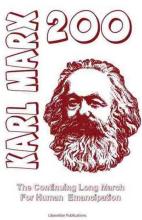
 In the year marking 200 years of the birth of the great revolutionary philosopher Karl Marx, we bring you a selection of writings reflecting on Marx’s legacy.
We begin with Friedrich Engels’ eulogy at Marx’s graveside – a moving and concise tribute to Marx’s legacy by his closest friend and comrade.
The articles by Dipankar Bhattacharya, General Secretary of the Communist Party of India (Marxist-Leninist), are based on a series of talks delivered across India on the occasion of the Marx Bicentenary, which discuss Marx’s relevance to contemporary India and the challenge of confronting fascist politics in India.
We have also included a biographical note on Marx, prepared by Arindam Sen, a Politburo Member of the Communist Party of India (Marxist-Leninist), in 1983.
Finally, we have an article by Vinod Mishra which he wrote as a Foreword to a Hindi edition of the Communist Manifesto published by Samkaleen Prakashan, Patna, in November 1998.
We hope that this little book - a window into the ways in which Marx’s legacy lives and breathes in India - will be useful for those meeting Marx for the first time and eager to know more, as well as for those who have long been practitioners of Marxist theory and politics.
“The philosophers have only
interpreted the world,
in various ways;
the point,
however,
is to change it.”
“... Against the collective power of
the propertied classes
the working-class cannot act,
as a class,
except by constituting itself into a
political party,
distinct from,
and opposed to,
all old parties formed by the
propertied classes.”
Highgate Cemetery, London
March 17, 1883
On the 14th of March, at a quarter to three in the afternoon, the greatest living thinker ceased to think. He had been left alone for scarcely two minutes, and when we came back we found him in his armchair, peacefully gone to sleep – but for ever.
An immeasurable loss has been sustained both by the militant proletariat of Europe and America, and by historical science, in the death of this man. The gap that has been left by the departure of this mighty spirit will soon enough make itself felt.
Just as Darwin discovered the law of development or organic nature, so Marx discovered the law of development of human history: the simple fact, hitherto concealed by an overgrowth of ideology, that mankind must first of all eat, drink, have shelter and clothing, before it can pursue politics, science, art, religion, etc.; that therefore the production of the immediate material means, and consequently the degree of economic development attained by a given people or during a given epoch, form the foundation upon which the state institutions, the legal conceptions, art, and even the ideas on religion, of the people concerned have been evolved, and in the light of which they must, therefore, be explained, instead of vice versa, as had hitherto been the case.
But that is not all. Marx also discovered the special law of motion governing the present-day capitalist mode of production, and the bourgeois society that this mode of production has created. The discovery of surplus value suddenly threw light on the problem, in trying to solve which all previous investigations, of both bourgeois economists and socialist critics, had been groping in the dark.
Two such discoveries would be enough for one lifetime. Happy the man to whom it is granted to make even one such discovery. But in every single field which Marx investigated – and he investigated very many fields, none of them super-ficially – in every field, even in that of mathematics, he made independent discoveries.
Such was the man of science. But this was not even half the man. Science was for Marx a historically dynamic, revolutionary force. However great the joy with which he welcomed a new discovery in some theoretical science whose practical application perhaps it was as yet quite impossible to envisage, he experienced quite another kind of joy when the discovery involved immediate revolutionary changes in industry, and in historical development in general. For example, he followed closely the development of the discoveries made in the field of electricity and recently those of Marcel Deprez.
For Marx was before all else a revolutionist. His real mission in life was to contribute, in one way or another, to the overthrow of capitalist society and of the state institutions which it had brought into being, to contribute to the liberation of the modern proletariat, which he was the first to make conscious of its own position and its needs, conscious of the conditions of its emancipation. Fighting was his element. And he fought with a passion, a tenacity and a success such as few could rival. His work on the first Rheinische Zeitung (1842), the Paris Vorwarts (1844), the Deutsche Brusseler Zeitung (1847), the Neue Rheinische Zeitung (1848-49), the New York Tribune (1852-61), and, in addition to these, a host of militant pamphlets, work in organisations in Paris, Brussels and London, and finally, crowning all, the formation of the great International Working Men’s Association – this was indeed an achievement of which its founder might well have been proud even if he had done nothing else.
And, consequently, Marx was the best hated and most calumniated man of his time. Governments, both absolutist and republican, deported him from their territories. Bourgeois, whether conservative or ultra-democratic, vied with one another in heaping slanders upon him. All this he brushed aside as though it were a cobweb, ignoring it, answering only when extreme necessity compelled him. And he died beloved, revered and mourned by millions of revolutionary fellow workers – from the mines of Siberia to California, in all parts of Europe and America – and I make bold to say that, though he may have had many opponents, he had hardly one personal enemy.
His name will endure through the ages, and so also will his work.
- Dipankar Bhattacharya
“Philosophers have hitherto only interpreted the world in various ways; the point, however, is to change it”: Karl Marx (5.5.1818-14.3.1883) had reached this conclusion quite early in his life when he was still in his late twenties. Till his last breath he worked relentlessly to this end, producing the richest and most inspiring legacy of human endeavour geared towards both comprehending and transforming the world we live in. From the Communist Manifesto, jointly produced with his lifelong comrade-in-arms Friedrich Engels in 1848, when he was only thirty, to his magnum opus Das Kapital (Capital), which was published in full only after his death, Marx remained steadfast in his spirit of ‘ruthless criticism of all that exists’ – ‘ruthless’, as he said, ‘both in the sense of not being afraid of the results it arrives at and ... of conflict with the powers that be’!
This spirit of ‘ruthless criticism of all that exists’ and the indomitable resolve to change the world put Marx in conflict with most governments of his day. Exiled from several countries of Europe he eventually made London his home. In those days, London was also the capital of the world’s most advanced capitalist country and the biggest colonial power\ in the world. Sitting in London, Marx immersed himself not only in study, research and writing but also in promoting revolutionary working class movements across the world and building international solidarity among them. He played the central role in launching the first international organization of the working class (the International Working Men’s Association) and developing it as a united platform of several ideological streams active in the international working class movement during those formative years. From the anti-colonial revolt of 1857 in India to the Paris Commune of 1871, he keenly watched, analysed and encouraged the stirrings for freedom and socialism in every part of the world.
In his study of society Marx treated the classes as the central actors and their struggles as the core drivers of social development. The classes that rule in a society do so not only by their control over resources and material production but also over the state and its laws and repressive machinery and the realm of mental production or the production and regulation of ideas. “The ideas of the ruling class are in every epoch the ruling ideas, i.e., the class which is the ruling material force of society, is at the same time its ruling intellectual force,” wrote Marx in his celebrated work ‘The German Ideology’ way back in 1845. The Marxist framework of class struggle thus challenges the domination of the ruling class from every angle – economic and political and also social, cultural and intellectual.
The ruling idea in the era of capitalism is the idea that mystifies capital as something eternal and natural, magical and invincible, that glorifies the bourgeoisie or the capitalist class as the most civilized class, and bourgeois rule as the most superior and democratic. All through his writings Marx tore apart this mask, analysing every contradiction that challenges this claim of bourgeois rule being natural, permanent and supreme, laying bare the hitherto unknown laws of motion of capital that inevitably lead to periodic crises, and exposing every hypocrisy that seeks to sell bondage as freedom, war as peace, plunder as prosperity, devastation as development. It was through this actual motion of existing social forces and this constant battle of ideas – and not on the basis of some abstract principles or utopian dreams – that Marx visualized humanity’s march towards socialism and communism, towards complete human emancipation.
During his lifetime and since his death, time and again Marx has been declared irrelevant and obsolete. But every time he has come back, with every successive generation discovering some new light in his writings, helping it to try and understand and overcome the problems of the day. For bourgeois triumphalists who believed they had finally managed to bury the ideas of Marx with the collapse of the Soviet Union, history proved a cruel teacher. No sooner had they proclaimed the end of history, than global capitalism encountered a massive shock. Dogged by the most protracted and severest crisis since the Great Depression of the 1930s, today even bourgeois thinkers are once again returning to Marx to make sense of the present state of chaos and churning.
While Marx is widely known, respected and studied by large sections of progressive and thinking Indians across ideological streams, he is also widely misunderstood and misrepresented. Both apologists and opponents of colonialism argue that Marx had seen British colonialism as a progressive intervention of history in a stagnant and backward India. There can perhaps be a no bigger misreading and misrepresentation of Marx’s views about India. Marx was very clear that capital did not operate only in the apparently legally regulated environment of capitalist countries; he was very much alive to the reality of colonial plunder and violent accumulation of capital from across the world, which in fact had created the conditions for capitalism to emerge. He was keenly aware that “If money comes into the world with a congenital blood-stain on one cheek, capital comes dripping from head to foot, from every pore, with blood and dirt” (Capital, Volume one, Chapter 31: Genesis of the Industrial Capitalist).
In the specific context of India, Marx was a trenchant critic of the barbarity of British colonial rule, its loot and torture, clearly acknowledging that “the misery inflicted by the British on Hindustan is of an essentially different and infinitely more intensive kind than all Hindustan had to suffer before ... The profound hypocrisy and inherent barbarism of bourgeois civilization lies unveiled before our eyes, turning from its home, where it assumes respectable forms, to the colonies, where it goes naked” – Marx wrote this in June 1853 in his dispatch “The British Rule in India” for the New York Herald Tribune. At the same time, for Marx, the village communities in India were no idyllic islands of peace and prosperity, rather they were contaminated by the distinctions of ‘caste and slavery’, and castes were “decisive impediments to Indian progress and Indian power”.
He was clear that “All the English bourgeoisie may be forced to do will neither emancipate nor materially mend the social condition of the mass of the people,” and he wrote this in July 1853 when the British rulers were claiming credit for the launch of the railways in India as a revolutionary development. In the same dispatch titled “The Future Results of British Rule in India”, Marx went on to argue that “The Indians will not reap the fruits of the new elements of society scattered among them by the British bourgeoisie, till in Great Britain itself the now ruling classes shall have been supplanted by the industrial proletariat, or till the Indians themselves shall have grown strong enough to throw off the English yoke altogether.” Marx thus posits the question of complete Indian independence in July 1853, four years before sections of Indians rose in revolt to wage India’s first war of independence.
It is also often heard that Marx despised religion as ‘opium of the masses’ and called for a ban on all religions. This again is a selective simplification, if not a mischievous mis-representation, of Marx’s ideas on religion. The expression ‘opium of the people’ comes at the end of a paragraph which reads thus: “Religious suffering is, at one and the same time, the expression of real suffering and a protest against real suffering. Religion is the sigh of the oppressed creature, the heart of a heartless world, and the soul of soulless conditions. It is the opium of the people.” Marxism has therefore always focused on changing that ‘heartless world’ and its ‘soulless conditions’, and insisted on treating religion as a matter for the individual, strictly separating it from the state and public affairs administered by the state.
As we observe the bicentenary of Marx’s birth, we are being ruled in India by a bunch of the most bigoted and obscurantist rulers who seek to address ideological debates through hate, lies and violence. Only the other day, heady with arrogance following their surprise victory in Tripura, they bulldozed statues of Lenin calling him a foreign icon unrelated to India. They will say the same thing about Marx. These are the people who invite foreign companies to come and plunder India’s resources, who kowtow to Trump as the supreme ruler of the world and if we go back in history we find their ideological forefathers collaborating all through with the British colonial rulers.
And in order not to be misled by this silly distinction of whether an idea or an intellectual is of Indian origin or foreign, we must always remember that the RSS has always idolised foreign icons. Incidentally, the icon they worshipped was another German called Adolf Hitler. And these people, who oppose Marx and Lenin, also oppose Ambedkar and Periyar. Clearly, it is not about the origin of the idea, but the idea itself which is the real bone of contention. All who stand and fight for equality and justice, liberty and fraternity will always feel inspired by Marx while the enemies of equality will always remain mortally afraid of this revolutionary giant. More power to the ideas and legacy of Marx!
(Editorial, Liberation, May 2018)
Dipankar Bhattacharya
We are commemorating the bicentenary of Karl Marx’s birth. At a time when the Sangh brigade has unleashed a virulent assault on democracy and is trying to forcibly impose the Sangh’s ideology on the entire country and society, the Marx Bicentenary gives us a great opportunity to widely disseminate and discuss Marx’s revolutionary ideas and wage a powerful battle for democracy, liberty and equality.
The fascists know the power of Marx. All through the twentieth century whenever and wherever fascists raised their ugly heads in the world, the followers of Marx fought them tooth and nail and consigned them to the dustbins of history. Hitler, their role model from German history, was vanquished in the Second World War by the Red Army of the Soviet Union. It was not just a military victory, but above all it was a great ideological victory which inspired and empowered the forces of freedom, democracy and equality across the world. Today when we resist the fascists in power in India, we have a great friend, philosopher and guide in Marx.
Indeed, Marx was a great friend and well wisher of India in his own lifetime. The Sangh brigade thinks they can keep us away from Marx by just saying that he was a foreigner. True, he was a German and never visited India. But from the 1850s till he breathed his last in 1883, he was based in London, the capital of the British colonialists who were plundering and suppressing India. Sitting in London, Marx was unravelling the mystery of capital and encouraging the working classes of all countries to fight against the exploitation of capital. India did not yet have much of a modern working class, but anti-colonial stirrings have begun and Marx followed them keenly with great hope.
The British colonialists wanted to camouflage their colonial rule as a great mission of civilisation. They sought to project their expedition in India as a great exercise in development and empowerment. Marx systematically challenged this false narrative and exposed the true nature of the colonial rule in India. As early as in July 1853, two years before the great Santhal revolt and four years before the historic 1857 upsurge, Marx was dreaming of the end of British colonial rule, either through a proletarian revolution in Britain or through Indians growing powerful enough to throw off the yoke of colonialism. That in a way is the first political vision of India’s independence, nearly a century before the colonial occupation actually ended.
While exposing the British hypocrisy of waxing eloquent about democracy at home and presiding over brutal police states in the colonies, Marx was no admirer of the pre-British Indian system either. Not for him was the myth of self-sufficient village communities, he knew enough about caste and social slavery in India to describe the Indian social system as nothing short of Oriental despotism. Indian thinkers like Phule have also used strong words like ‘Gulamgiri’ or slavery to describe the internal social condition of colonial India. A true account of India’s freedom movement must give equal focus on both India’s quest for freedom from the colonial rulers and also for an end to what Marx called Oriental despotism or what Phule called slavery.
After the collapse of the Soviet Union, apologists of capitalism all over the world had triumphantly declared that they had now buried Marx for good. But as the 21st century dawned and capitalism found itself caught in one of its worst ever crises, Marx was again back with a bang. Every time capitalism hits a new crisis, the managers of capitalism also turn to Marx to comprehend the crisis. The collapse of the Soviet Union was of course a major setback for the communist camp at the end of the 20th century, but it has freed Marx and Marxism from the straitjacket of the Soviet model and forced communists across the world to confront the post-Soviet world, and now we have an emerging post-Soviet generation of Marxists who are not weighed down by the Soviet collapse.
In his lifetime Marx was not exclusively identified with any single model. With his closest comrade-in-arms Friedrich Engels, he wrote the Communist Manifesto in February 1848 anticipating a wave of progressive revolutions in Europe that would be a step forward from the French Revolution of 1789 that had given the world the clarion call of liberty, equality and fraternity. But in real life, 1848 turned out to be a reverse turning point for Europe where bourgeois regimes consolidated themselves by restricting the scope for working class advances. It was not till 1871 Paris Commune that Europe could get a glimpse of a working class uprising, and even that uprising did not last for more than seventy days even as it contributed immensely to the concretising of the socialist vision. Marx’s mission of bringing together the working class movements of his time under the banner of the International Workingmen’s Association, recognised as the First International in world history, could not survive the setback and tactical debates that ensued in the wake of the Paris Commune. This shows us that the ideas of Marx never really became popular on the basis of so-called big models of applied success, rather they continued to spread defying setbacks and repression because they reflected the felt need and shared urgency for social change, for a society beyond the crisis and chaos and brutalities of capitalism.
Marx continues to resonate even after two hundred years of birth because he was a philosopher and champion of change. All through his life he remained true to his declaration: philosophers have interpreted the world in various ways, but the point is to change it. And he stuck to the method he had enunciated even before he wrote the Communist Manifesto: ruthless criticism of all that exists, ruthless both in the sense of facing up to its own consequences and with-standing the repression unleashed by inimical regimes. He never bothered about creating a detailed blueprint or plan of a society based on equality and emancipation, the details were left to be worked out by future generations. What was important for Marx was to fight for change here and now, with whatever materials and conditions handed down by history. Change for him is the only constant in nature and social life, and this change is a continuous process. Continuous, but not linear; for life always passes through a zigzag course, and keeps negotiating ups and downs. So there is no perfect context or minimum threshold for change in Marx, Marxism inspires and empowers us to fight for change in any situation.
Marx laid bare the mystery of capital for us, capital that was created by the human society in the course of its development and which now tries to set the terms for everything that human beings do. We are taught to treat capital as a key factor or component of production alongside land or natural resources and human labour. But unlike natural resources or living labour, there is nothing natural about capital. Marx takes us to the process of formation or accumulation of capital, exposes the cruelty and violence, loot and plunder, slavery and dehumanisation that are integral to the process that Marx calls the primitive accumulation of capital and which we continue to witness in various ongoing forms of dispossession of the people across the world especially in countries and regions that lag behind in the race of capital-dictated development. In Marx’s memorable words, if money comes into the world with a congenital blood-stain on one cheek, capital comes dripping from head to foot, from every pore, with blood and dirt.
We are schooled to believe that capital lies at the root of development, at the centre of modern human civilisation; that production and employment follow from capital. Marx tells us that if anything is central to capital, it is profit. This is the only motive for which capital exists and Marx approvingly quoted a trade union leader of his time to show how with increasing profit margin, capital exposes its true colours: A certain 10 percent will ensure its employment anywhere; 20 percent certain will produce eagerness; 50 percent positive audacity; 100 percent will make it ready to trample on all human laws; 300 percent, and there is not a crime at which it will scruple, nor a risk it will not run, even to the chance of its owner being hanged. The forms of capital have changed, its speed has now become electronic, it now truly considers the whole world its stage and brooks no border or barrier. The American inventor Thomas Alva Edison had famously said that genius is one percent inspiration and ninety-nine percent perspiration. Paraphrasing him today we can say the business of capital is one percent production and ninety-nine percent speculation. When subjected to production capital extracts surplus value from labour power, and away from the trouble of actual production it goes on creating bubbles through speculation that burst periodically plunging the increasingly globalised economy in ever deeper and wider crises.
Marx tells us that it is not money or machine that constitutes the essence of capital, the essence of capital lies in that social power whereby those who own capital need not work and those who are deprived of capital are compelled to sell their labour power, whether manual or intellectual, to eke out a living. This rule of capital is enforced by the state. But just as capital is a social construct so is the state. And it is possible to imagine and attain a society that will transcend capital and also the state where society will be an association of free producers or a community of freely associated individuals, an association where the free development of each is the condition for the free development of all. This was communism in Marx’s vision where each will contribute according to his or her capacity and get according to his or her needs.
Marx inspires us to imagine and fight for a society beyond capital and capitalism. To help us understand this, let us think of a quick analogy of an agrarian society where the economy is dominated by agricultural production. What do we need for agriculture? We need cultivable land, we need agricultural implements and inputs, we need techniques of farming and of course we need labour, whether put in by the peasant himself or by hired agricultural labourers. But do we at all need a landlord owning hundreds of acres of land? Today the answer is an obvious no when landlordism has been legally abolished and we know that the abolition of landlordism has actually contributed to the growth of agriculture. If a landlord has thus been rendered superfluous in the context of the agrarian economy, do we really need a capitalist, a private owner of capital, for a modern economy based on industrial production, wide-ranging services and specialised knowledge? The answer should again be NO.
We need factories and workplaces, we need machines and techniques, we need workers working in close coordination with each other, we need scientists and engineers and inspectors checking the quality of production and even various ways of organising and managing the work and the workers. What we do not need is an individual owning and inheriting a business empire which is actually a parasitical role that has come to dominate every necessary aspect and component of the production process and the entire economy. Match socialisation of labour with socialisation of appropriation and ownership and capitalism is shaken to its roots.
The journey from the dehumanising rule of capital to this reign of fullest human freedom is marked by small and big changes, by small steps and big leaps, reforms and revolutions. And this is the context in which Marx talks about class struggle, the key dynamic of his revolutionary theory and practice. Class struggle as such dates back to the emergence of class-divided society and class rule, and Marx claims no credit for discovering it, his historic contribution lies in linking the dynamic of class struggle to the destination of communism.
Obviously Marx is talking of class struggle not in the limited context of two antagonistic classes battling it out over some immediate and specific interest. That is often the first step of class struggle, and the worker usually takes and learns this first step quite instinctively as trade unions take shape amidst the constant guerrilla conflict between labour and capital. Marx is talking of class struggle as a weapon of social transformation. He acquaints us with the secret of class rule and through class struggle he seeks to challenge and overthrow the existing class rule in its entirety. Talking of class rule we usually talk about the two pillars – capital and the state. The concentration of capital in a few hands and hence the ever growing inequality in capitalist societies are facts that are widely recognised. The Occupy Wall Street movement articulated it as the battle of the excluded 99 percent against the power and privilege of the top one percent. In Britain the Corbyn campaign expressed it through the slogan ‘for the many, not the few’. When the state opens fire on unarmed people demanding closure of a polluting plant for the sake of breathable air and potable water, the character of the state as the organ of the rule of the dominant class becomes crystal clear.
But if we read Marx a bit carefully we find him drawing our attention to a third pillar – the domain of ideas. In every epoch, the ideas of the ruling classes are the ruling ideas, says Marx. In other words, the ruling classes constantly legitimise their rule in the realm of ideas. Chomsky calls it the manufacture of consent. To challenge and overthrow the rule of the dominant class, the battle therefore has to be waged on all fronts – against economic control, political control as well as ideological control. Many people who think Marx is inapplicable in India because of the domination of caste and religion in India actually miss this very crucial ideological dimension of class struggle.
What are the dominant ideas in India? We can easily see most of the dominant ideas in India are heavily tilted against change and social mobility. We are constantly told that everything is pre-ordained by fate, that you need not worry about what you get in life, for you are ordained to get the right thing in the right amount at the right moment. We are told that whatever we are getting now is because of our karma in previous births, and the rewards for good things we do now will accrue to us in our future births. We are encouraged to go on working without bothering about the result or reward. We are told that the common Hindu’s station in life is determined at his birth through his caste, that caste is a divinely ordained institution that must not be transgressed. Women are told in every possible way that they are inferior to men and that their job is to serve men all through their lives within the strict frontiers of community, caste and family, their silence and sacrifice are glorified while every attempt to seek their rights as free individuals are prohibited and punished. The Manusmriti is of course the cruellest possible codification of these regressive ideas, this and other texts of Brahminism constitute the ideological fountainhead of mi- sogyny, untouchability and social slavery in India.
Any Marxist theory and practice of class struggle in India therefore must entail a vigorous struggle against all the dominant and well entrenched ideas that justify the status quo and inhibit any kind of social change and mobility. Looked at this way there is really no Chinese wall between caste and class. No matter whether Marx had heard about Phule or vice versa, the fact that Phule wrote about social slavery in India in terms of both caste and gender way back in 1873 constitutes a major contribution to class struggle in the realm of ideology. It does not matter how much Ambedkar eventually agreed with Marx, his clarion call of annihilation of caste in 1936 articulated what must be recognised and grasped as a key thrust of class struggle in India. Indeed when Ambedkar tells us that caste is not about division of labour but division of labourers, he actually calls for unity and assertion of labourers as a class on an anti-caste basis. Annihilation of caste is one of the most essential and radical steps for class polarisation in India. Indeed, Communist Manifesto visualised the rise of the proletariat, the lowest stratum of the society, as ‘the whole superincumbent strata of official society being sprung into the air’. Caste hierarchy and patriarchy are key markers of the ‘official society’ in India and the proletariat can only rise by delivering decisive blows to the entire edifice of this official society.
In Communist Manifesto, Marx and Engels had entrusted the working class with the task of winning the battle of democracy and declaring itself the nation. This is the key significance of the working class emerging as the leading or ruling class in a class-divided society. Today in India, we are faced with not just a routine kind of class rule of capital, what we are confronting is nothing short of a fascist regime that combines the most unabashed kind of crony capitalism and subservience to imperialism with aggressive majoritarianism and the worst forms of caste and gender violence and oppression. While the Constitution of India is being daily subverted and shelved, the rule of lynch mobs, often openly protected and patronised by the state and the ruling party, has emerged as the order of the day in place of the rule of law that is supposed to be the basic foundation of every bourgeois republic. The most regressive ideas and trends in Indian history, that remained largely marginalised during the anti-colonial struggle, seem to have staged a parliamentary coup, using electoral victories as a licence to reshape the state and regiment the society on most regressive lines. A holistic understanding of Marx is extremely important in foiling this fascist design by unleashing the broadest unity and boldest resistance of the Indian people.
(Liberation, August 2018)
Arindam Sen
Any attempt to capture the vast panorama of the eventful and brilliant life of the most outstanding public figure of our time in a few pages, can have but one purpose: encouraging the reader to go beyond the brief sketch and take up a comprehensive study of Marx’s major works in the historical context of his age.
Karl Marx had a life of many facets. But, as his best friend Friedrich Engels said, the great theorist was above all a “revolutionist”. Let us, then, proceed to study the first great model of combining scientific theory and revolutionary practice in the life and works of one whose “idea of happiness” was “to fight”, “idea of misery” was “submission” and who declared his “chief characteristic” to be “singleness of purpose”[1].
Karl Heinrich Marx, the son of a well-to-do, progressive lawyer, was born on May 5, 1818, in the city of Trier in Prussia and studied in a local Gymnasium. His school-leaving essay on a young man’s choice of profession gives an idea of his frame of mind at the age of seventeen : “If he works only for himself he may perhaps become a famous man of learning, a great sage, an excellent poet, but he can never be a perfectly, truly great man.” On the other hand, if a man chose the station in life which enabled him best to serve mankind, he would feel not the petty and limited joys of egotism, for his happiness would belong to millions; and no burdens will bow him down.[2] These lofty ideals of love of freedom and humanism continued to grow on the basis of Hegelian idealism during his university years at Bonn and later at Berlin, where he studied law, philosophy and history. In Berlin he was a prominent member of a group of “Young Hegelians” who sought to draw atheistic and revolutionary conclusions from Hegel’s philosophy. They were opposed to the right wing Hegelians who read Christian orthodoxy into Hegel’s philosophy and vindicated the existing political order as a whole. The controversy between these two groups, though theological and academic in appearance, had a definite political content. For, by insisting that religion was not divine revelation but a product of human spirit and by putting forward the principle of transforming reality through criticism, the young Hegelians were undermining one of the major pillars of the Prussian absolutism. And this was what made their philosophy the philosophy of the radical German bourgeoisie.
After becoming a doctor in philosophy in 1841, Marx moved to Bonn to become a professor. But the growing opposition by the absolutist regime, which had already fired senior radical professors like Ludwig Feuerbach and Bruno Bauer, made Marx give up the idea of an academic career. Meanwhile the appearance, in 1841, of “The Essence of Christianity” by Feuerbach drew Marx and other young Hegelians irresistibly to the militant materialist views of Feuerbach who was the first to overcome, within limits, the idealism of young Hegelians. While Marx was zealously deepening his study of philosophy and developing his own philosophical methods and system, a radical bourgeois group in Rhine province set up an opposition paper called “Rheinische Zeitung” in early 1842 and because of the broad philosophical affinity mentioned above, invited Marx and Bruno Bauer to be the chief correspondents. Both of them accepted the offer, and in October 1842 Marx moved from Bonn to Cologne to become the editor. His journalistic career – such as his articles on the conditions of peasants – got him into sharp struggles against the Prussian censorship rules and the state. The paper’s increasingly pronounced revolutionary-democratic tone led first to Marx’s resignation and then to final closure of the paper on March 31 1843. However, this short but significant first schooling in real-life struggles had a profound impact. It greatly widened Marx’s cognitive horizons and at the same time made him aware of his scanty knowledge of political economy, the primary role of which in society he now came to realise and which he therefore zealously set out to study; it also brought home to him the urgent necessity of a critical review of Hegel’s idealist conception of society and the state (the latter was considered by Hegel as the embodiment of universal reason, of the interest of the whole society), and the need to identify the real motive forces behind social progress.
While deeply immersed in intense creative efforts on the above lines and producing several manuscripts and note-books on philosophy and history, Marx married Jenny, a childhood friend from an aristocratic family who remained a dedicated comrade-in-arms to her last breath and a constant source of inspiration. After a few months he went to Paris in order to publish a radical journal abroad jointly with Arnold Ruge. The first double issue of this journal, “Deutsch Franjo- sische Jahrbucher” appeared in late February of 1844 — but that was its last, too. Difficulties in secretly distributing it in Germany, and political differernces with Ruge brought a premature death to the paper. However, Marx’s articles put forth for the first time certain key theses of a new revolutionary outlook: e.g., that the modern proletariat is historically destined to destroy the old world and create a new, and that an advanced theory is a powerful weapon in the people’s struggle for a revolutionary transformation of society. “Of course”, he explained, “the weapon of criticism is no substitute for criticism by weapons and material force must needs be overthrown by material force, but theory itself becomes a material force as soon as it takes hold of [also translated as “grips”] the masses.”[3]
The paper also carried two articles by its London correspondent Frederick Engels, who first met Marx in Paris in late August, 1844. And thence began the illustrious friendship between the two great revolutionaries. Together (mainly through correspondence) they waged a vigorous struggle against the various schools of petty bourgeois socialism. And this continued even when Marx went to Cologne after he was banished from Paris in February 1845 at the repeated insistence by the Prussian authorities. His most notable works in the 1844-46 period included the brilliant ‘Economic and Political Manuscripts of 1844”; several articles in the Paris journal “Vorwarts!”; the “Holy Family” (February 1845), which he wrote together with Engels and which dealt the final blow to Young Hegelians’ idealism and passivity; the “Theses on Feurbach” (eleven brief theses that Marx hastily jotted down in his notebook in April 1845, the concluding one being “The philosophers have only interpreted the world, in various ways; the point, however, is to change it”); and the “German Ideology” (completed for the most part by April 1846 in collaboration with Engels). Through these works, Marx and Engels hammered out the theory and tactics of scientific socialism, or communism. The most important of these works — the “German Ideology” — never saw the light of the day during their lifetime for want of a publisher. However, as Marx would observe in 1859, “We abandoned the manuscript to the gnawing criticism of the mice all the more willingly as we had achieved our main purpose — self-clarification.”[4] With profoundly clear convictions, Marx now set out on the next phase of his eventful life.
In the 1840s, Germany comprised of 38 independent states ruled by feudal absolutism, only formally aligned in a German confederation. The socio-economic and political stagnation gave rise to various opposition (bourgeois and petty-bourgeois, most of them with various utopian socialist doctrines) movements, particularly in the Rhine province of Prussia. Among them were the “League of the Just” — a secret organisation of German workers and artisans abroad, mainly in London and Paris — which believed in sectarian communism and conspiratorial tactics. This situation confronted Marx and Engels with two major tasks — first, to build a proletarian movement and proletarian organisation with socialist orientation based on the political and organisational independence of the working class; and on that basis, to leave a proletarian imprint on the general democratic movement.
To accomplish the first task, they started by setting up, in January 1846, the “Brussels Communist Correspondence Committee” (BCCC). It carried on correspondence on living theoretical and political questions with workers’ and other socialist leaders and organisations in Belgium and other countries. By June of that year Marx and Engels persuaded the London leaders of the League of the Just to set up a CCC there; another Committee was set up in Paris. All these committees were inter- national in their composition and content of work. They forged close links with the Chartist movement in England and helped sharpen the struggle of the proletarian wing against the petty bourgeois wing. Under the guidance of the BCCC, socialists and communists in many German industrial centres gained a more or less strong foothold in the local democratic movements and to some extent left behind their narrow sectarian mentality. Marx and Engels also had to fight against many other wrong but influential trends – such as the “artisan communism” of Weitling, the “true socialism” of Grun, Krieg and others, and Proudhonism[5] — in such a way as to win over their mass following. Through all these extensive activities, Marx and Engels made a deep impact on the European and American working class movements and socialist discourse, and the ground was prepared for making a breakthrough in Party building.
So in the London Congress of June 1847, the League of the Just was renamed the Communist League, which replaced the League’s politically erroneous motto “All men are brothers!” (the bourgeoisie and the workers are surely not brothers!) by the class-conscious battle cry of the proletariat: “Workers of All Countries, Unite!”. The League branches spread across various countries remained secret, but were surrounded by open Workers’ Educational Societies which in their turn organised libraries, choirs, and lecture-series for workers,[6]. The erstwhile CCCs in different countries were merged with the organisations of the League. Thus a new period of integration of communist propaganda and mass working class movement was ushered in, and this was facilitated by two journals brought out by Marx and Engels. The Second Congress of the Communist League met in London in November-December, 1847. Through heated debates, the new proletarian doctrine upheld by Marx and Engels won decisive victory, and the Congress decided to formulate that doctrine into a programmatic manifesto. Marx and Engels were the obvious choice for the task, and this was how the “Manifesto of the Communist Party” came to be written.
“With the clarity and brilliance of genius, this work outlines a new world conception, consistent materialism, which also embraces the realm of social life; dialectics, as the most comprehensive and profound doctrine of development; the theory of the class struggle and of the world-historic revolutionary role of the proletariat –– the creator of a new, communist society.”
- Lenin on Communist Manifesto[7]
To accomplish the second task, i.e., to remold the general democratic movement in a proletarian spirit, Marx and Engels set up the “Brussels Democratic Association” (BDA) – with a bourgeois republican as chairman and Marx and a French socialist as vice-chairmen – in November 1847. Thanks to Marx’s brilliant efforts, the Association developed close contacts with the Chartist Party and gradually emerged as the coordinating and leading centre of almost all general democratic movements throughout Europe. At the same time, there was considerable two-line-struggle within and without the Association between the proletarian democrats on the one hand and the petty bourgeois democrats and bourgeois republicans (including the chairman) on the other.
In the meantime, bourgeois democratic revolution was brewing in many European countries including the German states. Marx displayed great organisational skill and tactical ingenuity in rapidly developing the activities of the Communist League, the various Workers’ Societies, and the BDA both in quantity and quality (e.g., under Marx’s initiative the BDA started arming the workers on the eve of the revolution of 1848), and in coordinating all these streams. Naturally he was banished from one country after another, and in April he and Engels arrived in their native land. They and other Communist League members set up numerous Workers’ Associations and Democratic Societies, successfully developed a broad-based united front organisation (the Democratic District Committee). The “Demands of the Communist Party in Germany” drawn up by Marx and Engels formulated for the first time the proletariat’s minimum national programme in the democratic revolution and was thus complementary to the “Communist Manifesto”. In June 1848 Marx and Engels established their revolutionary daily “Neue Rheinische Zeitung”, with the sub-title “Organ of Democracy”. As Engels subsequently pointed out, in the stage of democratic revolution their banner “could only be that of democracy, but that of a democracy which emphasised everywhere in every point its specific proletarian character,”[8] The paper supported the peasants’ seizure of landlords’ lands and directed its attacks not only against the avowedly reactionary forces, but also against the German big bourgeoisie, which put up a fake op- position. With Marx as its editor-in-chief the editorial board in fact took over the functions of the old Central Committee of the Communist League.
With the crushing defeat of the June uprising in Paris, counter-revolution began to gain the upper hand everywhere. Marx’s revolutionary activities, during this period, included : setting up of a broad-based, democratic “Safety Committee” in September 1848, organising a “People’s Committee”, with a still broader basis in November, taking care of arms collection, re-establishment of the disbanded Civil Guard, addressing numerous mass rallies, and so on. Marx provided outstanding strategic and tactical leadership on a carefully-prepared no-tax campaign in November 1848, a revolutionary utilisation of elections in February 1849 and, very notably, a people’s committee to supervise the elected deputies. At the same time, he continued to provide ideological and political guidance to revolutionary movements in countries like France, Italy and Hungary.
However, counterrevolution was reigning high. The “Neue Rheinische Zeitung” was closed down in May 1849, and Marx was repeatedly prosecuted in reactionary courts. Of these trials, the most important was the one at Cologne in February 1849. In the dock were Marx, Engels and the publisher of “Neue Rheinische Zeitung”; the charge: insult and libel on the Chief Public Prosecutor and the police. Though Marx and Engels had a defense counsel, they took upon themselves the task of beating their opponents with the latter’s own weapons. And they were highly successful. To the great admiration of even his opponents, and to cheers from the teeming public gallery, Marx gave a detailed legal analysis to prove the charges untenable in law and smoothly proceeded to uphold the freedom of the press and to spread the ideas of a people’s revolution. They had to be acquitted, but on the following day Marx and some others were arraigned in court. This time the charge was: incitement to revolt on the part of the Rhenish District Committee of Democrats. In a long speech Marx gave a profound theoretical analysis of the factors behind the recent coup in Prussia and of its true nature. He argued in favour of the tactics followed by the said District Committee and repudiated the idea that a revolution had to confine itself to the framework of legality. Referring to the Rhenish District Committee’s appeal to the masses for the non-payment of taxes, he cited examples from history to show that this was a legitimate means of popular self-defence against a government that was violating the people’s interests. He added, “If the crown makes a counterrevolution, the people have the right to reply with a revolution.”
As Engels subsequently pointed out, Marx confronted the bourgeois jury as a communist, forcefully demonstrating that the bourgeoisie themselves should have done the things for which he was being tried. The jury was so much impressed that, while acquitting Marx, their foreman thanked him for his instructive explanations.
After the trials failed, the authorities banished him from one country after another with wife and children. Finally he settled down in London where he lived from August 1849 to the end of his life.
In London, Marx carried on organisational activities in the Communist League, the German Workers’ Educational Society etc. and founded the Journal “Neue Rheinische Zeitung, Politisch Oknomische Revue”. Through all these he simultaneously summed up and propagated the lessons of the 1848-49 revolutions, most notably in his “The Class Struggle in France”, which was serialised in the Revue. He also took the most prominent part in setting up the Universal Society of Communist Revolutionaries which brought together the Communist League, the left-wing Chartists and Blanquist emigrants. Immediately after President Louis Bonaparte staged a coup d’état in Paris on December 2, 1851, he wrote, “The Eighteenth Brumaire of Louis Bonaparte”. This, together with “Class Struggle in France”, remains to this day outstanding sourcebooks of historical materialism and scientific socialism. In November 1852, counter-revolution forced the Communist League to close down. Marx, however, kept in close touch with the Chartist movement and the American working class movement, and wrote in various progressive bourgeois papers, notably the “New York Daily Tribune”. It was in the “Tribune” that his articles on India, such as “The British Rule in India” and “The Future Results of British Rule in India” were published. But he paid utmost attention to political economy. Of great importance was his Economic Manuscripts of 1857-58, parts of which were set out in Grundrisse published after his death and, in the words of Lenin, “revolutionised this science ... in his ‘Contributions to the Critique of Political Economy’ (1859) and ‘Capital’ (Vol. I, 1867)”.[9]
Marx achieved all these at a time when he was extremely oppressed by reaction and penury. In his own words, he often had to go without “pants and shoes”, number of his children died of malnutrition, and he could not even afford a small coffin for one of his daughters. But for Engels’s constant and self-less financial help, perhaps it would have been impossible for Marx to keep body and soul together, let alone complete the “Capital”:
Even after publishing the first volume, he continued work on the same till his death, and Engels brought out volumes II and III after taking great pains in revising and completing the rough manuscripts left by Marx.
While Marx was deeply immersed in theoretical and political endeavours, the revival of democratic movements in the late fifties and the early sixties prompted Marx to make himself busy once again with practical political activities. The International Workingmen’s Association (IWA) was founded in London on September 28, 1864 and soon Marx emerged as its best-known leader. He wrote its “Inaugural Address”, “Provisional Rules” and numerous resolutions, declarations, etc. “In uniting the labour movement of various countries”, said Lenin of Marx’s astounding work in the IWA, “striving to channel into joint activity the various forms of non-proletarian, pre-Marxist socialism (Mazzini, Proudhon, Bakunin, liberal trade-unionism in Britain, Lassallean vacillations to the right in Germany etc.) and in combating the theories of all these sects and schools, Marx hammered out a uniform tactic for the proletarian struggle of the working class in various countries.”[11] The work of the IWA spread across the developed capitalist countries, and the Paris Commune of 1871 marked the high point in its activism. On behalf of the IWA Marx kept in close touch with the Parisians. Issued in the name of the International, his “The Civil War in France” presented a profound revolutionary analysis of the Commune, which he regarded as the first historical form of the dictatorship of the proletariat.
The Commune, with all its path-breaking achievements, lived only a little more than two months. After its fall, ideological struggle between the different sects within the IWA crossed all limits and the “naive conjunction of all factions”, as Engels put it[12], started falling apart. Both he and Marx took it in a sporting spirit and bravely looked forward to the future. Their final view on the International was that it had a glorious history, but “in its old form it has outlived its usefulness. ... I believe the next International – after Marx’s writings have exerted their influence for some years – will be directly communist and will candidly proclaim our principles.”[13]
Engels was quite right when he said, “Without the International Moore’s (Marx’s family nickname) life would have been a diamond ring without the diamond”. For further details on the IWA and the Paris Commune, interested readers may see the three-part article Creatively Apply the Lessons of the First International published in Liberation, October and November 2014 and January 2015 numbers.
After pre-Marxian petty-bourgeois socialists of all hues beat a retreat in the face of the theoretical and practical-political work done by Marx and Engels centering around the IWA, Marx once again delved deep into scientific research, primarily for completing “Capital”. But decades of extreme over-work — and that under the most oppressive penury most of the times — brought him to the verge of disablement. However, thanks to the loving care of his wife and comrades, notably Engels, and a few recuperation trips abroad, he managed to remain active. He maintained a very close relation with the socialist parties and groups in various countries, notably Germany. There, the urgent need of unity between the Social-Democratic Workers’ Party (popularly known as the Eisenach Party) with which Marx and Engels were closely associated and the Laasallean General Association of German Workers was felt by everybody. Since Marx and Engels believed that condemnation of the retrograde Lassallean dogmas was a necessary condition for unification –– which was therefore a time-consuming affair — they advised leaders of the Eisenach Party not to be impetuous about organisational unifications, but to take real steps towards unity of action. This profound piece of advice, though adhered to initially, was gradually set aside by leaders like Liebknecht for petty tactical reasons, and in early 1875 a unification programme was drawn up by making major theoretical concessions and compromises on questions of principle. Both Marx and Engels instantly drew attention of the leaders of the Eisenach Party to the grave consequences of this blunder, but with little effect. Marx set out the main points of his criticism in what later came to be known as the “Critique of the Gotha Programme”.[14] A most important programme document of scientific communism, this critique was first published by Engels only in 1891, when the programme came up for review.
In the last few years, apart from providing ideological guidance to working class movement on a really universal scale, Marx was immersed in unprecedentedly extensive research work, the fruits of which went into volumes II and III of Capital (both of which remained unfinished; these were given a printable shape and published by Engels after the death of Marx) the “Chronological Notes” (on the history of a number of European, Asian and African countries, originally intended to cover the whole world), articles in journals of many countries and so on. The death of Jenny Marx on December 12, 1881, came as a mortal blow for her husband, and so did the death of their eldest daughter Jenny in January 1883. His health deteriorated irreparably.
And then came the terrible March 14, 1883, when Karl Marx passed away silently and peacefully alone in his room.
“Yesterday afternoon at 2.30 ... I arrived to find the house in tears. ... Our good old Lenchen, who had been looking after him better than any mother cares for her child, went upstairs and came down again. He was half asleep, she said, I might go in with her. When we entered the room he was lying there asleep, but never to wake again. His pulse and breathing had stopped. ...
Medical skill might have assured him a few more years of vegetative existence, the life of a helpless being, dying – to the triumph of the physician’s art – not suddenly, but inch by inch. Our Marx however would never have borne that. To live, with all the unfinished works before him, tantalized by the desire to complete them but unable to do so, would have been a thousand times more bitter to him than the gentle death that betook him. ...
Be that as it may. Mankind is shorter by a head, and that the greatest head of our time. The movement of the proletariat goes on, but gone is the central point to which Frenchmen, Russians, Americans, and Germans spontaneously turned at decisive moments to receive that clear indisputable counsel which only genius and consummate knowledge of the situation could give. ... The final victory remains certain, but the detours, the temporary and local mistakes – which are unavoidable in any case – will now occur much more often. Well, we must see it through; what else we here for? And we far from losing courage because of it.”
Engels to F A Sorge
15 March 1883 [15]
Speaking at the funeral ceremony at Highgate Cemetery, London, which was attended by representatives of many workers’ parties including veterans like Liebknecht, Engels impressively brought out the multi-dimensional genius of Karl Marx as a scientist and revolutionary fighter. Said he, “... Governments, both absolutist and republican, deported him from their territories. Bourgeois, whether conservative or ultra-democratic, vied with one another in heaping slanders on him. All this he brushed aside as though it were cobweb, ignoring it, answering only when extreme necessity compelled him. And he died beloved, revered, and mourned by millions of revolutionary fellow-workers — from the mines of Siberia to California, in all parts of Europe and America — and I make bold to say that though he may have had many opponents he had hardly one personal enemy.
His name will endure through the ages, and so also will his work.”[16]
[This is a slightly modified version of an article published in the September 1983 Special Number of Liberation commemorating the anniversary of the death of Karl Marx.]
“... Against the collective power of
the propertied classes
the working-class cannot act,
as a class,
except by constituting itself into a
political party,
distinct from,
and opposed to,
all old parties formed by the
propertied classes.”
Notes:
1. Marx’s answers to a questionnaire circulated in 1865 in England and Germany; quoted in the compendium “Marx and Engels: On Literature and Art”.
2. “Karl Marx A Biography” (English Translation of the Russian edition, Moscow, 1968, written by P.N. Fedoseyev and others on behalf of the Institute of Marxism-Leninism of the CPSU Central Committee.)
3. A Contribution to the Critique of Hegel’s Philosophy of Right by Karl Marx, Introduction.
4. Preface to A Contribution to the Critique of Political Economy” (Selected Works of Marx and Engels, Progress Publishers, Moscow, Vol. I.)
5. Named after Pierre-Joseph Proudhon, French anarchist politician and author of “Philosophy of Poverty”. It was this work that Marx mercilessly criticised in his “Poverty of Philosophy” (1847).
6. Marx’s lectures in one of these societies provided the body of his well-known pamphlet “Wage Labour and Capital”.
7. Karl Marx by Lenin (Collected Works, Progress Publishers, Moscow, Vol 21.)
8. Selected Works of Marx and Engels, Progress Publishers, Moscow, Vol. III.
9. Lenin in Karl Marx, ibid.
10. Letter to Sigfred Mayer, dated April 30, 1867; see Marx-Engels Selected Correspondence.
11. Karl Marx, ibid.
12. Letter to Friedrich Adolf Sorge, September 1874 (Marx-Engels Selected Correspondence.)
13. Ibid.
14. Gotha was the seat of the unification Congress held in May, 1875.
15. Marx-Engels Selected Correspondence.
16. Speech at the Graveside of Karl Marx, Selected Works. Vol. III.
Vinod Mishra
The Congress of the Communist League held in London in November 1847 had commissioned Marx and Engels to write a ‘detailed theoretical and practical programme for the Party’. Accordingly Marx and Engels drafted the Communist Manifesto in January 1848, the first German edition of which came out just a few weeks before revolution broke out in France on 24 February, 1848.
In view of the massive growth of modern industry and the concomitant expansion and development of working class party organisations, and especially in the light of the experience of the 1871 Paris Commune, a quarter century after the publication of the Manifesto, Marx and Engels felt that the programme had become dated in some of its details. They said the programme outlined at the end of the second chapter would have been written quite differently. The critique of socialist literature was also incomplete in the sense that it did not cover the period beyond 1847. Most of the parties described in the Manifesto had also become extinct by then. And the sea change in political situation had also rendered much of the comments about the relations of communists with other opposition parties considerably outdated.
The Communist Manifesto has now completed 150 years. These 150 years witnessed major periods of crisis in global capitalism, the quest for control over the world market led to two world wars among bourgeois states, socialist revolutions became victorious leading to the rise of socialist states, yet in the last decade of the twentieth century it was capitalism which prevailed over socialism in the global contention between the two (socialism and capitalism).
A unipolar world, a new world economic order, the break-neck speed of globalisation, the all-out domination of multinational corporations, the scientific and technological revolution and the more recent information revolution reducing the whole world to a single village – such are the principal features of the present age. Rifts in the international solidarity of the working class, the rise of ethnic, feminist and environmentalist movements, the philosophy of post-modernism – all these are questioning the very relevance of Marxism and the communist movement.
When the communist movement across the world finds itself at the crossroads, Marxist intellectuals are once again returning to a renewed study of Marxist classics to find directions for an answer to today’s questions. Indeed, it has become imperative for every progressive individual to revisit the Communist Manifesto and study it afresh.
According to the Communist Manifesto, “Constant revolutionising of production, uninterrupted disturbance of all social conditions, everlasting uncertainty and agitation distinguish the bourgeois epoch from all earlier ones. All fixed, fast-frozen relations, with their train of ancient and venerable prejudices and opinions, are swept away, all new-formed ones become antiquated before they can ossify. All that is solid melts into air, all that is holy is profaned, and man is at last compelled to face with sober senses his real conditions of life, and his relations with his kind.”
Further on, we find, “In place of the old local and national seclusion and self-sufficiency, we have intercourse in every direction, universal inter-dependence of nations. And as in material, so also in intellectual production.”
And then “The bourgeoisie, by the rapid improvement of all instruments of production, by the immensely facilitated means of communication, draws all, even the most barbarian, nations into civilisation. ... In one word, it creates a world after its own image. ... Just as it has made the country dependent on the towns, so it has made barbarian and semi-barbarian countries dependent on the civilised ones, nations of peasants on nations of bourgeois, the East on the West.”
The informed reader can see in these lines a living picture of today’s globalisation.
The picture of internationalism of the working people drawn by Marx and Engels in contrast to this globalisation of capital clearly underlines the complex interrelationship between national and international circumstances as between classes and nations: “The working men have no country. We cannot take from them what they have not got. Since the proletariat must first of all acquire political supremacy, must rise to be the leading class of the nation, must constitute itself the nation, it is so far, itself national, though not in the bourgeois sense of the word. ...
“In proportion as the exploitation of one individual by another will be put an end to, the exploitation of one nation by another will also be put an end to. In proportion as the antagonism between classes within the nation vanishes, the hostility of one nation to another will come to an end.”
The Manifesto had clearly stated that “The executive of the modern state is but a committee for managing the common affairs of the whole bourgeoisie.” Even in its most liberal and broadest form of parliamentary democracy, the modern state can essentially be nothing else. The socialist state, in contrast, champions real democracy for the common people. In spite of this if the bourgeoisie has succeeded in projecting the defeat of socialism as the victory of democracy, we will surely have to deeply investigate the reason.
In the wake of the experience of the Paris Commune (1871) in which the proletariat had controlled political power for full two months, Marx had drawn the important conclusion that “the working class cannot simply lay hold of the ready-made state machinery, and wield it for its own purposes.” (The Civil War in France).
Lenin, in his debate with Kautsky in his all-important work “The State and Revolution”, raises the crucial question as to whether the old state machinery will continue after revolution or be smashed. Citing the aforementioned inference drawn by Marx, Lenin answers this question categorically: the old state machinery will have to be smashed because the bourgeois state rests on the very basis of alienation of the people from state power.
According to Lenin, democracy in a capitalist society is always hemmed in by the narrow limits set by capitalist ex-ploitation, the majority of the population is denied participation in public and political life.
In clear contrast to Kautsky who limits the political struggles of the proletariat to the goal of securing parliamentary majority and establishing parliamentary control over the state machinery, Lenin advocates a representative assembly of the proletariat which will be a working body, executive and legislative at the same time, where the electorate will enjoy the right to recall and representatives will have to work and take responsibility for implementing the laws they have legislated, will have to test their impact in real life and will have to be accountable directly to the electorate.
“[T]he mass of the population”, emphasised Lenin, “will rise to taking an independent part, not only in voting and elections, but also in the everyday administration of the state. Under socialism all will govern in turn and will soon become accustomed to no one governing.” (The State and Revolution)
According to Lenin the Paris Commune was one such organisation and after the Russian revolution, the Soviets had also emerged as similar organisations. Regarding the state Lenin goes so far as to say that in the first phase of the communist society, the socialist state itself is a remnant of the bourgeois state: “The state withers away insofar as there are no longer any capitalists, any classes, and consequently, no class can be suppressed. But the state has not yet completely withered away, since there still remains the safeguarding of “bourgeois law”, which sanctifies actual inequality. For the state to wither away completely, complete communism is necessary.”
This is why “In its first phase, or first stage, communism cannot as yet be fully mature economically and entirely free from traditions or vestiges of capitalism. Hence the interesting phenomenon that communism in its first phase retains “the narrow horizon of bourgeois law”. Of course, bourgeois law in regard to the distribution of consumer goods inevitably pre-supposes the existence of the bourgeois state, for law is nothing without an apparatus capable of enforcing the observance of the rules of law.
“It follows that under communism there remains for a time not only bourgeois law, but even the bourgeois state, without the bourgeoisie!” (The State and Revolution) Since the days of the Paris Commune to the Soviet and Chinese Revolutions, we have seen several experiments with proletarian state power. The Cultural Revolution in China witnessed vibrant debates on the nature and form of proletarian state power. The setbacks suffered by socialism in recent years have further intensified these debates.
While Social Democracy accepts parliamentary democracy as the ultimate limit of democracy, anarchism ends up negating democracy itself by its primitive negation of parliamentary democracy. The basic challenge facing Marxists today is to explore the broadest form of proletarian democracy beyond the limits of parliamentary democracy so that the defeat of world capitalism in the coming century is seen as the victory of not just socialism but also democracy.
Many changes could possibly be made in the Communist Manifesto in the light of the questions arising from the experiences of the last 150 years of the international communist movement, but as Marx and Engels wrote in the preface to the 1872 German edition, “the Manifesto has become a historical document which we have no longer any right to alter”. Indeed, nobody has this right today, especially because the general principles delineated in this document, remain by and large as true as they were 150 years ago. The practical implementation of these principles will however depend on the historical circumstances of a given country and time.
Note:
1. Comrade VM wrote this for a Hindi edition of the Communist Manifesto published by Samkaleen Prakashan, Patna, in November 1998.
“The development
of civilisation
and industry in general
has always shown itself
so active
in the destruction of forests
that everything
that has been done
for their conservation
and production
is completely
insignificant in comparison.”
- Capital, Vol. 2