THE Demonetisation move has inflicted enormous pain on the common people, and with an acute shortage of new notes to replace the scrapped currency, the cash-dependent sections of the population, virtually 9 out of every 10, are suffering from a debilitating cash crunch.
And with every passing day it is becoming clear that the cash crunch is just the gateway to a much bigger and graver economic crisis hitting production and employment, and hence income and mass consumption across the board. The government initially talked about momentary inconvenience for a few days, but the pain is now threatening to become chronic and the damage permanent and irreparable.
The original stated purpose of the note ban exercise – neutralizing black money and counterfeit currency – now seems to be only an excuse. The government itself has offered to launder black money at just 5 per cent higher rate than the income disclosure scheme earlier on offer. People like Mahesh Shah who declared a black income of Rs 13800 crore, openly saying that the money belonged to politicians and businessmen, are being let off and the declarations dismissedwithout any investigation. We also know how ahead of the November 8 announcement, across the country the BJP converted huge sums of money into landed property and how BJP leaders are now being spotted with lakhs and crores of rupees in the newly introduced 2000 rupee notes. While common people had to defer weddings and were deprived of medical care owing to lack of cash, the likes of Janardan Reddy and Nitin Gadkari hosted royal weddings spending a fortune.
It is becoming clear that almost the entire amount of scrapped currency is set to return to the banking system, putting paid to speculation and rumours of large-scale decimation of hoarded cash, Modi is inflicting immense pain and insult on the poor by incriminating Jan Dhan Accounts as repositories of black money.
One important purpose behind the massive exercise of scrapping big notes seems to have been to bail out the banks which have been looted by India’s big corporate houses and crooks like Vijay Mallya who was made a Rajya Sabha MP by the BJP and allowed to flee the country by the Modi government. Risky loans worth Rs 11 lakh crore have been extended over the years to the corporate sector, which are now being systematically written off in a phased manner.
Note ban has sucked in all the savings of the common people, and the improved liquidity of the banks will now be translated again into cheap loans to the rich and the corrupt.
Apart from injecting fresh capital into the banks, demonetisation is also aimed at giving a big push to the digital India campaign and the entire gamut of pro-corporate economic reforms establishing greater corporate control over the entire economy.
Everything small-scale, from small agriculture and trade to small industries and various enterprises and occupations in the informal sector, will now have to fight hard for sheer survival in the face of heightened corporate aggression.
For the people who are paying the biggest price for the Modi government’s demonetisation disaster, let their sufferings be translated into yet another roaring rebuff for the BJP.
Reject the Modi Emergency,
Resist the Demonetisation Disaster !
(Excerpt from a piece by Sidharth Bhatia, The Wire, on 18/12/2016)
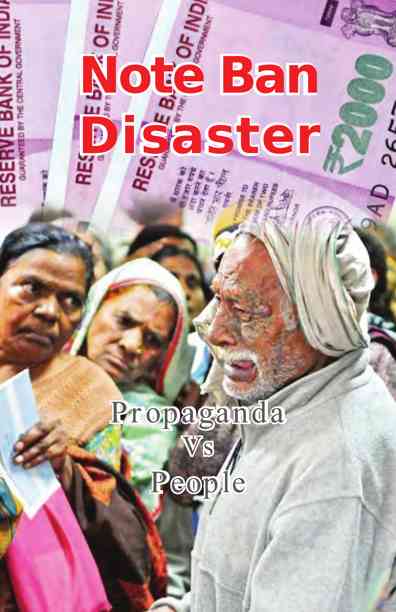
LOOK at the photograph on the cover page of this booklet (originally published in Hindustan Times, Photo Credit: Praveen Kumar).
Nand Lal, an elderly ex-serviceman, is crying after missing his spot at a queue outside an SBI branch in Gurgaon.
Look at the photo carefully. The face of the man tells us countless stories of hardships suffered and misfortunes borne with fortitude. We now know that he lives alone in a small room and that he was a soldier; he would have faced enemy bullets and much else, but the failure to withdraw a few hundred rupees even after queuing up for three days proved just too much for him. Knowing that he would have to start all over again, and fully aware that at the end of it he may still come back empty handed, his dam just burst.
It is the others around him that give the photo its real meaning. The women may or may not be sympathising with him, but they don’t want to step out to console him because they could lose their place in the line too. Sympathy and solidarity must take second place to survival. The women’s faces are full of quiet desperation too, because they must get money, however little it may be, and go home, otherwise their families could suffer. The country is united in its suffering, but given that there is so little cash to go around and that even that is so difficult to get, it is each man or woman for themselves. Others’ sadness must wait....
The pain of demonetisation is not going to disappear any time soon. And even when it does, the lives of the poor are not going to improve. The
lines may disappear, but they will have to cope with a regime hellbent on imposing technology on to them; what if a limit of cash withdrawal is set as a permanent feature? We would be foolish to think of this radical step being a whimsical, one-off move; this is part of a larger plan to redraw the way not just the country is administered but also how citizens themselves run their lives. In the meantime, the lines show no signs of getting shorter and people no closer to getting hold of cash.
More stories and more images of hardship will emerge. It is possible that the world will forget Nand Lal and move on. But his image will remain seared in our collective memory, if not our conscience. It is another matter that those who can and should ease his pain will not face that dilemma because they never even registered the photo in the first place.
ONE by one the PM’s tall claims come undone – exposed as lies....
The PM’s speeches were initially full of ‘surgical strike on black money’. Then he began speaking more of ‘counterfeit currency’ and ‘terror funding’. Then his speeches became silent on black money and began claiming the main purpose of Note Ban was to make India a ‘cashless economy.’
In the 2014 elections, Modi’s ‘jumla’ was ‘bring back black money from foreign banks’ and ‘put Rs 15 lakhs in each Jan Dhan account.’ Post the 8 November Note Ban, ‘surgical strike on black money’ was the jumla. Now, it seems that black money is forgotten and “cashless economy” is the new jumla. What is the next one?
(Excerpt from a piece by Dhirendra K Jha, Scroll.in, Dec 13, 2016)
FOR a snapshot of how urban daily-wagers are dealing with the impact of demonetisation-induced joblessness, visit Shanti Nagar, a residential hub of labourers in Firozabad, an industrial town in Uttar Pradesh 200 km from New Delhi\ and known for its glass industry, particularly its famed glass bangles.
“For a few days after bad times hit us, we survived on our savings,” said Raeesa Begum, a bangle worker and mother of eight. “By the end of November, we had consumed almost all of our savings. So we sold our bhathhi [household gas furnace used for soldering the joints of bangles] for Rs 500. Now, we have started eating only one full meal a day.”
Apart from the bhathhi, Raeesa Begum has sold most of her household utensils, and on December 5, when this reporter last met her, she was looking for a buyer for the family’s sole bicycle.
(Excerpt, SV Krishnamachari, International Business Times, December 1, 2016)
THE pace at which the demonetised notes are coming back to the banking system is raising a question: will the demonetisation drive result in a “surgical strike” on black money? A report by business news channel CNBC-TV18, citing government sources, says about Rs 11 lakh crore has returned to the system as of November 30, out of a total of Rs 14.18 lakh crore. Indians still have 30 more days to deposit the banned notes with banks.
The earlier speculation by analysts was that about Rs 2.5 to 3 lakh crore of these notes will never return and was seen as a windfall for the Reserve Bank of India (RBI) and ultimately, the government. However, those calculations could go awry if the trend till now as indicated by the CNBC-TV18 report is any indication.
What about the claims that demonetisation will smash terror funding or stone pelting stopped in Kashmir because terrorists can’t pay them Rs 500 anymore?
Well, the police of J&K claim that terrorists have been found with new Rs 2000 notes! The fact is,
MODI is saying that Indira Gandhi and previous Congress Governments were not ‘bold enough’ to take a decision to demonetize. But that is a deliberate untruth – in fact the BJP itself called demonetization ‘anti-poor’ when it was partially introduced by the RBI during the UPA tenure!
In 2014 when the RBI announced that currency notes printed before 2005 would be withdrawn, the BJP lashed out at that emasure – even though that move did not even come close to causing the chaos that the BJP Government’s has done.
BJP leader Meenakshi Lekhi then said:
“Because those who have black money, who live in the cities, or have the means, they will exchange the notes for new ones. But the poor, the aam aurat and aadmi, or the woman who has saved her husband’s money and kept it in an aata ke dabba or hidden in the dal or chawal, their lives will be affected.”
Lekhi said that those who keep their savings in US dollars and other foreign currencies would not be hurt, but those who kept their cash in rupees would be badly hurt. She declared that the move was “an unjustified attack on poor people” and demanded that the “RBI must publish a note on how many currency pieces will be affected, how many of these are in rural India, and estimate the impact of this measure on the poor. RBI must conduct a full and impartial inquiry into the impact this measure will have.”
How come partial demonetization is ‘anti-poor’ when UPA does it, but sweeping, sudden, secret demonetization causing palpable, lasting chaos and distress is ‘pro-poor’? Will the BJP agree for a “full and impartial enquiry” into the demonetization impact, or will it simply demand that we accept the findings of the farcical and biased Modi app survey?
These are just some of the new forms of corruption Note Ban has spawned. People in queues did not get cash but the corrupt did! Now, the Government says - blame the banks for this corruption.
Yes, some bank and RBI officials are no doubt involved in this corruption – while most ordinary bank employees are working day and night coping with the Note Ban crisis and facing the wrath of the people.
But the real question is, if corruption continues and flourishes in spite of Note Ban – what was the point of imposing so much suffering on the false promise of fighting corruption?
(Excerpt from a piece by Praveen Chakravarty, Firstpost, December 5, 2016)
The Prime Minister made six speeches across the country on the demonetisation policy between November 13 and November 27, including his radio address to the nation, Mann Ki Baat, according to data available on the Prime Minister’s personal website. The text of all the speeches are available on the website.
A data analysis of the speeches (after translation) reveals a shifting of the narrative of the demonetisation action and its objectives.
In his speech on November 8, 2016, when he announced the demonetisation policy, the Prime Minister used the phrase “black money” four times more than “fake/counterfeit currency”.
By November 27, he used the phrase “digital/cashless” thrice as much as “black money” with no mention of “fake currency”. Recall, there was zero mention of “digital/cashless” in the initial November 8 speech.
THE PM said the Note Ban decision was kept secret in order to keep the corrupt in the dark. PM Modi mocked the Opposition parties saying they are complaining because they did not have time to ‘prepare.’ But the question arises: did Modi himself give his own party and his friends prior information and ample time to ‘prepare’ for Note Ban and dispose of black money?
This Note Bank Scam by the BJP must be investigated by an independent agency!
‘IRONY of India’ web portal reported from Gorakhpur, UP, December 14 2016:
“At Jangal Chawri we have found at least 248 TVS bike with BJP stickers, parked and ready to be distributed.”
The BJP’s Beniganj office in Gorakhpur bought at least 188 of these bikes. Every constituency is to get four bikes for campaigning in UP elections.
Each bike is roughly estimated to cost Rs 37,105/- including registration fees: this means a total of Rs 91,80,000 for 248 bikes. Was this bought with white money? Will it be cited in poll expenditure to the Election Commission?
THE PM says ‘Go Cashless.’ By destroying 86% of cash and printing Rs 2000 notes instead of smaller denominations, the Government is forcing the economy and the people to go cashless. What is the impact of enforced cashlessness on the poor, on street vendors and small shopkeepers, on citizens?
In most of rural India, there is no electricity, let alone internet coverage. How can the poor of India go cashless? In Kashmir or Manipur, internet and mobile phone services have been shut down in the name of security often. This has been done even in cities like Bangalore in the name of preventing racist or communal violence. In such situations how can people survive without cash?
Note Ban has hit street vendors and small shops hard since more and more people are forced to buy vegetables etc from supermarkets or online shops which allow for digital /card payments. It is all too likely that in a cashless economy, the well-off people with plastic money will choose to buy vegetables etc at Ambani’s Reliance Fresh or Biyani’s Big Bazaar rather than street stalls.
Street vending or small shops is the last means of survival for many of India’s poorest. The Government was already trying to evict street vendors and small shopkeepers to benefit corporate retailers by bringing in FDI in retail. Now – thanks to Note Ban, the transaction time for online transactions, the cost overhead, the time overhead will all make street vending less attractive and further evict the poor retailers.
Even Modi’s own brother Prahlad Modi, President of the Ration Shopkeepers Association, has protested against the impact of ‘cashless economy’ on poor shopkeepers, and has refused to install a swipe machine in his ration shop. He has said, “Ration shops cannot be expected to bear the costs of installing a swipe machine, and moreover most people who come to the ration shop have neither credit nor debit cards.” Can’t Narendra Modi at least listen to his own brother? The Government is now saying it will pay for installing swipe machines in ration shops – but will it also provide each and every poor citizen of India with credit or debit cards and guarantee that they will get rations even if electricity or internet fails? Will the poor starve if electricity or internet is unavailable, if they do not have credit/debit cards, or if the swipe machines don’t work?
NOTE ban has made poor and oppressed communities even poorer and more desperate for survival. As a result new, younger girls are being pushed into sex work. Sex workers already in the industry are being forced to work for credit or for free. Pimps are forcing women to work for credit – this is nothing but sexual bondage thanks to Note Ban.
Sex traffickers have faced some difficulty in paying for victims and for transport – but that is a temporary inconvenience that they have already overcome.
Sex workers and trafficked women do not usually have identity papers to set up a bank account, so they were not able to exchange their cash savings. As a Kolkata-based activist Urmi Basu said, “There are thousands of women who have no documentation, no bank accounts, apart from a few hundred rupees they tuck under their blouses” meaning that their cash savings were wiped out overnight.
The PM says wages will be paid directly into workers’ accounts cashlessly or by cheque, ensuring that minimum wage is paid. Workers know that’s a lie! In Delhi for instance, contractors of security firms keep security guards’ ATM cards with them and withdraw money even as they are depositing the official ‘minimum wage’ amount. So minimum wage theft continues even in ‘cashless’ transactions!
We can either be cruel and callous and believe the PM Modi’s farcical claims that even beggars in India now have swipe machines. If we have any human feeling at all, we will know that let alone beggars, even the poor vendors and shop keepers and farmers cannot go ‘cashless.’ In France the cruel Queen Marie Antoinette, seeing starving people demanding bread, asked, “If they don’t have bread, why don’t they eat cake?” Mr Modi, the Indian Marie Antoinette, is saying about India’s poor, “If they can’t get cash, why don’t they just go cashless?” Let us not be like Marie Antoinette or Modi. Let us recognize and resist the forced ‘cashlessness’ as a war on the poor.
(From an IANS report, November 11, 2016)
TERESA, a woman who sells fish in Thiruvananthapuram, is upset that customers wanting to buy fish have only Rs 500 and Rs 1,000 denomination notes.
“What will I do with these notes? Even if I take these, I will find it difficult to change them, and if I don’t take them, then tomorrow I won’t be able to buy fish. I have decided to sell fish to those only who come with legal money. I sold a kilo of seerfish for just Rs 250 a kilo, while the average price is Rs 500 and upwards. From tomorrow (Saturday), I will bring only low value fish so that it can be purchased using Rs 100 notes and other legal tender,” said an angry Teresa.
With the traditional fishing activities coming to a grinding halt, a few online fish vendors are seeing sales zoom.
INITIALLY people said about Note Ban, ‘The intention was good, implementation bad.’ But now the facts force us to ask questions about the PM’s intentions behind demonetisation.
Was ‘Note Ban’ just a mad and cruel whim of Modi the megalomaniac, so that Modi can feel powerful like a cross between Tughlaq and Hitler? Or is there also a method in the madness?
Remember how crooks like Mallya looted India’s banks and scooted without paying loans? The total amount of risky loans thus looted from banks by rich loan defaulters is Rs 11 lakh crore. To put this in perspective, recall that the 2G scam was just Rs 1.76 lakh crore – a tiny fraction of this amount. How are these huge loans to be recovered?
If an ordinary farmer takes a bank loan – he or she would have to repay the loan somehow even if they have to sell their fields for that. Farmers unable to repay debts have committed suicide in lakhs in our country. Governments refuse to waive loans of farmers. But in effect they are waiving the huge bank loans of the richest people in the country!
Governments are not willing to confiscate the assets of these rich loan defaulters, nor to blacklist them for further loans. Instead, in November 2016 the SBI has written off loans worth Rs 7,000 crore of its top 63 loan defaulters - including that of Vijaya Mallya’s Kingfisher Airlines. Mallya owns several homes in the UK and is living in luxury even today, having fled India with the Government’s help. Similarly in 2015, public sector banks ‘restructured’ massive loans owed by Mukesh Ambani’s Reliance Gas to various public sector banks: Ambani will have to repay the loans by 2031 instead of 2019!
Now, because of these huge unpaid loans, banks became severely short of cash. The Government has chosen to restore cash to the banks’ coffers – not by forcing the rich defaulters to pay their loans but by using demonetisation to suck the savings of the poor into banks, and controlling the release of hard-earned savings only in small trickles. The poor are standing in queue for days on end and unable to withdraw their own savings. But banks will now be able to use those savings of the common people to pay out cheap loans again to the rich and corrupt!
Shaktikanta Das – the Government’s Economic Affairs Secretary– admitted recently that because of the Note Ban, “Domestic savings lying idle at home have come into banking system, will enable banks to give loans at lower interest rates.” Mr Das, the savings of the poor were not ‘lying idle at home’ – they were needed by them for running their families on a daily basis. Now these savings are lying in the banks – for you to give cheaper loans to the rich. The blood-and-sweat savings of the poor will, with your Government’s help, be looted from banks by the rich and corrupt for their profits!
Remember how on November 9 itself – the very morning after the PM Modi’s announcement of Note Ban on the midnight of 8 November – newspapers had full-page PayTM ads with the PM Modi himself in them. Clearly the PayTM company must have had prior information about the Note Ban decision to have had their ad ready.
The other reason for the Note Ban decision is political. With Assembly elections in several states coming up, resentment was building up against the Modi Government for its broken promises. Modi had failed to bring back black money, bring down prices or create jobs. Instead all around attacks on Dalits and minorities by Sangh outfits which had the patronage of the Government. The PM first tried to bolster his sagging popularity with the ‘surgical strike’ in Uri. But people began to question why such a large number of soldiers were being killed on Modi’s watch – and why the Indian security establishment was unable to prevent attacks on military camps at Pathankot, Uri, or Nagrota. So Modi needed a new election plank – and he hoped that the ‘surgical strike on black money’ would help rebuild his image.
Narendra Modi and his Government are also using the Note Ban as a test run for fascism. In making the decision he bypassed the decision-making mechanisms of the RBI, his own Cabinet as well as Parliament. He is trying to see how far he can go in imposing a secretive, destructive and undemocratic decision on the public.
The poor are beginning to realize that Modi lied to them about Note Ban being pro-poor and against the rich and corrupt. So now the RSS machinery is busy spreading rumours about Modi’s plans to provide housing for the poor and other benefits. Such promises are totally hollow. In fact, Modi and his Government are cutting back on all pro-poor welfare schemes including MNREGA and Food Security.
Modi ‘bhakts’ branded students as ‘anti-national’ and beat them up for criticizing the PM. They bully and beat up all dissenting voices, and they shower abuses on women who criticize or question the PM. Now, even criticizing the PM for the disastrous Note Ban decision is being branded ‘anti-national.’ Lallan Singh Khushwaha, a Delhi man, was beaten up by some criminals for criticizing Modi’s Note Ban decision.
As journalist Ravish Kumar said, all citizens must perforce chant ‘Baagon me bahaar hai’ (Spring is in the air/All is well) and must not question decisions of the PM, no matter how much we suffer. Questioning will be silenced by creating a climate of fear. If this is not an Emergency, what is?
The PM in his speech promised the nation that we could punish him at public crossroads all over the country if the sufferings of the poor lasted beyond 50 days. The 50 days are up but the Note Ban pain seems permanent. Let us hold public hearings at every crossroad, and invite the PM to attend. If he does not dare to come face the people’s wrath, let us burn his effigies instead.
NOTE Ban has been nothing short of a disaster – for the economy, for the poor, for the country. It has pushed people who were somehow eking out their survival, over the edge into destitution and penury. People are desperate – on the brink of starvation; suddenly rendered jobless; and unable to afford medical care, fees for education and other necessities. The Prime Minister should take responsibility for this disastrous decision. When a natural calamity occurs, the Government and Prime Minister compensate the affected people. In the case of a man-made disaster like the Note Ban, directly created by the Prime Minister Modi himself, the Government must compensate the people for the immense sufferings and losses inflicted on them for no fault of theirs.
Moreover the Government must take concrete measures that really hit at black money holders – not protect such corrupt people behind a smokescreen of ‘Note Ban’.
THE NM App ‘survey’ questions were rather like an Arnab Goswami interview of Modi: cosy questions designed to elicit pre-scripted answers, no room for questions or answers that might be inconveniently critical of Modi or demonetisation! It did not even give the ‘disagree’ option on the most crucial questions, and implied that all critics are pro-corrupt and pro-terrorist. Moreover, this app-based ‘survey’ was a farce given that a mere 17% of Indians (obviously very few in rural India) use smart phones. Instead of this rigged ‘survey,’ we compiled a set of questions a responsible PM should have asked but Modi did not, followed by a set of political questions Modi should answer – in Parliament, in the media and public – but won’t.
1. How much time did you stand in queues at the bank/ATM?
2. Have you been able to withdraw the amount you need? If so, how many attempts did it take?
3. Are ATMs/Banks in your locality supplied with adequate cash?
4. Does your local grocer, tea vendor, vegetable vendor, canteen, milk vendor, school etc accept cashless payment? Do you have any means of cashless payment?
5. Has a broker/dealer ever offered to exchange your old Rs 500 or Rs 1000 notes for a lesser amount?
6. What hardships have you faced due to demonetisation?
7. What is responsible for demonetisation-related hardships?
8. Which of the following in your view is true?
9. Who do you think demonetisation has hit worst?
10. What is your opinion of the the demonetisation move?