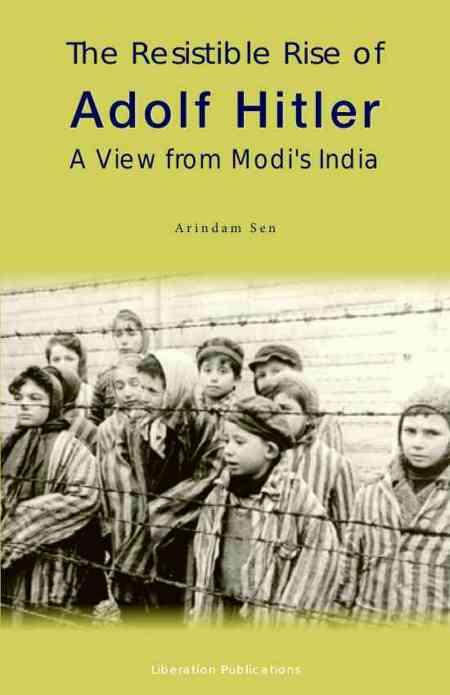
The Resistible Rise of Adolf Hitler
A View from Modi's India
Arindam Sen
Liberation Publications
2nd Edition : August 2018
Charu Bhawan, U - 90 Shakarpur,
Delhi – 110092
Phone: 9-11-22521067
Website: http:\\w.w.w.cpiml.net
“Illusion is the most
enacious weed in the collective
consciousness; history teaches,
but it has no pupils.”
- Antonio Gramsci,
On Fascism (1921)

Marxist philosophy of dialectical materialism has two outstanding characteristics. One is its class nature : it openly avows that it is in the service of proletariat. The other is its practicality. It emphasises the dependence of theory on practice, emphasises that theory is based on practice and in turn, serves practice.
Proletariat is a class with no private property. It has nothing to loose but its chains. On the other hand it has the whole world to win. Therefore this class is free from the narrow sectarian mentality of petty producers and can only have an unbiased, unprejudiced and farsighted attitude in looking at things. Being a thoroughgoing revolutionary class whose mission is the liberation of whole mankind, only proletariat can make use of the thoroughgoing revolutionary system of human thought—the dialectical materialism. No other class can make use of this philosophy for its sectarian ends. Proletariat, armed with this philosophy, will inherit and further advance whatever fine traditions the mankind has developed so far. It looks at all objects, forces, organisations, individuals, as they are, in both their positive and negative aspects, in their contradictions and process of development. This is the philosophical basis of the difference between largeness of mind of the proletariat and sectarianism of petty producers.
Dialectical materialism does not allow any wishful thinking but demands an objective analysis. It safeguards proletariat from indulging in any pessimistic or rash methods while implementing any change. It is an ardent enemy of subjectivism and guides the proletariat and the people in having strong confidence on the future as well as asks them to formulate correct strategy, and tactics in accordance with the concrete situation at any particular stage of development and to advance step-by-step towards victory. Marx said, “Philosophers have hitherto interpreted the world. The point, however, is to change it.” And Marxist philosophy, by taking out the philosophy from the confinement of the “philosophers” and dead “books” and unveiling its mysterious shell, has precisely handed over this weapon of change to the broad masses.
With this weapon in our hand, we can clearly perceive that the present turmoil in the world is only the result of process of disintegration of old system and creation of the new one, and understand the role of revolutionary vanguards to hasten the disintegration of the old and to usher in a new era of peace, progress and stability.
The first edition of this booklet was published in March this year to coincide with the CPI(ML) ‘s Tenth Congress held in Mansa, Punjab (23-28 March, 2018). Here is a revised and enlarged edition with the following additions: a new chapter summing up the evolution of Nazism; short excerpts from Georgi Dimitrov in the Appendix (I); and an Epilogue where, responding to the desire expressed by some of our readers, we have sought to broaden and update our understanding of fascism with notes on Italian fascism of yesteryears and what has been called “functional fascism” in present-day America. We have also incorporated another Appendix (II), covering corporate-communal fascism in our country.
The struggle against fascism on the soil of India will be long-drawn and multifaceted, ranging from direct physical resistance through electoral battles to the war of ideas and narratives. As part of this movement, we shall soon be publishing booklets on a series of key issues around which the RSS-BJP is conspiring to manufacture a malicious common sense, to weave a web of vitriolic false consciousness. Hope our readers find this booklet useful in the ongoing anti-fascist resistance.
Liberation Publications
August 2018
- Bertolt Brecht
(Translation - Jennifer Wise)
Note:
1. The satirical play, written in 1941, draws a parallel between the career of Hitler and the rise of a fictional Chicago gangster, Arturo Ui. The epilogue, spoken at the end of the play by the actor who plays Ui, urges on the audience to keep a close watch on what’s happening, to be active rather than talkative, and vigilant rather than being complacent, because the “ooze” – presumably the filthy pus seeping out of rotten, decaying capitalism – is still “rich” or potent enough to produce the progenies of the original demon.

History, the English historian E.H. Carr observed, “is an unending dialogue between the past and the present.” Here is a short history of the meteoric rise of Adolf Hitler, retold from the present Indian perspective overshadowed by the marauding march of the Modi-Yogi-Bhagwat band. It is part of a continuing conversation in which we ask questions, reflect on the answers we get, and use these feedbacks for charting a new, different course of advance, where the saffron fascists are pulled down well before they reach their cherished goal of a totalitarian Hindu Rashtra. History for us is interactive between past and present, and proactive towards the future.
In this study we have used the terms Nazism and fascism interchangeably, where the former is a specific form of a broader category or genus called fascism. As Umberto Eco points out in his 1995 essay Ur- Fascism (Eternal Fascism), there was “only one Nazism”, whereas “the fascist game can be played in many forms, and the name of the game does not change.” The novelist and semiotician refuses to “define” fascism, but points out 15 broad features – such as “the cult of tradition”, “rejection of modernism”, “disagreement as treason”, “fascism is racist by definition” and so on – most of which, with some regional variations (e.g., caste supremacism as an additional attribute of Hindutva fascism in our country) are easily discernible in Italy, Germany and India.
Indeed, over the past hundred years since it arose in Italy and acquired a more complete shape in Germany, fascism has taken on many national/regional colours and contours in course of adapting itself to varying contexts in different times and countries. Through all such mutations, however, it has retained certain core features or characteristics that place it in a very special category among comparable and allied trends like various shades of right-wing populism, authoritarianism, military rule, etc. Among these features, we believe, the single most important is the instigation and mobilisation of racial/ communal/ supremacist/ national-chauvinist mass frenzy for sneaking into the corridors of power and then engineering or attempting a complete fascist takeover of the state, all along relying on a carefully calibrated combination of demagoguery and terror, and progressively enlisting the support of big capital. In this pamphlet we study some of these features in their quintessential form in the classic case of Hitler’s Germany, where fascism had reached its zenith, because we believe a deeper knowledge of the original would help us better understand the derivative that we are confronting here and now – the current Indian variant.
Was Hitler’s rocket-like ascent really irresistible? Why did the left and democratic forces fail so miserably to arrest the rise? And that in a country gifted with one of the most advanced working-class movements in the world and leaders like Marx, Engels and their followers such as August Bebel, Wilhelm and Karl Liebknecht, Rosa Luxemburg and Clara Zetkin? Can we learn a thing or two from that experience, the huge differences between the then German and present Indian scenarios notwithstanding?
Keeping in mind the specific political purpose of resisting and defeating fascism in our country, in this pamphlet we have, rather than trying to tell the whole story of the rise and fall of Adolf Hitler, chosen to focus the spotlight on the period of fascist ascendance, i.e., the years between 1920 (when Nazism as a political force spearheaded by Hitler was born) and 1933 (when Hitler became Chancellor, going on to liquidate parliamentary democracy and establish a totalitarian fascist dictatorship).
This pamphlet does not lay any claim to original research. The biographical storyline and related facts we have taken mainly from Volker Ullrich’s Hitler: Ascent 1889 – 1939 (a Borzoi Book published by Alfred A. Knopf, a division of Penguin Random House LLC, New York, 2016) and certain other books and articles, such as The Rise And Fall Of The Third Reich A History of Nazi Germany by William L. Shirer (Simon & Schuster, 1960; and Economy and Politics in the Destruction of the Weimar Republic by Kurt Gossweiler; (the last one is an article taken from the collection Resistible Rise: A Fascism Reader edited by Margit Koves and Shaswati Mazumdar (LeftWord Books, New Delhi, 2005). We acknowledge our debt to these authors and publishers here at the beginning itself, because we do not wish to burden this activists’ handbook with detailed citations. We have also reproduced excerpts from an article on Fascism by Clara Zetkin (Appendix), who was not only a leading light of the communist women’s movement but also a major theoretician and activist of the struggle against fascism. Published in August 1923, it contains one of the earliest communist assessments of fascism and a basic guideline on how to combat it. For our political inferences and the overall presentation, the responsibility of course lies with the author alone.

Fascism and its state form – like its other, bourgeois democracy and the parliamentary system – is a product of class struggle. But the course of class struggle varies widely from country to country and so do its outcomes.
Back in 1848 the authors of The Communist Manifesto had good reasons to declare that the German proletariat was expected to be the first in the world to usher in socialist revolution. Actually that happened in Russia and the victorious Russian communists expected the working class in neighbouring Germany to be the next in line. Indeed, post-First World War Germany, being in the throes of the most severe economic crisis, social instability and political breakdown, found itself at a historical crossroads marked by two opposite prospects: socialist revolution or capitalist consolidation. The most advanced sections of the working class in Germany boldly espoused the path of socialist revolution, the big bourgeoisie in alliance with the Junker landlords responded with a counterrevolution. The Left failed and, as Clara Zetkin pointed out as early as in 1923 (see Appendix), was punished with fascism. Our study, therefore, starts with this civil war, this prelude to the emergence of fascism in Germany.
As the first imperialist world war was drawing to a close, the monarchist rulers in Germany were completely discredited and alienated. Popular unrest and upheavals were growing. The year 1918 opened with a general strike involving more than one million workers, demanding peace, bread and the ouster of the Kaiser’s imperialist government. Workers in Berlin were getting organized in Soviet-like councils. Revolutionary ferment also spread throughout the army. It seemed the country was going the Russian way.
In the face of imminent defeat, Germany was eager for peace talks but as a precondition, the US insisted on a civilian government being installed in the defeated aggressor country. Under pressure from victors abroad and the disgruntled masses at home, the ruling dispensation headed by Chancellor Max Von Baden put in place a so-called democratic coalition government, headed by Prince Baden himself and including social democrat leaders like Scheidemann, in the first week of October 1918. The purpose obviously was to preempt revolution and satisfy the victors through a constitutional reform that left the economic system and political power structure intact.
The Spartacus League (SL) and the delegates of revolutionary councils in Berlin, who had been elected during the January 1918 strike, called for another general strike and an armed uprising to overthrow the government of betrayal. In January 1919 Berlin was in the grip of a general strike, with soldiers joining the armed workers, who were taking to the streets of Berlin. The turmoil continued. In November sailors spread the revolutionary ferment to major coastal cities as well as Munich, Frankfurt on Main, Hanover etc. The Kaiser abdicated on November 9 and on the same day, SL leader Karl Liebknecht proclaimed a Socialist Republic. As a counter tactic Scheidemann advanced the slogan of a “free German republic”. Workers’ and soldiers’ councils came up in Munich and other major towns and cities throughout the country (in Berlin they had been already formed). However, the SL lacked the strength to win a majority in the councils and transform them into bodies representing the real interests of the working class and the toiling masses. Gaining a majority in the councils, the opportunist leaders of the Social Democratic Party (SDP) and the Independents (or ISDP, a centrist faction of social democrats) made the councils toe their line. The provisional government—the Council of People’s Commissars—which was elected on November 10 at a general assembly of the Berlin councils, included three representatives of the right-wing Social Democrats including F. Ebert, Scheidemann and three Independents; there was no one from the SL. The Council allowed the Kaiser’s officials to keep their posts and formed an alliance with the monarchist head of the army, P. von Hindenburg.
At the First All-German Congress of Workers’ Councils (December 16–21, 1918) the Social Democratic leaders succeeded in passing resolutions on elections to the bourgeois Constituent Assembly and on the transfer of legislative power to the government. The revolutionaries started an insurrection to seize power. The Ebert-Scheidemann government then switched to an open offensive against the revolutionary workers. It got the foremost leaders of the revolution, Karl Liebknecht and Rosa Luxemburg, brutally murdered by members of the right-wing paramilitaries, the “Freikorps” on January 15, 1919.
 Rosa Luxemburg had opined, within the party, that an insurrection would be disastrous when the forces of the right were gathering strength. But when it was started, she joined her comrades; arguing that events were now in motion and that standing on the sidelines would be a worse mistake than waiting for the right moment. Days later, Luxemburg and Liebknecht were taken prisoner by the freikorps and summarily executed. Liebknecht’s body was dumped anonymously at the city morgue and Luxemburg’s was found months later in the Landwehr canal.
On the evening of her murder, almost certainly knowing that the uprising had failed and that she personally faced death, Rosa wrote:
“The leadership has failed. Even so, the leadership can and must be recreated from the masses and out of the masses. The masses are the decisive element, they are the rock on which the final victory of the revolution will be built...Order reigns in Berlin! You stupid henchmen! Your ‘order’ is built on sand. Tomorrow the revolution will already ‘raise itself with a rattle’ and announce with fanfare, to your terror: I was, I am, I shall be!”
In the meantime, a Socialist Republic of Bavaria had also been proclaimed in Munich. Extremely ill-prepared, this one also was brutally crushed by the armed forces in early May 1919. Later in the year a new constitution adopted by the Constituent Assembly, which met in Weimar town, formalized the foundation of a parliamentary republic, popularly called the Weimar Republic. A half-baked bourgeois republic replaced the monarchy, with big Junker landlords left untouched. Ideologically influenced by opportunist politics, and organizationally divided, the working class was not in a position to lead the revolution to a socialist culmination. However, compared to the House of Hohenzollern’s 400-year rule over Prussia (and 30-year rule over Germany) the republic with all its shortcomings (e.g. the President having almost arbitrary powers of appointing and discharging a Chancellor, issuing decrees etc.) represented a relatively progressive institution in the sense that it allowed for more open and free development of class struggle. Exactly how that struggle would play itself out in the political arena – and which side would win -- would depend, of course, primarily on the political conduct of the parties representing the antagonistic classes.
Every failed revolution evokes a two-pronged response from the ruling class that is threatened but not destroyed. One, brutal repression to try and finish off the revolutionary party; two, some kind of reforms aimed at preempting further attempts at revolution and at the same time expanding its social base among the masses. In Germany the repression was targeted against the SL and then the Communist Party of Germany (KPD) while a reform of the state was introduced in the shape of the Weimar Republic. The first and subsequent governments were formed by a coalition of the liberal bourgeois parties and the Social Democratic Party of Germany (SPD). Clearly, these were governments of class compromise. To smother the smoldering embers of revolution, the SPD-dominated coalition government introduced what we now call social safety net for the working people. And the capitalists accepted it for the time being, as a policy of pragmatic adjustment in place of foolhardy confrontation. Explaining this position, a leading German industrialist candidly told his fellow capitalists in June 1919:
“Gentlemen, in Russia events took the wrong turn and, right from the start, industry found itself rejecting the revolution. If we – and this would have been feasible – had taken up a stance of non-cooperation, then I am sure that by today we would have the same conditions as prevail in Russia”.[1]
Lenin too pointed out that the big bourgeoisie learned from the Russian example and adopted an excellent strategy. For a small price of economic concessions, they as well as the Junker landlords thus saved themselves from the threat of revolution spreading from Russia. The SPD and the trade union leadership attached to it (the latter enjoying the support of the vast majority of workers) also did not try to intensify class struggle to resume the revolution.
Political compromises, as we know, are a temporary truce between two warring parties/sides, a period during which the battle goes on by subtler means, with each party trying to outmanoeuvre the other. One side wins, the other loses. In this case the social democrats, in continuation of their 1914 betrayal of supporting the Kaiser’s war policy, backtracked from their own land reform programme and, rather than using the government for extending the scope of class struggle, sought to consolidate class peace and thus hang on to office in the bourgeois parliamentary setup. Naturally they saw the revolutionary communists as major obstacles and sought to remove them by political – and, during the phase of direct confrontation between armed revolution and armed counterrevolution, by physical/conspiratorial means as well.
Alongside the social democratic prototype based on compromise with the big bourgeoisie, alliance with the liberal bourgeoisie and struggle with the revolutionary communists – a prototype that would be replicated all over the world in the decades to come – the revolutionary communists in the form of the nascent SL-KPD had their bout of ‘left-wing communism, an infantile disorder’. They correctly underscored the need for an uninterrupted transition from the democratic to the socialist revolution, but initially failed to make a sober assessment of the overall balance of class forces in the raging civil war, tried to move too fast, and suffered heavy losses, which further eroded the chances of revolution. However, following the installation of the republic, they supported the social democrats in office on every real move in defence of democracy while opposing the instances of capitulation. The failure of the two left parties to unite in struggle against fascism helped the reactionary big bourgeoisie gradually reclaim its dominance (e.g. through the repudiation, in the mid-1920s, of the eight-hour working day that was instituted soon after the foundation of the republic, and the ouster of the social democratic government in Prussia, led by Otto Braun, in 1932). With the National Socialists emerging as the strongest right-wing and ferociously anti-left, anti-labour party within and without the parliament, the big bourgeoisie and the Nazis came closer and closer together. And the absolute supremacy of the big bourgeoisie was finally restored under Hitler’s “Third Reich”, which replaced the Weimar Republic.
The economic crisis of the 1920s, which matured into the Great Depression by 1929 and led to large-scale economic disruption and intensified class struggle, sets a common backdrop to the emergence of fascist groups in countries like Italy, the US, France, Austria, Romania, Portugal, England and Spain[2], and in several of these the fascists grabbed power too. But it was Germany that had the misfortune of being home to the most savagely successful, genocidal fascist regime.
This was due to a unique constellation of exceptional socio-political developments and anextraordinary political leader doggedly pursuing his mission Conducive objective factors like unprecedented economic woes, disruptions in individual and social lives and the sense of wounded national pride, which followed defeat in the war and the humiliating terms of the Versailles Treaty, and which rendered all classes and strata (with the honorable exception of the industrial proletariat) highly vulnerable to fascist propaganda, are well-known; so we do not go into details of all these. Instead, we investigate the politics of fascism. We try to understand exactly how – with what strategic perspective, tactical maneuvers and modus operandi – Hitler navigated the stormy seas of post-war German polity to reach his goal so fast and with such deadly effect on the national and international planes.
Adolf Hitler was born on 20 April 1889 in the Upper Austrian border town Braunau am Inn, not very far from Munich, and ended his own life on 30 April 1945 in an underground bunker in Berlin when he learnt that his nemesis – the Russian Red Army – had already entered the city. His father, Alois Hitler, was a mid-level customs official. In his teens Adolf tried twice to get admitted to the Academy of Fine Arts, but in vain. However, he did manage to earn a living by painting watercolor scenes of Vienna, where he had to spend a few years in homeless shelters after frittering away a handsome inheritance left by his parents. In those days he was influenced by the prevalent currents of German racist nationalism and antisemitism. At the age of 25 he went off to war as a “private” (the lowest-ranking soldier) and was discharged, along with others, in March 1920, after the Versailles Treaty came into force.
At the time of the revolutionary uprisings and counter-revolutionary reprisals in 1918-1919, Hitler was living in Munich, the citadel of extreme right nationalist forces. He neither supported nor opposed the revolution. During the initial high tide he conveniently appeared to lean towards the Social Democrats but overall he just kept a low profile.[3] Subsequently, of course he always denounced it and its product, the Weimar Republic, while having a word of praise for those SPD leaders who “never intended to spark a revolution” such as Noske, Ebert, Scheidemann, and the Bavarian leader Auer.
Hitler joined active politics in September 1919 when he attended a meeting of the German Workers’ Party (Deutsche Arbeiterpartei, DAP) –- one of many ethnically chauvinist, nationalist groups that evolved after 1918 – in Munich. His speech was well-received, and very soon he was invited to join the party. He readily agreed because, although it was a small and unimpressive group in the making, the DAP offered him an opportunity to get ahead quickly and shape the party according to his own ideas. With Hitler as the party’s star speaker, DAP events began to attract larger gatherings. His strident ultra-nationalism and communication skills attracted the attention of his bosses and in a very unusual move, he was also appointed as an assistant to the educational officer in the Regiment he belonged to.
 The gift of the gab was Hitler’s prime weapon in building his political career; so why not take a closer look at it?[4]
Contrary to popular belief, Hitler did not speak extemporaneously: he diligently prepared for all his public appearances. He would fill several pages with catchwords and slogans to keep him focused during his two- to three-hour performances. Usually he arrived late to ratchet up the excitement and his speeches followed a set pattern.
Most of the times he would begin calmly, almost hesitantly. As the historian John Toland put it, Hitler spent the first ten minutes or so gauging the mood of his audience with the fine sense of an actor. Only when he was convinced of their approval did he begin to relax. He then started to punctuate his remarks with dramatic gestures — throwing his head back, extending his right arm and underlining particularly vivid sentences with his finger or hammering on the lectern with his fists. At the same time his tone and choice of words became more aggressive. His own excitement was infectious. By the end of his speeches, after a furious crescendo, the entire venue would be in a state of intoxicated fervour, and the orator himself, covered in sweat, would accept the congratulations of his entourage.
Many were the factors that contributed to Hitler’s power as a speaker, starting with his full-bodied and flexible voice—“his best weapon,” as it has been called—which he used like an instrument. He had mastered the “language of the post-war little guy,” peppering his speeches not only with the coarse phrases of a former military man, but also with irony and sarcasm. He was adept at using religious imagery and motifs and showed a great capacity to express what his audience thought and felt: he exploited their fears, prejudices and resentments, but also their hopes and desires. As Hitler’s first biographer, Konrad Heiden, wrote, Hitler was “someone seduced by himself,” someone who was so inseparable from his words “that a measure of authenticity flowed over the audience even when he was telling obvious lies.”
Hitler’s speeches typically began with a look back at the “wonderful, flourishing Germany before the war”. Again and again, he directed his audience’s attention to the “great heroic time of 1914,” when the German people, unified as seldom before, had been dragged into a war forced upon them by the Entente powers. This glorified vision of the past allowed Hitler to paint the present day in hues that were all the darker. His constant refrain was that the revolution of 1918–19 led to Germany’s downfall, casting it into slavery. Those primarily responsible were Jews and leftists whom he described as “revolutionary” or “November criminals.” “The ‘utterly fearless’ army was ‘stabbed from behind’ by ‘Jew-socialists’ bribed with Jewish money,” was how a USPD pamphlet cited a statement by Hitler as early as April 1920. Paul von Hindenburg and Erich Ludendorff, the former heads of the Third Supreme Command, had launched the stab-in-the-back legend, which then became a constant component within the propaganda arsenal of right-wing nationalists.
Polemical attacks on the Treaty of Versailles occupied a central position in Hitler’s campaigns, playing upon widespread bitterness about what was perceived as a shameful and humiliating peace. The conditions of the treaty, Hitler repeatedly hammered into his listeners’ heads, condemned it to “serfdom”. He skillfully combined the acerbic condemnation of the Versailles Treaty with hateful attacks on the Weimar Republic and its leading representatives. By turns he excoriated Germany’s new democratic order as a “republic of scoundrels,” a “Berlin Jew government” and a “criminal republic.”
From the beginning of his political career to the very end, Hitler’s world outlook and politics comprised three basic strands: (a) radical anti-Semitism[5] (b) aggressive anti-Bolshevism/communism/Marxism and (c) racial/national revivalism and chauvinism, complete with a clamour for conquest of “a living space in the East”. Such themes were nothing new in German right-wing politics at the time, but Hitler packaged and marketed them incomparably better than the others. The third component – shrill, supremacist nationalism – would always be there in his speeches and write-ups, but as a rule he would emphasise one particular strand for a particular occasion and audience. Here are a few examples.
In one of his early (1920) speeches, Hitler said:
Being unable to form a state, Jews lived as “nomads…parasites on the bodies of other peoples…as a race within other races and a state within other states.” Driven by their two most prominent racial characteristics, “Mammonism6 and materialism,” they had accumulated enormous wealth “without putting in the sweat and effort required of all other mortals.” With that, Hitler arrived at his favourite subject, international “interest and stock-market capital,” which dominated “practically the entire world…with sums of money growing beyond all measure and—what’s worst—with the effect of corrupting all honest work.” The National Socialists, Hitler claimed, had come forth to combat this destructive force by “awakening, augmenting and inciting the instinctual antipathy of our people for Jewry.” From here, from the global “stock-market and interest capital” holding Germany in its vice-like grip Hitler smoothly moved on to the nightmare of a “worldwide Jewish conspiracy.”
On 24 February 1928, the eighth anniversary of the announcement of the party programme, Hitler proclaimed: “If he [the Jew] behaves, he can stay—if not, out with him!” (Looks like Golwalkar took his infamous warning to Indian Muslims directly from here) But in the same breath he insisted that “We are the masters of our house” and issued an unmistakably murderous threat: “One cannot compete with parasites, one can only remove them.
In another speech in 1920 he said:
“Those who are on top in Russia are not the workers but, without exception, Hebrews.” Hitler spoke of a “Jewish dictatorship” and a “Moscow Jew government” sucking the life out of the Russian people and called on the NSDAP to become “a battering ram of German character” against the “dirty flood of Jewish Bolshevism.”
Now, on what grounds could anyone talk of a “Jewish Bolshevism” or a “Moscow Jewish government”? It is a fact that many Bolshevik leaders happened to be from a Jewish background, and so were many other communist leaders in other countries. And Hitler was not alone in using this fact to claim that Bolshevism was guided and controlled by Jews, thereby conveniently merging the two enemies. Just see how Winston Churchill pours venom on the Bolsheviks (box).
Regarding Marxism, Hitler believed that by destroying it he could eradicate class conflict and create a “genuine ethnic-popular community.” He was also constantly coming up with new phrases to describe the marriage of nationalism and socialism, the unification of “workers of the mind and workers of the fist.” National Socialism knew neither bourgeois nor proletarian, only “the German working for his people.”
At times he would combine the two objects of hatred: “The Jew is and remains the world’s enemy, and his greatest weapon, Marxism, is and remains a plague for humanity,” he wrote in February 1927 in the Völkischer Beobachter.
National Socialism depicted itself as a political religion. “What does Christianity mean for us today?” Goebbels wrote in his diary, “National Socialism is a religion.” This view corresponded to the party’s inflation of itself to a “community of faith” and its programme to an “ideological creed.” Like the biblical apostles, the task of the Führer’s disciples was to spread Nazi principles “like a gospel among our people.” This was one reason why Hitler staunchly refused to consider any amendment of the original twenty five-point NSDAP manifesto. He once told his close confidante Hanfstaengl, who once suggested some realistic modifications, “Absolutely not. It’s staying as it is. The New Testament, too, is full of contradictions, but that did nothing to hinder the spread of Christianity.” At the Nazi Party’s 1925 Christmas celebrations, Hitler drew a revealing parallel between early Christianity and the “movement.” Christ had also been initially mocked, and yet the Christian faith had become a massive global movement. “We want to achieve the same thing in the arena of politics,” the NSDP chairman declared. A year later he was explicitly casting himself as Jesus’s successor, who would complete his work. “National Socialism,” Hitler proclaimed, “is nothing other than compliance with Christ’s teachings.”
“…From the days of Spartacus-Weishaupt to those of Karl Marx, and down to Trotsky (Russia), Bela Kun (Hungary), Rosa Luxemburg (Germany), and Emma Goldman (United States), this world-wide conspiracy for the overthrow of civilisation and for the reconstitution of society on the basis of arrested development, of envious malevolence, and impossible equality, has been steadily growing…
There is no need to exaggerate the part played in the creation of Bolshevism and in the actual bringing about of the Russian Revolution by these international and for the most part atheistical Jews. …With the notable exception of Lenin, the majority of the leading figures are Jews.”

- Winston Leonard Spencer Churchill
Zionism versus Bolshevism
(Illustrated Sunday Herald,
8 February, 1920)
In his public speeches, especially in their final crescendos, Hitler often utilised religious vocabulary. He would conclude with a final “Amen!” or invoke his “faith in a new Holy German Empire” or call upon “Our Lord to give me the strength to continue my work in the face of all the demons.” He constantly warned his followers that there would be no shortage of sacrifices along the way. Here, too, he drew parallels with early Christianity: “We have a path of thorns to go down and are proud of it.” The “blood witnesses” who had lost their lives for the Nazi movement, Hitler promised, would enjoy the sort of reverence once reserved for the Christian martyrs.
Together with Anton Drexler (a DAP leader from whom he acquired the idea of fusing nationalism and socialism, of freeing the working classes from the “false teachings” of Marxism and winning them over for the nationalist cause), Hitler produced a party programme that forcefully expressed ideas in currency among ethnic-chauvinist and anti-Semitic circles at the time. Ulrich notes that at the top of the agenda was the demand for all ethnic Germans to be united within a greater Germany. This was followed by demands for the revocation of the Treaty of Versailles and the return of Germany’s colonies. Point 4 clearly expressed the party’s anti-Semitic orientation, reading “Only an ethnic comrade [Volksgenosse] can be a citizen. Only someone who is of German blood, irrespective of religion, can be an ethnic comrade. Thus no Jew can be an ethnic comrade.” This was followed by the demands that Jews in Germany be treated as foreigners under the law and that all further Jewish immigration be halted.
Also there were demands for “the eradication of work-free, effortless income” (this was obviously pointed against Jewish moneylenders and bankers) and the “confiscation of all wartime profits without exception”. Demands for nationalisation of large banks, for profit-sharing and for an expansion of the pension system were designed to appeal to the working classes. A promise to communalise large department stores was aimed at the middle classes, and the prospect of land reform at farmers. The programme also contained slogans like “communal welfare comes before selfishness” and “strengthening of central authority”, combined with a pledge to fight against “the corrupting parliamentary system”.
As a whole, the programme/manifesto left no doubt that the aim was to get rid of the democracy of the young Weimar Republic and create an authoritarian government for an ethnic community, which would no longer have any room for Jews. At the same time, it also had a dash of what we now call lemon socialism (nationalization in certain cases, for example)[7]. It was read out to a 2000-strong public event on 24 February 1920, to great applause of the majority and loud protests from opponents from the political Left, who were also in attendance in sizeable numbers.
It is testimony to Hitler’s political acumen that he added the qualifying phrase “National Socialist” (from which ‘Nazi’ is derived) to the lacklustre “German Workers Party”. Nationalism and Socialism were the two most powerful political trends of the time, and he tried to dupe and attract people of both persuasions. The party was thus renamed as the National Socialist Workers’ Party of Germany (NSDAP) and this meeting came to be counted as the foundational act of the Nazi movement. As Hitler wrote at the end of the first volume of Mein Kampf (My Struggle), “A fire was sparked, from whose embers the sword would necessarily come which would restore freedom to the German Siegfried and life to the German nation…The hall gradually emptied. The movement was under way.”
For Hitler, socialism was of course only a façade. But there were some who took it more seriously – Joseph Goebbels and Gregor Strasser for example. “National and socialist!” Goebbels wrote in his diary. “What has priority and what comes second? There’s no doubt about the answer among us here in the west. First socialist redemption, and then national liberation will arrive like a powerful storm wind.” In 1925 they came up with ideas of a revision of the party programme along these lines. To this end they founded a “Working Association North-west”, which explicitly recognized Hitler as the leader. When they proposed the revision in a conference, they were confident that Hitler would agree with them. Actually the Führer rubbished all that vehemently, declaring the party programme sacrosanct. The Working Association North-west was finished. But before long Hitler befriended and won over both Goebbels and Strasser. It was the last time there would be an open debate about the party’s political orientation, although differences on tactics would surface again.
Notes:
1. Cited by Kurt Gossweiler, op cit. p 121.
2. n the case of Spain, we refer mainly to the Falange Espanola founded by Jose Antonio Primo de Rivera in 1933 and a few other kindred groups which were subsequently merged together under the fascist dictatorship of General Franco (1939 – 1975).
3. This approach – concentrating all energy only on his own agenda and organization and refusing to unite with any other party or movement even at crucial junctures – would remain a permanent feature of his politics.
4. he following description is excerpted from Ullrich’s well-researched work.
5.Radical or not, anti-Semitism was a powerful trend in many parts of the world. To cite just one example, the racist pamphlet by American carmaker Henry Ford, “The International Jew: The World’s Foremost Problem” -- which had appeared in German translation in 1922 and became a huge hit -- is said to have been a major influence on Hitler.
6. Fixation on money and the drive to accumulate more and more of it.
7. The “anti-capitalist strain” -- hence (national) socialism -- obviously relates to usurious capital, or as Hitler put it, the practice of amassing wealth “without sweat and effort” and was actually targeted at the Jewish community who were dominant in this branch of business. Latent anti-Semitic prejudices had long been rife across Europe (recall The Merchant of Venice), so the conditions existed for many to succumb to Hitler’s scapegoating of the Jews in this context. This ‘anti-capitalist’ charade would be maintained in later years too (though never emphasised or acted upon, and kept completely hidden during close interactions with business magnates) so as to project a pro-worker, pro-poor image.

From day one Hitler was the party’s most active and authentic leader, delivering speeches at crowded meetings, some in rural areas, and various panel discussions. His central concern at this stage was to attract public attention. “Who cares whether they laugh at us or insult us, treating us as fools or criminals?” Hitler later wrote in Mein Kampf describing his mind in the initial years, “the point is that they talk about us and constantly think about us.” The police and military bosses on their part were quite appreciative of the “beneficial patriotic effect” of the NSDAP activities.
The NSDAP leader was always absolutely focused on his own political agenda. In January 1923, French and Belgian troops entered the Ruhr Valley, the country’s industrial hub, for exacting delayed reparation payments as decided in the Versailles Treaty. A huge protest arose across the country, united demonstrations against the intruders were organised, but the militant nationalist party led by Hitler – much to the surprise of others -- stayed away. It tried to redirect the general hostility at the enemies within -- the “November criminals.” By “stabbing the army in the back,” Hitler said in a public meeting, political leaders at the end of the First World War had left Germany defenceless and exposed to “total enslavement.” He was alluding to the leaders who signed the Versailles Treaty and those responsible for the foundation of the Weimar Republic. The task, he insisted, was to see that those criminals (social democrats and communists in the main) were punished and a new and strong Germany was built up. So, he argued, the “babble about a united front” would only distract the German people from their main task.
But in hot pursuance of this “main task”, and emboldened by the indulgence shown him by the Bavarian police and the Central military leadership, Hitler committed a couple of costly mistakes.
Hitler felt that the situation was rapidly hotting up and mere propaganda was not enough. So he ventured into a direct clash with his most organised political enemy number one – the working class parties – on the occasion of May Day. He tactfully demanded that the Bavarian government must ban the traditional May Day celebrations because it was also the anniversary of Munich’s conservative “liberation” from the revolutionary councils set up in 1919. Predictably, the government refused to take this harsh, provocative step. Hitler then decided to stop the May Day parade himself. On his call, some 2000 armed freikorps (armed paramilitaries) assembled to forcibly block the parade. Hitler himself, in full military attire complete with the steel helmet and the Iron Cross, was proudly in command. But the authorities this time decided that the upstart should not be allowed to take them for granted andthe army was called in. While some hotheads among his followers were willing to fight, Hitler backed away from a hopeless armed confrontation with the state rather than risking his entire political career. In the meantime, the massive May Day celebrations had ended peacefully.
The fiasco meant a huge loss of prestige for Hitler. His comrades and followers, particularly members of the SA (the original paramilitary wing of the Nazi party, also known as the Stormtroopers or Brownshirts), were highly disappointed. Many political observers felt the Nazis were on the wane. But the objective situation was developing in their favour. Since the summer of 1920, inflation was going through the ceiling and in August the incumbent Chancellor Wilhelm Cuno had to step down in the face of strikes and demonstrations, mainly organised by the SPD-led trade unions. Speculation of a right-wing coup d’etat was rife and there were wild expectations in broad right-wing circles that the brightest young leader would come up with some drastic action – like Mussolini’s “March on Rome” just a year earlier – to oust the liberal-left federal government and install a hard-core right-nationalist one.
This latter goal was cherished by other rightist forces as well, including the “triumvirate” virtually ruling Bavaria in intense animosity with the Republican government in Berlin -- Kahr (state commissar of Bavaria), Lossow (head of Reichswehr troops in Bavaria) and Seisser (head of the Bavarian police). Hitler publicly demanded that the Bavarian rulers must take immediate action: “It’s high time. Economic misery is so pushing our people that we have to act or risk our supporters going over to the Communists.” He thus tried to force their hands, but they kept dilly-dallying. The Nazi leader then plunged into his second adventurist act of the year.

Kahr had called a meeting in the Bürgerbräukeller (one of the largest beer halls in Munich) on 8 November inviting all ministers, officials and political VVIPs. Hitler reckoned that if his supporters succeeded in seizing the Bürgerbräukeller, they would have a unique opportunity to bring the entire political class of Munich under their control. The plan was to leave the triumvirate with no other option but to rebel against Berlin (the Berlin-Munich acrimony was already very intense in any case) by presenting them with a fait accompli.
With truckloads of armed SA men on guard and accompanied by his elite bodyguards, Hitler stormed into the beer hall, fired a shot to quiet the crowd, and proclaimed excitably: “National revolution is under way. The hall is under the control of 600 heavily armed men. No one is allowed to leave. If things don’t immediately quieten down, I will have a machine gun posted on the gallery. The Bavarian government has been deposed. The Reich government has been deposed. A provisional government has been formed.”
Hitler then asked Kahr, Lossow and Seisser, at gun-point, to accompany him into an adjoining room, guaranteeing their safety. There he both threatened and apologized to them, exacted their word of honour, and then came back to the hall. Everybody was angry and disgusted. But, in a short speech Hitler completely turned the mood in the beer hall around.
Hitler then persuaded the triumvirate to return with him to the hall to publicly seal the agreement. Before the crowd dispersed, an SA commando arrested all the members of the cabinet in the audience. Hitler left Kahr, Lossow and Seisser under ex-General Ludendorff’s supervision and went out to help the uprising in other parts of the city. But the General allowed the triumvirate to leave the beer hall with only a promise that they would stick to the agreement. The latter, once freed, took all necessary initiatives to put down the uprising. The putsch failed. Hitler and his associates were arrested.
But the failed putsch made Hitler a hero for large sections of people who were fed up with the ruling cliques in Munich and Berlin. There were spontaneous demonstrations against the triumvirate – who were now called “clique of traitors” — in Munich and other Bavarian cities. Students in particular tended to sympathise with Hitler and his co-conspirators. At a mass event at the University of Munich on 12 November, speakers were repeatedly interrupted by cries of “Up with Hitler, down with Kahr.” As the university dean called upon those present to sing the German national anthem, the audience sang the freikorps song “Swastika on a Steel Helmet” instead.
At the trial Hitler and other leaders of the putsch were found guilty of the “crime of high treason” which carried a minimum sentence of five years’ imprisonment; however, the court declared that the sentences could be suspended for good behaviour after just six months. The court also ruled that Hitler, who “is so German in his thinking and feeling,” was exempt from possible deportation to Austria. The sentences were scandalously mild and the ruling came in for sharp criticism. “Judicial murder has been carried out against the republic in Munich,” wrote the left-wing journal Die Weltbühne. In fact, the court’s verdict praised the defendants as “having acted in a purely patriotic spirit, led by the most noble, selfless will.”
The prison term came as a boon in disguise. As Hitler recollected later, while in prison he “became convinced that violence would not work, since the state is too established and has all the weapons in its possession.” He also claimed that he achieved conceptual clarity about things “he had largely intuited” before and that helped him write the first volume of Mein Kampf. It had been stupid of the government, Hitler commented, to imprison him: “They would have been better off letting me speak and speak again and never find my peace of mind.”
Enamoured of what they saw as the Nazis leader’s heroic nationalism, the Supreme Court of Bavaria cut short the five-year jail term to just one year. Released in late December 1924, he reconstituted the NSDAP to further concentrate all decision-making authority in his own hands. He also resisted a proposal to shift the party headquarters to Berlin because he felt that, being his personal power base, Munich must remain the seat of the party. For public consumption, of course, he argued that Munich, after all, was the birthplace of Nazism “Rome, Mecca, Moscow —every one of these places embodies a world view!” he proclaimed. “We shall remain in the city that saw the first party comrades shed their blood for our movement. It must become the Moscow of our movement!”
Out of prison, Hitler found the situation much less conducive to his kind of politics. From 1925, following the stabilisation of the currency, the German economy recovered quickly. Industrial production, employment, and even real wages in some cases went up. Germany was ceremoniously inducted into the League of Nations and the Weimar Republic was on stronger grounds. The NSDAP’s political activism waned compared to the early 1920s and membership was growing very slowly. Hitler appealed to the Bavarian government to lift the ban on his party, and in view of its shrunken profile and also the goodwill he personally commanded among the public, the authorities relented. “The beast is tamed”, BVP leader and “Minister President” (a position comparable to the Prime Minister) Heinrich Held is said to have remarked, “now we can loosen the shackles”. But Hitler’s first post-imprisonment speech was so inflammatory (“either the enemy will march over our dead bodies”, he fumed, “or we will march over his”) that the government banned him from speaking in public. After about two years, with the party’s popularity waning, even this ban was lifted.
The party fared poorly in the May 1928 Reichstag elections, polling only 2.6 per cent, slightly less than their last election results in December 1924. The SPD came to power, with Hermann Müller as chancellor, at the head of a so-called “Great Coalition” that included four bourgeois parties: the Centre Party, the BVP, the DDP and the DVP.
The economic recovery in Germany petered out by late 1928 and next year the worldwide Great Depression brought the country back to severe crisis. In February 1929, the number of people registered as unemployed once more crossed the three-million mark. Prices for agricultural produce were falling. In north Germany, farmers staged demonstrations under black flags. A radical group led by a farmer named Claus Heim even carried out bomb attacks against local tax and government offices. The popularity of the NSDAP was growing rapidly in rural as well as urban areas. The Nazis also achieved spectacular results in the elections to Germany’s student parliaments in 1928 and 1929. In November 1928, Hitler spoke to an audience of 2,500 Munich University students in the Löwenbräukeller and was greeted with rapturous applause.
In Landtag elections in December 1929, the NSDAP got six seats and 11.3 per cent of votes in Thuringia. The conservative and liberal parties wanted to govern without the SPD, but then they needed the support of the National Socialists. Hitler decided that the party would join a governing coalition, but only if it were given two key ministries, those of the interior and of culture and popular education. “He who possesses these two ministries, and uses his power within them unscrupulously and with determination, can achieve the extraordinary,” Hitler wrote in a confidential letter on 2 February. The Interior Ministry gave the NSDAP oversight of the state police force; the Culture Ministry put the party in charge of the entire Thuringian school and educational system. Hitler was not interested in participating in government per se: he was aiming to take over the executive branch from the inside. As his candidate for both ministerial posts, Hitler put forward Wilhelm Frick, his comrade from the Beer Hall Putsch. The DVP initially demanded some other name, but Hitler insisted “that either Dr. Frick would be our minister or there would be fresh elections”. The centre-right parties, aware that new elections would further strengthen the NSDAP’s position, gave in to Hitler’s ultimatum.
During his fourteen-month term in office, even the one-man Nazi army in the coalition government amply demonstrated, in miniature, what a future Nazi rule at national level might look like. Experienced and efficient civil servants suspected of sympathising with the SPD were fired and replaced with Nazi stooges. Prayers were made mandatory in schools in order, as Frick told the Landtag, to “prevent the people being swindled by Marxism and the Jews.” The University of Jena was given a chair in racial sciences, which was filled by the notorious anti-Semite Hans F.K. Güntherar overruling the vote of the professoriate. The new director of the Weimar Academy of Art and Architecture, the National Socialist true believer Paul Schultze-Naumburg, removed modernist works of art from the city’s Royal Museum. Frick forbade the playing of “Nigger Jazz” (an abusive term for extremely popular jazz music with roots in African-American culture) in pubs and forced Nazi-flavoured prayers in schools. He infiltrated the police department, including the post of police president in Weimar, with Nazi members. In the face of mounting criticism, Frick was ousted on 1 April 1931 by a vote of no confidence in the Landtag.
In a situation like this, the two radical parties at two poles of the political spectrum – the Communists and the Nazis – grew swiftly at the cost of the middle-roaders.
An interesting experience was gained in the State of Thuringia, which would serve as a laboratory for Nazi rule a couple of years before the party came to rule the whole of the country. (See sidebar) Then in March 1930 the SPD Ministry headed by Muller collapsed. In the September elections to the Reichstag, SPD votes tumbled by six percent while the KPD vote share rose by 40 percent compared to May 1928. However, in absolute terms the KPD’s rise did not compensate for the SPD’s loss. So their combined vote share went down, while the Nazi vote share rose by a whopping 700 percent – pushing the NSDAP from the ninth to the second position in the Reichstag.
In utilizing the excellent revolutionary situation, in this case the fascists thus beat the militant left by a long margin. But this was not a general pattern: only two years later, in November 1932, the Nazi vote share would decline compared to July that year, while that of the KPD would rise. In any case, the major contention remained between the far right and the revolutionary left.
The astounding success had three major political fallouts. For one, in a bid to block the Nazis in parliament, the SPD lent support to the minority government led by Centre Party leader Heinrich Brüning, which had just replaced their own government. This enabled the Brüning government to continue in office for another two years – a period of bad governance that proved to be only a pathway for Hitler’s ascendance to power.
Second, the capitalists learned to see the NSDAP as a real claimant to power and began to contribute somewhat freely to its coffers. To facilitate this, Hitler met former chancellor Wilhelm Cuno, the chairman of the Hamburg-America ocean line HAPAG, in the election month itself. He tried to assure Cuno, and through him other business magnates, that the NSDAP would support entrepreneurial initiative and private capital, and only intervene in cases of illicitly acquired wealth. Still the industrialists remained somewhat suspicious about the party’s economic program and their doubts grew stronger the very next month (October 1930) when the NSDAP moved a number of parliamentary motions that were not only anti-Jewish but also against finance capital – such as nationalisation of large banks, restricting interest rates at 5 percent and banning the trading of securities (share market operations).
These motions showed that the NSDAP chairman did not want to alienate the ‘socialist’ wing of the party even as he tried to allay the fears of the capitalists. Referring to the political influence of the latter, he told Otto Wagener, a close confidante who saw such overtures to the capitalists as useless if not harmful, “I have the feeling that we won’t be able to conquer [the Chancellor’s office in] Wilhelmstrasse over their heads.”
Third and most important, with a veritable membership explosion in both the party (from nearly 3, 89,000 at the end of 1930 to approximately 8,06,000 a year later) and the SA (from 77,000 in January 1931 to 2,90,000 in in January 1932 to 4,45,000 by August 19 1932), the question of “what next” became the hottest talking point in the Nazi fraternity. State power seemed to be in striking distance, and the SA men in particular were restless for action – for a coup to be precise. But Hitler was not prepared to risk another term of imprisonment and a ban on the party, or even a ban on his public appearance, all of which had proved so detrimental to the party’s growth only recently. He warned SA men to be on guard against “spies and provocateurs” trying to tempt them into breaking the law: “Our legality will smash and deflect all measures taken by those currently in possession of state power.” At a meeting of the Munich SA brigade in early March 1931, he had to defend himself against the charge that he was “too cowardly” to fight with illegal means. He did not want to send them out to be cut down by machine guns, Hitler said, because he would need them for more important tasks, namely constructing the Third Reich.
Hitler had good reasons to believe that the SA and perhaps the NSDAP as a whole could be banned in the event of an adventurist step. An emergency decree issued by the President implied that very clearly. So on 30 March he ordered that anyone violating the decree would be summarily expelled from the party. He actually had to fire Walter Stennes, head of the Berlin chapter of the SA, for refusing to provide security to party events and for excessive anarchic activities. Stennes and his supporters staged a revolt in Berlin, but it did not spread to other cities and collapsed in a few days.[1]
This episode, however, did not stop Count Wolf-Heinrich Von Helldorf, the next head of the Berlin SA, fromleading some 500 armed men in vandalising Jewish shops and brutalising people they thought to be Jewish on 12 September 1931, the Jewish New Year’s day. “Germany Awaken, Judah must die”, they shouted. Some of the rioters, including the gang leaders, were tried but let off with minor sentences. Hitler’s response, as expressed within the party, was that the SA leaders must not get provoked; they must understand that “the legal path is the only secure one at the moment.” At the same time he suggested that in large cities, the SA faced the necessity “of undertaking something to satisfy the revolutionary mood of the people.” The party would have to publicly distance itself from the SA leaders who had been involved, but he assured his henchmen: “You can be certain that the party will not forget their services and will restore them to their posts as soon as the time is ripe.”

In 1932 the NASDAP contested several major elections, with the performance card showing sharp ups and downs. The first was the presidential elections in March, where Hitler was the main contender against Hindenburg. In an effort to project himself as a future head of government, he accepted an invitation to address the prestigious Industrial Club of Dusseldorf representing, among others, the Ruhr Valley tycoons. As was his wont on such occasions, he avoided openly anti-Semitic comments. But for conquering a “living space in Russia”, he promised, a revitalised Germany under his leadership would live in “peace and friendship” with its neighbours. But the lacklustre speech failed to cut much ice. Top industrialists like Krupp and Duisberg came out in support of Hindenburg and Hitler’s party received comparatively much less in donations.
Belying wild expectations among Nazis including Hitler himself, the incumbent president got 18 million votes compared to Hitler’s 11 million. Nazi ranks and supporters were so demoralised that in many places the swastika flags were flown at half-mast.
A run-off election was announced for April 10 because Hindenburg just stopped short of majority vote share. More resolute after the defeat, Hitler embarked on his first “flying tour of Germany,” one of the first such initiatives in history. The slogan “Hitler over Germany,” which party newspapers published in screaming headlines, suggested not only that Hitler was omnipresent: it also symbolised his claim to be above classes and parties and anticipated the coming “ethnic community.” And the fact that Hitler never cancelled an event, even when the weather made flying risky, solidified the myth that he was a “national saviour” willing to sacrifice himself and unafraid of any danger. Hindenburg was re-elected, but Hitler gained around 2 million additional votes. However this was partly due to the withdrawal of one nationalist candidate in favour of Hitler.
In late April elections were held to Landtags in Prussia, Bavaria, Württemberg and Anhalt along with civic body polls in Hamburg. Everywhere the NSDAP performed brilliantly. For example in Prussia, the largest and most important state in Germany, they became the largest party with 36.3 percent vote share, up from 1.8 percent in 1928. But except for Anhalt, the party could not convert this strength into positions of government because it refused to form or join any coalition. It was a peculiar situation indeed. Amidst all the euphoria over the NSDAP’s “phenomenal victory,” Goebbels noted in his diary: “What now? Something has to happen. We have to gain power. Otherwise we will triumph ourselves to death.”
Meanwhile, a way out of this imbroglio seemed to be opening up for the Nazis thanks to a political rift between the centrist chancellor and the hard-core right nationalist president. The latter had the impression that Brüning was taking stern action against the SA rioters (he even persuaded the president to issue an emergency decree dissolving Nazi paramilitary units) but remained blind to “the communist menace”. So he expressed his “urgent wish” to the chancellor that “the Cabinet should be reformed and moved to the right”. The latter, himself largely responsible for undermining parliamentary democracy by considerably distancing the Reichstag from political decision-making and thus bolstering the powers of the president and the military top brass vis-a-vis the Parliament, had to bow down to this autocratic diktat and resigned at the end of May. Franz Von Papen became the new Chancellor.
 “ … before the establishment of a fascist dictatorship, bourgeois governments usually pass through a number of preliminary stages and adopt a number of reactionary measures which directly facilitate the accession to power of fascism. Whoever does not fight the reactionary measures of the bourgeoisie and the growth of fascism at these preparatory stages is not in a position to prevent the victory of fascism, but, on the contrary, facilitates that victory.”
Georgi Dimitrov
Political report to the Seventh World Congress,
The Communist International, August 1935
The banning of the SA did not go down well with many in the government, who viewed the armed gangs as a potential tool for rebuilding Germany’s military prowess. The most influential among these people was defence minister General Kurt Von Schleicher, who, like Hindenburg, strongly believed that a correct approach to the NSDAP must be to try and tie the party to a governing coalition and thus tame it.
Schleicher secretly met with Hitler to discuss the conditions under which the NSDAP chairman would join or at least tolerate a governing coalition. The latter refused to join the government but he agreed to engage in “productive cooperation” (in today’s terms, support from outside the cabinet) with a more right-wing, interim presidential cabinet under Papen, if fresh elections were scheduled and the ban on the SA and SS lifted. On both counts he received assurances. Hitler was very happy: he had not tied himself down and still held all the trump cards. This understanding was duly carried through under the Hindenburg-Papen disposition. The Reichstag was dissolved on 4 June and 31 July was set as the date for new elections. On 16 June, the ban on the SA was lifted. The Brownshirts who were merely operating in semi legal fashion – since there had been no arrests, no crackdowns on them after the ban was imposed two months earlier – now resurfaced in their true colours. Violence escalated to previously unseen levels as fascists now engaged in bloody street battles on a daily basis.
The next blow to parliamentary democracy came in July in the form of deposition of the Social Democratic government and imposition of military emergency in Prussia. The pretext was that the SD government was failing to maintain law and order (a recent bloody clash between armed Nazi gangs and workers was cited as evidence) and had lost its majority in the state legislature. Papen appointed himself Reich Commissioner for Prussia. The SPD was expected to mount vigorous street protests: after all, their government had been arbitrarily overthrown and it still had the support of powerful trade unions. But it only appealed to the court, for justice, and nothing came out it. The KPD did call for a general strike but with the SPD and the unions remaining passive, it was a non-starter. Thus there was hardly any effective resistance from the Left.
Immediately after the ‘constitutional coup’ the new rulers began to “cleanse” the Prussian civil service of democrats – a process the National Socialists would zealously take over once they came to power. As the historian Karl-Dietrich Bracher rightly pointed out, the “Prussia coup” was a prelude to the Nazi assumption of power six months later.
It is interesting and instructive to note that none of these reactionary autocratic blows to the parliamentary system was dealt by Hitler (he of course played the role of a catalyst or instigator in some cases) yet at the end of the day he alone would reap all the benefits, knocking all his contenders, facilitators and fellow travelers off the road to power as he went.
Note:
1. But the events of the spring of 1931 had long-term political consequences as they led to the rise of the SS, which at the time was still subordinate to the SA. During the crisis, the SS had proved absolutely loyal to the party leadership, and the resulting political capital left that group able to rival the SA. The SS would play a very crucial part in the history of Nazism by enacting the infamous “Night of the Long Knives” in 1934 when Hitler deployed it to kill and disarm rebellious SA leaders and men. SA violence on the other hand was a double-edged sword for the party leadership, for it constantly threatened to get out of hand and give the lie to Hitler’s assurances that the party was acting within the bounds of the law.


1932 was proving to be a year of great instability, uncertainty and turmoil. For the end-July elections, the main slogans coined by Goebbels were “Germany awaken! Give Adolf Hitler Power!” And “Down with the System, its parties and its exponents!” In his speeches Hitler would condemn the Weimar “system” for the general economic and political decay and promise to get rid of “the nepotism of parties”. As he thundered in one of his last pre-election speeches, he will “sweep the thirty different political parties out of Germany”. The hint of a single-party dictatorship was clear enough. But the Nazis, Hitler proclaimed, were interested in “the future of the German people,” not in parliamentary seats or ministerial positions. The NSDAP did not present itself as a party representing narrow interests or classes of people: instead as a “party of the German people”. However, this time around he avoided shrill anti-Semitism, presumably in an attempt to gather some votes from the liberal middle classes also. (Much like our own Hitler, who at times tries his hand mobilising Muslim votes too!)
The results were impressive. With 37.3 percent of the votes cast (19 percent more than what it got in the last Reichstag elections of 14 September, 1930) and 230 seats, the NSDAP formed the largest parliamentary group. Yet it was quite clear that the 50 percent plus vote needed for government formation would remain a far cry. A round of negotiations on forming a coalition government failed because Hitler doggedly insisted on the post of chancellor for himself, while the Reich president, though eager to rope in the NSDAP, considered Hitler too risky as chancellor. Therefore no new government was formed. Hindenburg asked Papen to head an unelected “presidential cabinet” as chancellor.
With the stalemate lingering on, the stormtroopers’ patience was running out. Belying Hitler’s assurance that they would not take a single step from the path of legality, in August the SA engaged in a whole series of politically motivated acts of violence directed primarily against members of the KPD, trade union buildings, left-wing newspapers and also the Reich Banner and Jewish locations. Particularly ghastly was the murder of a mine worker and KPD activist in Potempa, who was dragged out of bed at night by a gang of uniformed SA men and killed in front of his mother and brother. Hitler openly came out in defence of the murderers, letting slip his mask of peace and legality.
The rightist parties, hungry for power, chose to see the killings and rioting as the work of fringe elements (as if the SA did not belong to the Nazi Family!) and to pursue the goal of a grand rightist coalition. But there was hardly any progress to that end. Papen had come no closer to his goal of tying the National Socialists to the government, just as Hitler had made no progress towards securing the chancellor’s post — his cherished launching pad for erecting a dictatorship. In a situation where no party or coalition had the numbers, the only proper course would have been to seek the people’s verdict again, but that was indefinitely postponed by the Hindenburg-Papen government on the ground that an “emergency of state” required extraordinary measures. The Reichstag met for the first time after the July elections on 12 September 1932.
Before the proceedings started, KPD deputy Ernst Torgler seized the floor, demanding an immediate vote on the motions brought by his party, which included rejecting emergency governmental measures and a declaration of no confidence in the Papen government. To the surprise of all, Nazis supported the communist move. Hitler’s intent was to demonstrate, for all to see, how little parliamentary support the Papen government enjoyed. The SDP and the Centre Party also voted for the move and it was passed with a very big margin. Papen was compelled to dissolve the parliament. New elections were announced for 6 November.
The Nazi campaign for what would turn out to be the last free election in Germany before the end of World War II saw a peculiar combination of two thrust points. On one hand, taking a sharp U-turn from the July campaign, Hitler fully indulged in anti-Semite hate speeches and tried to combine this with his diatribe against the incumbent government, making the false allegation that Papen’s economic program was drafted by the Jewish banker Jacob Goldsmith and served Jewish interests. On the other hand, Nazi propaganda this time contained an unusually distinct anti-capitalist tone (as Goebbels wrote in his diary, “right now the most radical socialism has to be advanced”) presumably because the Great Depression was already taking its toll and generating anti-capitalist feelings among the working people and the middle classes. Goebbels indeed walked the talk when, as the party leader in charge of Berlin, he ensured that the NSDAP supported a strike by the city’s public transport workers a few days before the election. Together with the communist -led Revolutionary Union Opposition (RGO), the Nazi Factory Cell Organisation (NSBO) formed picket lines and brought traffic in Berlin to a grinding halt.
The Nazis thus used all instruments in their kit to attract different classes and strata, but the result was even more disappointing than the July verdict. In the November elections, they lost 2 million voters, their share of the vote declined by 4.2 per cent to 33.1 per cent and they won 196 parliamentary seats, down from 230 four months earlier. Along with the DNVP, the big winners of the election were the KPD, who increased their share of the vote from 14.5 to 16.9 per cent and took 100 seats in the Reichstag. With the SPD mopping up 21.58 percent of the vote, the combined share of the two left parties far surpassed the Nazis’. In terms of seats also, SPD got 133 and KPD 100, i.e., a total of 233 compared to NSDAP’s 196 in a 584 seat Parliament. But the left parties did not come together to try and utilise this historic opportunity, which would never again come their way.
After the November setback, the 4 December 1932 election in Thuringia came as another shock. Some forty percent of votes were lost compared to July and this was seen as a personal failure of Hitler, because he had personally led the campaign. The repeated failures led many political observers in Germany and abroad to conclude that Hitler’s obstinacy in demanding complete power had caused him to miss the bus. Harold Laski, the British political scientist and Labour politician, remarked that Hitler would likely end up as an old man in a Bavarian village.
Not a few party insiders were thinking along similar lines. For the first time, Party members declined: from 455,000 in August to 435,000 in October 1932 and so on. From around the country came reports of a “downcast” mood and a “tendency to complain.” Within the top leadership, a political debate was launched by Gregor Strasser, the ideologue who in 1925 played the principal role (with support from Goebbels) in trying to bolster the socialist strain vis-a-vis the nationalist one in the party program. (See box)
After the election defeat in November, Gregor Strasser expressed the opinion that the party should move from opposition into government without insisting on the chancellor’s office as a categorical precondition. He spelled that out to Hitler in no uncertain terms. Hitler interpreted this as a challenge to his authority and reacted with commensurate venom. According to Goebbels, he wanted to strip Strasser of power, but that was far from easy. Being the Reich organisational director, Strasser enjoyed great respect with the party rank and file; he was also considered by German industrialists as one of the few National Socialists with whom one could do business.
On the eve of the first session of Reichstag, Hitler ordered NSDAP deputies to take a hard line, arguing that “Never has a great movement been victorious if it went down the path of compromise.” Strasser on his part summoned the NSDAP state inspectors and argued that Hitler had not been following a “clear line” since August 1932 other than “wanting to become chancellor at all costs.” Since there was no realistic chance of that happening, Hitler was risking the disintegration and decay of the movement. There were two ways to achieve power, Strasser argued. The legal one—in which case Hitler should have accepted the position of vice-chancellor and tried to use it as a political lever. And the illegal option—which would have entailed trying to seize power violently through the SS and SA. He would have followed his Führer down either path, Strasser said, but he was no longer prepared to wait indefinitely. So he was leaving the party, he told the distressed audience.
After receiving the information of this meeting, Hitler met the state inspectors in his hotel suite to refute the arguments put forward by Strasser. Becoming vice-chancellor, he said, would have quickly led to fundamental differences with Papen, who would have dismissed any initiative on his (Hitler’s) part and thus shown that Hitler was incapable of governing. “I refuse to go down this road and still wait until I’m offered the chancellorship,” Hitler said. “The day will come, and probably sooner than we think.” Even less promising was the illegal path to power, he pointed out, since Hindenburg and Papen would not hesitate to issue orders for the army to shoot. Mustering all his powers of persuasion and melodrama, Hitler succeeded in securing the loyalty of the state inspectors.
Behind the scenes, another plot was being worked out. Aware of Strasser’s position, General Schleicher, former defence minister under Papen and currently Reich chancellor, briefly tried to rope in the moderate forces in NSDAP under Strasser for government formation. He introduced Strasser to Hindenburg, and the latter said he was amenable to the idea. But Strasser failed to mobilise any support from his colleagues. Schleicher’s game plan failed.
Hitler came to know of Strasser’s secret meeting with Hindenburg and saw his fears of a conspiracy confirmed. Finding himself in a very tight corner, Strasser resigned from all his party positions, gave up his Reichstag mandate and promised to keep away from political activism for two years. He was completely isolated. On 30 June 1934 (“the Night of the Long Knives”) to be precise, Hitler would have Strasser shot dead.
The Strasser episode gave the NSDAP another rude shock. The party seemed to be going into free fall from the zenith of its career. But Hitler stuck to his guns. He was “utterly decided”, he said, “not to sell the first-born child of our movement for the pittance of being allowed to participate, without power, in a government” The question of ‘what next’ remained unresolved. The year 1933 opened in utter confusion.
But suddenly, the NSDAP saw light at the end of the tunnel. On 30 January 1933, Hitler became the chancellor of the most powerful state in central Europe at a relatively young age of 43. The KPD called for a general strike and urged the SPD and all trade unions to join a common front of resistance against fascism. The social democrats, rather than joining the strike, asked its members to continue the battle within constitutional parameters, and to steer clear of “undisciplined behavior”. Echoing this defensive attitude, the General German Trade Union Association chairman, Theodor Leipart, stated on 31 January, “Organisation and not demonstration is the watchword of the hour”. No significant resistance, not to speak of a general strike, could be organized by a pathetically divided Left.
But how did the great breakthrough come to materialise? It was actually a product of sinister intrigues behind the scenes in which a handful of figures, most notably DNVP leader Alfred Hugenberg, former Chancellor von Papen and the incumbent chancellor Schleicher, pulled the strings.[1] Papen, eager to play the kingmaker and thus wield real power himself, met and urged Hitler to bury the hatchet and seal a deal with him for getting into Schleicher’s shoes. For his part, Hitler reckoned that an understanding with Papen offered a chance of getting out of the stalemate and reaching his cherished goal. He knew that the ex-chancellor retained privileged access to the president and could help break down Hindenburg’s resistance to the idea of Hitler becoming chancellor. So he did not hesitate to take a chance.
And the secret plan did click. Under attack from various quarters for various reasons, very soon Schleicher lost Hindenburg’s confidence and with continuous prodding by Papen, the president dismissed him, asking his trusted ex-chancellor to find ways of forming a new government. Papen, after much effort, finally overcame Hindenburg’s resistance to the idea of Hitler as chancellor—on the condition that the NSDAP leader formed his government “within the framework of the constitution and with the assent of the Reichstag.” Papen and Hitler now lost no time in finalizing their deal. It was agreed that the NSDAP would get the post of chancellor and just two ministerial positions, with Papen as vice chancellor.
On the face of it, this was a great concession from the Nazi side, who had to contend themselves with only two posts in an eleven-member cabinet. With an overwhelming majority, Hitler’s conservative partners believed, they would be able to use Hitler as a tool. When an acquaintance warned Papen about Hitler’s thirst for power, he replied: “You’re wrong. We engaged him for our ends.” Many others including foreign observers also thought that Papen and Hugenberg as Minister of Economy would hold the real power in the cabinet with the support of Hindenburg, whose closeness with Papen and distaste for Hitler was well-known.
“The September 1930 electoral result immediately created a hitherto unprecedented situation. Both the leaders of the bourgeois parties and important ‘captains of the economy’ were suddenly confronted with a party that had mushroomed from an 800,000 voter organisation to a six million one, thus turning the NSDAP into a powerful political force and the second most powerful party. The NSDAP had thus become a force that could no longer be overlooked, but equally as important, a power that opened up quite new, surprising, and welcome possibilities for overcoming the parliamentary obstacles for the ‘legal’ transition to a dictatorial form of domination.
… However, its possible role and the leadership under which this was to happen became a matter of contention…. To simplify matters the following four major groups and strategies can be observed:
1. Alfred Hugenberg and his party [DNVP] as well as the circles from heavy industry and the landed aristocracy behind his party, relying on Reich president Paul Von Hindenburg, resolutely pressed for an alliance with the NSDAP, with the NSDAP as a junior partner, attracting the masses – in other words, an alliance that would assure the Hugenberg party of supremacy in the bourgeois camp and leadership in the desired ‘National Dictatorship’, the culmination of which should in due course be the restoration of the monarchy.
2. The Centre party (Bruning) and those circles in heavy industry, chemicals, the electrical industry, the export sector, and the bankers behind it, wanted to win over the NSDAP for a government alliance. With the assistance of the NSDAP it thereby hoped to move from the Weimer democracy to and authoritarian regime that in the long run would similarly culminate in the restoration of the monarchy.
3. In contrast to these strategies, Hjalmar Schacht and Fritz Thyssen – both principal spokesmen of a group of industrialists and bankers particularly strongly linked to the US finance capital – were not anxious to subordinate the Hitler party to one of the old bourgeois parties. Instead, using Herrmann Goring, whom they backed very generously as their go-between to the NSDAP, they pressed Adolf Hitler to stake a claim to the chancellorship as a precondition for the NSDAP’s joining the government. [Gossweiler adds after two pages, “Both Schacht and Thyssen ... feared that Hitler, given the signs of decline in his party, might be influenceable and agree to a compromise solution as suggested, for example, by Schleicher and Strasser. Therefore, [they] did everything possible to periodically prop up Hitler’s confidence in the final, successful outcome.”]
4. General Kurt Von Schleicher cooperated with the NSDAP organization head Gregor Strasser, until his demise in December 1932, in attempting to set up a military dictatorship.
-- Kurt Gossweiler, ibid, pp 132-33
But very soon such naïve hopes fell flat. It was not a government formed by a proper coalition of parties but a presidentially appointed cabinet in which the ‘majority’ (barring Papen and Hugenberg) was actually a motley collection of men without any party affiliation and political experience. Secondly, the other members of the cabinet were no match for Hitler’s tactical cleverness and his notorious mendacity. Within weeks, he succeeded in securing the sort of favour with Hindenburg that Papen had formerly claimed for himself and had their backs against the wall. With Wilhelm Frick as the minister of the interior and Hermann Goering initially as minister without portfolio (many more would be added to the cabinet as time passed) the Nazi triumvirate now set out to replicate the experience of the Thuringia laboratory on a grand national scale.
Hitler was sworn in on 30 January 1933, and in five hours he was conducting the first, privately held, cabinet meeting. The cabinet did not command an absolute majority in the Reichstag, and a solution had to be found. Hugenberg suggested banning the KPD and redistributing their parliamentary seats, which would yield a parliamentary majority. Hitler was a more intelligent politician; he did not wish to start his rule with such a draconian move. Banning the Communist Party would cause domestic unrest and perhaps lead to a general strike, he told the cabinet. He added: “It is nothing short of impossible to ban the 6 million people who stand behind the KPD. But perhaps in the coming election after the dissolution of the Reichstag, we (meaning the cabinet as a whole) can win a majority for the current government.” To allay the apprehensions of his conservative coalition partners, he promised that even if his party fared extremely well relative to the others, the composition of the cabinet wouldn’t change. Then it was Papen—and not Hitler—who made a radical suggestion. It should be made clear, the vice-chancellor declared, that the next election would be the last one and that a return to the parliamentary system would be ruled out “for ever.” Hitler gladly endorsed this proposal, saying that the upcoming Reichstag election would indeed be the final one and that a return to parliamentary democracy was “to be avoided at all costs.” With the whole pack of reactionary power-grabbers having a negative consensus on questions of democracy, communism and the people’s right to elect their representatives, the first meeting thus ended on a happy note.
A Presidential decree dated 1 February 1933 announced new elections on 5 March 1933. The real motives were suppressed and the decision was justified as giving the German people the opportunity to “have their say on the formation of a new government of national solidarity.” “Now it will be easy,” Goebbels wrote in his diary on 3 February, “… for we can call on all the resources of the State. Radio and press are at our disposal. We shall stage a masterpiece of propaganda. And this time, naturally, there is no lack of money.”
The same day the nation heard the chancellor’s man ki baat for the first time on public broadcast. He combined his customary attacks on the democratic “betrayal” of November 1918 and the Weimar Republic (such as “fourteen years of Marxism have brought Germany to the brink of ruin”) with appeals to conservative, Christian, nationalist values and traditions. The first task of his government, Hitler said, was to overcome class hostilities and restore “the unity of our people in spirit and will.” Christianity, Hitler added, was to be “the basis of our morals,” the family the “basic cell of our body as a people and a state,” and respect for “our great past” the foundation for the education of Germany’s young people (replace ‘Christianity’ with ‘Hinduism’, and you are easily transported from Nazi Germany to RSS India!). On foreign policy he said a Germany that had recovered its equality with other states would stand for “the preservation and solidification of peace, which the world needs now more than ever.” He also announced a “massive, blanket attack on unemployment” that would overcome the problem “once and for all” within four years. Hitler ended his speech with the same appeal he was to utter innumerable times in the future: “Now, German people, give us the span of four years and then you may pass judgement upon us!”
All such fine words of peace and democracy were, however, contradicted by another presidential decree issued on 4 February 1933 -- the Decree for the Protection of the German People -- which allowed the government to curtail the right to free speech and free assembly and subjected the SPD and the KPD to stringent restrictions.
In his introductory visit to the commanders of the German army and navy, Hitler defined his government’s first goal as to “reclaim political power,” which would have to be the “purpose of the entire state leadership.” Domestically there would have to be a “complete reversal” of present conditions. Pacifist tendencies would no longer be tolerated. “Anyone who refuses to convert has to be forced,” Hitler declared, and Germany’s youth and the entire population had to be aligned with the idea that “only battle can save us and everything else must be subordinated to this thought.” The “sternest, authoritarian state leadership” and “the removal of the cancerous damage of democracy” were necessary to strengthen Germany’s “will to defend itself.” As regards foreign policy, Hitler said his first goal would be “to fight against Versailles” by achieving military equality and rearming the Wehrmacht. “Universal conscription has to be reintroduced,” Hitler demanded. He also dropped clear hints about his preferred foreign policy direction once Germany had regained its status as a major military power — “conquest of new living space in the east and its ruthless Germanification.”
 The World’s One Hope
- Bertolt Brecht
The generals could easily identify with a battle against Marxism and pacifism, demands for a revision of the Treaty of Versailles, a rearming of Germany’s military and the restoration of its status as world power. They were especially pleased to hear Hitler promise that the Wehrmacht would remain the country’s only legitimate military force and that it would not be used to put down domestic opponents. The latter, Hitler declared, was the job of National Socialist organisations, particularly the SA.
The early bonding between the Fuhrer and the military leadership reassured and benefited both sides. The chancellor could now concentrate on crushing the political Left and bringing German society as a whole into line with Nazi ideals without any fears of military intervention. Moreover, unflinching army support would really stand him in good stead at all critical junctures in his political career, including the war years from the late 1930s. The military leadership in turn had received a guarantee for its monopoly position and was assured that its concerns would enjoy the highest priority within the new government.
Though support from big business was growing over the years, some of the biggest corporations were somewhat hesitant. So on 20 February 1933 a meeting was arranged with 27 top industrialists and bankers including Krupp von Bohlen, the president of the Reich Association of German Industry, who had become an enthusiastic Nazi overnight, Bosch and Schnitzler of I. G. Farben, and Voegler, head of the United Steel Works. Hitler and Goering clearly spelt out the government’s attitude to industry. The former once again reaffirmed his belief in private property, denied rumours that he was planning any wild economic experiments and stressed that “only the NSDAP offers salvation from the Communist danger.” He promised that he would restore the Wehrmacht (the unified armed forces) industry, which was of special interest to such industrial concerns as Krupp, United Steel and I. G. Farben, which stood to gain the most from rearmament. At the end, Hitler declared, “Now we stand before the last election,” and promised that “regardless of the outcome, there will be no retreat.” If he did not win the majority, he would stay in power “by other means . . . with other weapons.” The leaders of the business world were visibly impressed with everything Hitler said, and said so candidly.
Goering, talking more to the immediate point, stressed the necessity of “financial sacrifices” which “surely would be much easier for industry to bear if it realized that the election of March fifth will surely be the last one for the next ten years, probably even for the next hundred years.” After both leaders left the hall, the host passed the hat and collected no less than three million marks.
Having effectively denied their main opponents SPD and KPD a level playing field in the forthcoming elections through the decree of 4 February 1933, NSDAP leaders believed an early election would give them an absolute majority that would allow them to jettison the coalition and make a smooth transition from the ramshackle parliamentary democracy to naked one-party dictatorship. To ensure this, and to leave nothing to chance, they took recourse to all sorts of administrative shake-ups, underhand means and repressive measures on concocted charges. And once again they had the full support of the pack of reactionaries in the Cabinet and of the Monarchist president, none of whom realised that by undermining the parliamentary system, they were actually digging their own graves.
While Goebbels had been busy overseeing a comprehensive change in personnel in German Radio, the most important medium of political and ideological indoctrination, Goering in his capacity as acting Prussian interior minister had already begun to “cleanse” the Prussian police and administration of the few remaining democrats. Prussian police departments were instructed to “support the national propaganda with all their might, combat the activities of organisations hostile to the state with the most severe means and, if necessary, to have no qualms about using firearms.” To be perfectly clear, Goering added: “Police officers who use their weapons in the performance of their duties will be covered by me regardless of the consequences. Conversely, those who hesitate to do their duty will suffer disciplinary action.” This “fire-at-will decree” was in effect a license to kill anyone who dissented from the official ideology.
On 22 February 1933, Goering also ordered the creation of an auxiliary police force consisting of members of the “national associations”— the paramilitaries the SS, the SA and the Stahlhelm—ostensibly for the purpose of combating “increasing unrest from radical left-wing and especially Communist quarters.”
Per instructions from above, the police did nothing to prevent the SA from terrorising people. Social Democrats were mistreated, but Communists got the worst of it. As early as the first week of February, it became practically impossible for the Left to assemble in public even in Berlin, till recently a stronghold. Almost without exception, Communist newspapers were banned. During 1933-34, the political police was gradually centralised to form the Secret State Police (Gestapo).
On 10 February 1933 the National Socialists kicked off the campaign with a lavish event in Berlin’s Sportpalast, where Hitler was presented as “the leader of young Germany”. The chancellor repeated his attacks on the “political parties of disintegration,” promised to replace “lazy democracy” with “the virtue of personality and the creative power of the individual” – thus preparing the public mind for a transition to dictatorship -- and asked for “four years” to bring about the “renewal of the nation.” His speech was very well-received, not so much for the content but for the oratorical frenzy and emotional appeal of the concluding lines which, as almost always, sounded like a political echo of the Lord’s Prayer.
The Nazis carried on election propaganda such as Germany had never seen before. Under Goebbels’ expert direction, the NSDAP also sought to co-opt Hindenburg’s aura for their own propaganda. One of their campaign posters showed Hitler, the anonymous First World War soldier, and the former field marshal standing shoulder to shoulder. The caption read: “The marshal and the private fight with us for peace and equal treatment.” They also sought to exploit Hindenburg’s mythic status by playing up Papen’s connection to the Reich president. “If Hindenburg trusts him, so can Germany,” read one campaign poster featuring images of both men. “Vote for his close associate, Vice-Chancellor von Papen.” In addition to drawing votes for the cabinet, this line of propaganda aimed at keeping the two important political figures under the false impression that the Nazis were really sincere about the coalition.

Soldiers! don’t give yourselves to brutes - men who despise you - enslave you - who regiment your lives - tell you what to do - what to think and what to feel! Who drill you - diet you - treat you like cattle, use you as cannon fodder. Don’t give yourselves to these unnatural men - machine men with machine minds and machine hearts! You are not machines! You are not cattle! You are men! You have the love of humanity in your hearts! You don’t hate! Only the unloved hate - the unloved and the unnatural! Soldiers! Don’t fight for slavery! Fight for liberty!
You, the people have the power - the power to create machines. The power to create happiness! You, the people, have the power to make this life free and beautiful, to make this life a wonderful adventure.
Then - in the name of democracy - let us use that power - let us all unite. Let us fight for a new world - a decent world that will give men a chance to work - that will give youth a future and old age a security. By the promise of these things, brutes have risen to power. But they lie! They do not fulfil that promise. They never will!
Dictators free themselves but they enslave the people! Now let us fight to fulfil that promise! Let us fight to free the world - to do away with national barriers - to do away with greed, with hate and intolerance. Let us fight for a world of reason, a world where science and progress will lead to all men’s happiness. Soldiers! in the name of democracy, let us all unite!

Note:
1. For a brief but insightful account of the political developments and intrigues that eventually led to Hitler being chosen as chancellor, see box based on a paper written by Kurt Gossweiler, which we have taken from the aforementioned compendium Resistible Rise. Born in 1917, Gossweiler served in the German Army till 1943 and then defected to the Russian Army. At the end of the war he became a well-known scholar on fascism in the GDR.

In mid-February, there were rumours that the Nazis were planning a “bloodbath” by faking an assassination attempt on Hitler as a pretext for taking revenge. In the midst of this ominous atmosphere, news broke in the evening of 27 February 1933 that the Reichstag was on fire.
Although the origins of the blaze had yet to be investigated, Goering raged: “This is the beginning of the Communist uprising. Now they will strike. We have not a minute to lose!” After the war, Rudolf Diels, whom Goering named head of the Gestapo, recalled:
“Hitler yelled … Now there’ll be no more mercy. Anyone who gets in our way will be cut down…Every Communist functionary will be shot on the spot. The Communist deputies must be hanged from the gallows this very evening. Everybody connected with the Communists is to be arrested. There’s no more taking it easy on the Social Democrats and the Reich Banner either.”
Hitler would not hear of it when Diels said he thought the man arrested, Marinus van der Lubbe, was a lunatic. “This is a very clever, carefully planned matter,” he argued, “The criminals thought this through very thoroughly.”
Who was responsible for the fire? The question has never been resolved. What is beyond doubt is that (a) not a shred of evidence showing the involvement of KPD was ever presented and (b) the Nazis were not at all unhappy about the Reichstag fire. On the contrary, it was a welcome excuse to strike a decisive blow against the KPD. Later that evening, when the Nazi leadership assembled in the Hotel Kaiserhof, the mood was positively relaxed. “Everyone was beaming,” Goebbels noted. “This was just what we needed. Now we’re completely in the clear.” As is suspected in the case of the Godhra train fire incident of 27 February 2002 in India, taking all circumstantial evidence into account historians have inferred that the Nazis started the Reichstag fire themselves and blamed it on the communists.
By the night of 27–28 February, the KPD’s leading functionaries and almost all of the party’s Reichstag deputies had been arrested. On 3 March, KPD Chairman Ernst Thälmann was located and detained. The material allegedly confiscated in the Karl Liebknecht House suggested that the Communists intended to form “terrorist groups,” set public buildings on fire, poison the food served in public kitchens and take “the wives and children of ministers and other high-ranking personalities hostage.” Although it was easy to see that this nightmare scenario was a crass invention, Hitler’s colleagues concurred in issuing a Decree for the Protection of the People and the State, which “suspended until further notice” fundamental civil rights including personal liberty, freedom of speech and the press, the right to assemble, and the privacy of letters and telephone conversations.
The decree of 28 February has been correctly described as “the emergency law upon which the National Socialist dictatorship based its rule until it itself collapsed” and as the “constitutional document” of the Third Reich. In a speech in Frankfurt am Main on 3 March 1933, Goering made it abundantly clear what he intended to do with the new powers he had been granted. The measures he ordered, Goering promised, would not be diluted by any legal considerations: “In this regard, I am not required to establish justice. In this regard, I am required to eradicate and eliminate and nothing more!”
As in other cases, here also Hitler faced no opposition from others in the government. Hindenburg had no qualms about signing the emergency decree, which was sold to him as a “special ordinance to fight Communist violence.” Unwittingly or not, he helped transfer political authority from the office of the Reich president to the Reich government.
The U.S. ambassador, Frederick Sackett, termed the elections on 5 March 1933 a “farce,” since the left-wing parties “were completely denied their constitutional right to address their supporters during the final and most important week of the campaign.”
Yet, despite an extraordinarily high voter turnout of 88.8 per cent, the NSDAP came up clearly short of their stated goal of an absolute majority. They got 43.9 per cent of the vote — an increase of 10.8 per cent over the November 1932 election. They registered strong gains in many of those regions including metropolitan Berlin where they had hitherto performed poorly. And it was the Nazis who seemed to have mobilised the majority of previous non-voters.
On the other hand, the SPD took 18.3 per cent of the vote (down 2.1 per cent), and despite everything, the KPD still polled 12.3 per cent (down 4.6 per cent). Notwithstanding all the obstacles placed in their way, the two left-wing parties still managed to capture nearly a third of the vote. Overall, the results demonstrated that left-democratic opposition to Nazism was still quite strong.
Repeatedly snubbed at the hustings, and even the Reichstag fire failing to deliver the coveted majority and thus the authority to rule alone, Hitler now pushed through another set of measures that would make him de-facto dictator, and that too with an apparently ‘constitutional’ sanction. On top of this was the “Enabling Act” passed soon after the election.
The Reichstag met in the Kroll Opera House (the Reichstag building was not usable after the fire) on 23 March 1933 in an intimidating backdrop. As SPD Deputy Wilhelm Hoegner later recounted,
“The entire square in front of the Kroll Opera House was swarming with fascists. We were received with wild chanting: “We want the Enabling Act.” Young men with swastikas on their chests look us up and down insolently and blocked our way. They made us run the gauntlet while they shouted out insults like “Centrist swine” and “Marxist sow”…When we Social Democrats had taken our seats on the outside left of the assembly, SA and SS men positioned themselves in a semicircle in front of the exits and along the walls behind us. A gigantic swastika flag hung at the front end of the grandstand, where the members of the government were seated, as if this was a Nazi Party event and not the session of an institution representing the people. Hitler appeared again in a brown shirt, after presenting himself in civilian clothing two days before.”
The Law to Remedy the Distress of the People and the Reich, as the Enabling Act was officially known, was a bill to amend the constitution. And article 76 of the constitution stipulated that (a) any constitutional amendments had to be approved by a two-thirds parliamentary majority, (b) with at least two thirds of the deputies being present. Since it was not possible to fulfill these conditions depending on the votes of Nazis and their allies, a mischievous plan was worked out. To take care of the first condition, 81 seats held by KPD members who had been arrested under the Reichstag Fire Decree were invalidated. This brought down the total number of eligible mandates from 647 to 566, of which 378 (not 432) deputies would need to vote in favour of the Act. And in order to comply with the second condition, parliamentary rules (which the cabinet had powers to modify) were changed so that “Reichstag members absent without excuse” would also be considered in attendance. Thanks to these manipulations the Act was passed, with only the SPD members (KPD members, being already arrested, were not present) boldly opposing it.
The Act “enabled” Hitler’s government to issue decrees/laws independently of the Reichstag and the presidency. It was permissible for such laws “to deviate from the constitution” and in place of the president, the chancellor was allowed to formulate and publish laws.
The immediate fallout: the KPD having been brutally suppressed with the help of the aforementioned Reichstag fire decree, the regime now took immediate repressive action in response to the Social Democratic parliamentary faction’s refusal to support the Enabling Act. Disappointment and resignation spread among SPD members and increasing numbers quit the party. And then there were many far-reaching, long-term consequences.
First, it gave the cabinet the authority to make laws without legislative consent but in practice this power was vested in the chancellor. The trick was that serious deliberations more or less ended at cabinet meetings and it met only sporadically, so Hitler could do anything in the name of the cabinet. Moreover, it divested the president of his power of issuing emergency decrees over the head of the cabinet. The chancellor was now free to rule as he wished, although Hitler was wily enough to avoid unnecessary confrontation with the charismatic Marshal. For all intents and purposes, Hitler thus became almost a dictator.
Secondly, by driving the last nail in the coffin of the constitution and the parliament, which had already been rendered largely obsolete and useless by Papen and Brüning during their chancellorships, the non-Nazi political parties supporting the bill unwittingly forfeited their raison d’être. What role can political parties play without a representative institution?
Thirdly, the Act, initially limited to four years, was extended three times and remained the basis of fascist rule – of all its crimes against humanity – until the demise of the regime. Given that the Act did not contravene the letter of the Constitution, and that it was actually passed by a majority vote in Parliament, it ended up as a constitutional charter of self-abnegation.

The draconian powers the government acceded to itself was now vented on Jews on a much larger scale than before. The first concentration camp was established in a former munitions factory near the small city of Dachau in March 1933. Initially, as a state facility, it was guarded by the Bavarian police, but on 11 April the SS assumed command. It became the first cell from which a national system of terror germinated. It was a kind of laboratory where experiments could be carried out with the forms of violence that would soon be used in the other concentration camps. Stories about what went on in this camp acted as a powerful deterrent to opposition to the Nazis.
The concentration camps served another purpose. The heightened sporadic violence perpetrated by frustrated SA men in the wake of the lost election of 5 March (even judges were intimidated; they were afraid for their lives if they convicted and sentenced a storm trooper for cold-blooded murder) was seen by many, including business people, as a law and order nuisance, which the Nazi leadership had promised to solve after the civil-war-like conditions of the past few years. The move from scattered to centralized or institutionalized terror partially solved this problem – partially, because uncontrolled violence on the ground did not stop totally.
The need for state intervention was felt in another area. Few people had responded to repeated Nazi calls for blacklisting Jewish businesses, lawyers and doctors. On the morning of 1 April, SA men took up positions with placards in front of Jewish businesses, doctors’ offices and legal firms all over Germany and tried to get people to participate in the boycott. “The Jewish businesses were open, and SA men planted themselves, their feet spread wide apart, before their front doors,” wrote journalist Sebastian Haffner, who witnessed the boycott in Berlin, in retrospect. “A murmur of disapproval, suppressed but still audible … went through the country”. The British ambassador, Horace Rumbold, observed that the boycott had not been popular but neither had public opinion swung around in Jews’ favour. There were plenty of contemporary stories about customers who deliberately visited Jewish businesses, doctors and lawyers on 1 April. But these people were no doubt a courageous minority. The majority seem to have followed the wishes of the regime.
 “I feel wicked sleeping in a warm bed, while my dearest friends have been knocked down or have fallen into a gutter somewhere out in the cold night. I get frightened when I think of close friends who have now been delivered into the hands of the cruelest brutes that walk the earth. And all because they are Jews!”
― Anne Frank,
The Diary of a Young Girl
[Anne herself, and her sister Margot, died in the Bergen Belsen
concentration camp in 1945)
Many German Jews were deeply shocked by the first government-organised national anti-Semitic initiative. “I always felt German,” Victor Klemperer wrote in his diary. These feelings were very similar to what the tortured and ostracized Muslims feel in Modi’s India.
On 7 April the regime issued the Law Concerning the Re-establishment of a Professional Civil Service, which not only allowed the government to dismiss state employees considered politically unreliable, but also mandated that civil servants from “non-Aryan backgrounds” be sent into early retirement. On Hindenburg’s request, Jewish state employees who had fought at the front in the First World War, or whose fathers or sons had fallen, were exempted. Once again, the similarity with the current Indian scenario stands out: are not the ‘good Muslims’ spared – even awarded – by the Sanghi government? But it is equally pertinent and necessary to remember too that ultimately, no one who was Jewish or belonged to other targeted minorities was spared in Nazi Germany.
A candidly titled Second Law for Bringing the States into Line with the Reich, issued on 7 April, installed “Reich governors,” eradicating once and for all the sovereignty of the regional German states. This law gave Hitler the leverage to reorder the power structure in Prussia as well. He himself assumed the authority of Reich governor, rendering Papen’s position as Reich commissioner obsolete. Only three days later, Goering was named Prussian state president, and two weeks later Hitler assigned him the authority of the governorship. The vice-chancellor, who as recently as 30 January had depicted himself as the ringmaster taming the Nazis, had been pushed to the political margins.
From his life’s experience Hitler knew that the only force strong enough to stop his cavalry charge was the working class organised under the banner of the Confederation of German Trade Unions (ADGB). So he allowed – rather encouraged – the SA to engage in scattered battles of attrition with this formidable foe, so as to weaken it as much as possible, but deferred the final battle till the time he had more or less finished with all other internal enemies and created the right kind of political atmosphere.
By April, that decisive moment seemed to have arrived. He had neutralised first the communist and then the social democratic functionaries, thereby depriving the working class of mature political leadership; destroyed the organs of parliamentary democracy and the free press; paralysed those who could throw a challenge to his authority from within the cabinet and even the President; monopolised all power in his own hands; had at his beck and call, in addition to the Brownshirts, a Nazified police force and a friendly Army; secured full support of a bourgeoisie that nurtured, until recently, serious doubts about the movement he led; and created an atmosphere of total panic by bloody persecution of Jews and working-class vanguards.
Despite all this, Hitler proceeded cautiously and step-by-step, with a carrot and stick approach, in the final battle against the German working class. Soon after the Reichstag fire, the right to strike was practically abolished; any instigation of strike was subject to imprisonment of one month to three years. Some Houses of the People[1] were occupied by the stormtroops. At the beginning of April, the privileges and rights of the factory committees were restricted: elections were put off; members in office could be recalled “for economic or political reasons” and replaced by members nominated by the Nazis. The committees themselves could be dissolved for “reasons of state”. Employers were authorised to dismiss a worker suspected of being “hostile to the state” without allowing him any recourse to the defence procedure granted by the social legislation of the Reich.
[This sentence by Anne Frank, teenage diarist who documented two years of hiding from the Germans and died in a German concentration camp, resonates in today’s world. Try replacing the word ‘Jew’ with Muslim in today’s world, and in India, replace ‘Christian’ with ‘Hindu’.]
― Anne Frank,
The Diary of a Young Girl
Side-by-side with the stick – the sledge hammer would be a more correct description – there were some carrots also. To lull the workers and their leaders before it struck the final blow, the Nazi government proclaimed May Day as a national holiday, officially named it the “Day of National Labour” and celebrated it as it had never been celebrated before. The government arranged for the labour leaders to be flown to Berlin from all parts of Germany. The leaders were taken in by this unbelievable display of friendliness toward the working class by the Nazis and extended full cooperation in making the day a success. Union members and Nazis marched together under swastika banners. Before the massive rally, Hitler himself received the workers’ delegates, declaring, “You will see how untrue and unjust the statement that the revolution is directed against the German workers is. On the contrary.” Later in his speech to more than 100,000 workers, which was again broadcast on all radio stations, he pronounced the motto, “Honour work and respect the worker!” (Narendra Modi has a more concise copy: Shrameva Jayate - Work Will Be Victorious!). In a clever and crafty move, Hitler appropriated the traditional symbolism of 1 May for the German labour movement, attempting to conflate it with the idea of the “ethnic-popular community.”
The surprise attack came the very next day. As planned, stormtroopers occupied union headquarters and took labour leaders into “protective custody.” All Houses of the People everywhere were quickly taken over. A few days later, a law was promulgated for the foundation of the German Labour Front, a mammoth umbrella organisation that brought together all the unions and associations which had been ‘forced into line’, grouping them into fourteen profession-based federations. The Front took in not only wage and salary earners but also the employers and members of the professions. It was not a class organization but a vast propaganda body that proved to be a most effective tool for integrating the working classes into the Nazi state. Its aim, as stated in the law, was not to protect the worker but “to create a true social and productive community of all Germans.” German labourers no longer had a body independent of the government to represent their interests.
The right to strike was finally abolished on 16 May. On 19 May, a law deprived the unions of their right to make collective agreements. From early the next year, the fourteen profession-based federations would be dissolved one after another.
After the unions, came the turn of the parties – one by one. Goering confiscated the DSP’s assets on 10 May. In late June and early July, the DSP, the German State Party and the German People’s Party dissolved. Gradually the other bourgeois parties also dissolved themselves under pressure of threats/attacks by the SA and SS, opportunist defection to the NSDAP, or simply because they lost the will to continue. On 14 July, the Reich government issued the Law Prohibiting the Reconstitution of Parties. It proclaimed the NSDAP to be the “only political party in Germany” and made the attempt to preserve or found any other party a prosecutable offence. The one-party state became a reality.


In his very first radio address on 1 February, Hitler had announced a “massive, blanket attack on unemployment” that was to overcome the problem “once and for all” within four years. However, he was intelligent enough to know that populist rhetoric alone would not suffice, incentives were needed to stimulate a recovery. So in mid-1933 the Law for the Reduction of Unemployment was passed. It allocated first 1 billion and then another 500 million reichsmarks for the creation of additional jobs, particularly in what we call infrastructure development. Other measures were also adopted, such as interest-free “marriage loans” to women leaving the workforce on the day of their wedding. Simultaneously the regime launched a campaign against what it called the “double-earner syndrome,” aimed at forcing women out of the labour market. Nazi patriarchy thus cast its shadow on its economic programme too.
The government also expanded the Volunteer Labour Service, a state employment programme that had been introduced in the final years of the Weimar Republic. All these measures led to some reduction in the numbers of people officially registered as unemployed. The “Reich Autobahn” (a national highway network) was launched later in the year. Hitler personally dug the first turf for the stretch of motorway between Frankfurt and Darmstadt—a gesture with the propaganda aim of suggesting the Führer was leading the way in what was called the “labour battle.” Employment in road construction and the car industry gradually picked up, especially after Hitler mooted the idea of producing a small car suitable for German conditions and the Volkswagen—the people’s car affordable to the working classes – began to roll out and sold in larger numbers.
The strongest long-term stimuli driving economic recovery and the decrease in unemployment came from the rearmament of Germany. “Sums in the billions” would have to be found, Hitler declared, because “the future of Germany depends solely and alone on the reconstruction of the Wehrmacht (The Unified Defence Forces).” The military-industrial complexes would kill three birds with one stone: providing employment, satisfying the national chauvinist ego, and laying the necessary foundation for a war of aggression.

Bertolt Brecht
My hunger made me fall asleep
With a bellyache.
Then I heard voices crying
Hey, Germany awake!
Then I saw crowds of men marching:
To the Third Reich, I heard them say.
I thought as I’d nothing to live for
I may as well march their way.
And as I marched, there marched beside me,
The fattest of that crew
And when I shouted ‘We want bread and work’
The fat man shouted too.
The chief of staff wore boots
My feet meanwhile were wet
But both of us were marching
Wholeheartedly in step.
I thought that the left road led forward
He told me I was wrong.
I went the way he ordered
And blindly tagged along.
And those who were weak from hunger
Kept marching, pale and taut
Together with the well-fed
To some Third Reich of a sort.
They told me which enemy to shoot at
So I took their gun and aimed
And, when I had shot, saw my brother
Was the enemy they had named.
Now I know: over there stands my brother
It’s hunger that makes us one
While I march with the enemy
My brother’s and my own.
So now my brother is dying
By my own hand he fell
Yet I know that if he’s defeated
I shall be lost as well.
After monopolising political power, Hitler redefined certain key ideas. Revolution, he announced to his Reich governors on 6 July, could not be allowed to become a “constant state of affairs.” The revolutionary “current,” he proclaimed, had to be “redirected into the secure riverbed of evolution”, to “people’s education.” Goebbels rendered this idea more profound in a radio address: “We will only be satisfied when we know that the entire people understands us and recognises us as its highest advocate.” The goal, Goebbels stated with utter frankness, was that “there should be only one opinion, one party and one faith in Germany.” (The echo of this goal of uniformity can be heard unmistakeably in Modi’s slogan during his 2014 campaign for the Sardar Patel Statue, calling for “one emotion, one nation, one culture, one voice, one resolution, one goal, one smile”; in the calls by the BJP for a ‘Congress-mukt’ India, which basically means an ‘Opposition-free’ India; and in the attempt by BJP and Sangh cadres to brand any and everyone differing with Sangh ideology as an ‘anti-national’ who should have no place in India.) This meant that all sectors of media, culture and education were to be brought into line with Nazi ideas.
 One of the key aspects of Nazism was the deterring and prohibition of inter-racial relationships between men and women.
In Mein Kampf, Hitler accused Jewish men of seeking to deliberately ‘pollute’ the ‘Aryan’ race by seducing, and encouraging Black men to seduce, white ‘Aryan’ women. He wrote, “The black-haired Jewish youth lies for hours in ambush, a Satanic joy in his face, for the unsuspecting girl whom he pollutes with his blood and steals from her own race. By every means, he seeks to wreck the racial bases of the nation he intends to subdue. Just as individually he deliberately befouls women and girls, so he never shrinks from breaking the barriers race has erected against foreign elements. It was, and is, the Jew who brought Negroes to the Rhine, brought them with the same aim and with deliberate intent to destroy the white race he hates, by persistent bastardisation, to hurl it from the cultural and political heights it has attained, and to ascend to them as its masters. He deliberately seeks to lower the race level by steady corruption of the individual…”
One model that Nazi Germany wanted to emulate was that of racist US laws enforcing segregation and prohibiting ‘miscegenation’ (inter-racial relationships). In 1934, leading Nazi lawyers met to draft the anti-Jewish ‘Nuremberg Laws’, and took for their model the notorious racist ‘Jim Crow’ laws of the USA. Anti-miscegenation laws that criminalized inter-racial sexual relationships and marriage were declared unconstitutional by the US Supreme Court as late as 1967. Hitler and the Nazis also admired another aspect of US racism – eugenics (forced sterilisation to prevent the birth of humans of genes deemed to be ‘inferior’). In the US in the 1930s, there were laws allowing forced sterilization of women deemed to be genetically ‘immoral,’ ‘criminal’ or disabled. A large proportion of such women were poor and/or Black. Hitler’s eugenics program (that finally led to genocide in the gas chambers) was also inspired by these racist laws.
Hitler also admired the genocide of the American Indians – the original inhabitants of the land now known as ‘USA’. “Indeed as early as 1928, Hitler was speechifying admiringly about the way Americans had “gunned down the millions of Redskins to a few hundred thousand, and now keep the modest remnant under observation in a cage.” (Hitler’s American Model, The United States and the Making of Nazi Race Law, James Q. Whitman, Princeton University Press, 2017)
In the era of the ‘Jim Crow’ laws, Black men in the US could be killed for having or even being suspected of having consensual relationships with white women. Mob lynching of Black men – often on the pretext of allegations of ‘raping’ white women – was common. We have seen how Nazi Germany admired and wanted to replicate racist laws that provided a pretext and a rationalization of such mob lynchings.
In India, too, we can easily see how the ‘love jehad’ bogey raised by the Sangh Parivar and its various outfits is a copy of the ‘Jim Crow’ and the Nazi models. These outfits make no secret of their hatred for the Indian Constitution that allows inter-caste and inter-faith marriage. In the name of combating ‘love jehad’, they justify violence against relationships and marriages between Muslim men and Hindu women.
 Goebbels had already brought about a thorough shake-up in German radio, now a good many newspapers were simply banned and others subjected to strict government monitoring and economic pressure. Some of the larger liberal newspapers were granted a measure of freedom, but even these were constrained by daily governmental press instructions and self-censorship.
In the realms of music, film, theatre, the visual arts and literature, the process of Nazification ran parallel to the removal of Jews from of cultural life. Jewish artists and intellectuals had always been hated by the Nazis for their modernism and intellectual/cultural accomplishments and defamed as advocates of “cultural Bolshevism”; now they were completely ostracised. Not just because they were Jews but because many of them represented the rationalism, scientific spirit, artistic creativity and freethinking of which the Nazis were mortally scared. Why else should the 20th-century inquisitors organise book-burnings – where the best of German literature and those of other nations were committed to the flames -- in university campuses and elsewhere all over the country?
The bonfires organised by the students were in most cases supported by university authorities. The latter also helped the government cleanse the campuses of ‘undesirable elements’; the few who resisted were unceremoniously thrown out. Thanks to this atmosphere of savage intolerance, the very first year of the Nazi regime saw a mass exodus of artists, writers, scientists and journalists. Such outstanding members of the German intelligentsia and exponents of German culture as Einstein, L. Feuchtwanger, T. Mann, A. Zweig and many others were compelled to leave the country.
The establishment of the Reich Cultural Chamber, which was inaugurated with Hitler in attendance at the Berlin Philharmonic Concert Hall in November 1933, completed the reshaping of the entire arena of German culture. Anyone who wanted to work in film, music, theatre, journalism, radio, literature or the visual arts was required to be a member of one of the seven chambers that comprised this institution.
 The first major Nazi massacre was directed against its own people – the SA. And the reason was entirely political.
 When the Nazi party consolidated its power with the Enabling Act, the SA found itself robbed of their most important raison d’être: terrorising and neutralising the Nazis’ political opponents. Indeed, the Brownshirts’ violent activism had become superfluous and politically counter-productive. So in early August 1933 the government rescinded the decree which had made the SA an auxiliary police force. The consequent disgruntlement among SA men was accompanied by disillusionment among sections of the population triggered by price hike and stagnant wages, corruption and nepotism, unrealistic expectations from the Messiah remaining unfulfilled, and so on. Hitler was still very popular, but not all his colleagues. A report compiled by the SPD in exile based on information from sources within Germany, recorded as typical the sentiments of a Munich resident: “Our Adolf is all right, but those around him are all complete scoundrels.”

(excerpt)
A foreigner, returning from a trip to the Third Reich
When asked who really ruled there, answered:
Fear.
Fear rules not only those who are ruled, but
The rulers too.
Why do they fear the open word?
Given the immense power of the regime
Its camps and torture cellars
Its well-fed policemen
Its intimidated or corrupt judges
Its card indexes and lists of suspected persons
Which fill whole buildings to the roof
One would think they wouldn’t have to
Fear an open word from a simple man.
But their Third Reich recalls
The house of Tar, the Assyrian, that mighty fortress
Which, according to the legend, could not be taken by any
army, but
When one single, distinct word was spoken inside it,
Fell to dust.
Bertolt Brecht
The conjunction of popular discontent, still at a primary level though, with the palpable disquiet among the Brownshirts worried the ruling party bosses. They were especially perturbed when SA Chief of Staff Ernst Röhm referred to the popular dismay in an article published in June 1933 and observed that the “national uprising” had thus far “only travelled part of the way up the path of German revolution.” The SA, he asserted, “would not tolerate the German revolution falling asleep or being betrayed by non-fighters halfway towards its goal.” He made it clear that the SA did not want to be reduced to a mere recipient of commands from the party leadership. On the contrary, he laid claim to a position of power for himself and his organisation within the Third Reich. Röhm envisioned transforming the SA into a kind of militia army, thereby challenging the regular army’s monopoly on the right to wield weapons.
This was just too much for both the Nazi party and the military. After collecting incriminating material against the leaders of the SA and making necessary organisational preparations on the sly, Hitler decided on a double blow – against SA leaders and also against his old rivals such as Papen (who had in the meantime openly criticised the cult of personality surrounding Hitler and excessive violence).
The blow was handed out on the night of 30 June and over the next two days in what came to be known as the “Night of the Long Knives”. Hitler personally led the surprise campaign with SS men headed by Heinrich Himmler. Papen was allowed to escape death but placed under house arrest, Strasser and Röhm were murdered, about 180 SA men (thirteen of them were Reichstag deputies) killed and hundreds arrested.
Hitler was quick to get the cabinet approve a draft law that would legalise the series of murders ex post facto: “The measures taken on 30 June and 1 and 2 July to put down treasonous acts against the nation and states are a legal form of emergency government defence.”

When the Regime
commanded the unlawful books to be burned,
teams of dull oxen hauled huge cartloads to the bonfires.
Then a banished writer, one of the best,
scanning the list of excommunicated texts,
became enraged — he’d been excluded!
He rushed to his desk, full of contemptuous wrath,
to write fiery letters to the morons in power —
Burn me! he wrote with his blazing pen
Haven’t I always reported the truth?
Now here you are, treating me like a liar!
Burn me!
Bertolt Brecht
(translation by Michael R. Burch)
A fortnight later, Hitler defended his unlawful action adamantly and eloquently in the Reichstag, invoking once again “the nation” and “the people”: “Mutinies are broken according to never changing laws. If someone tries to criticise me for not enlisting the regular courts, I can only say: in that hour, I was responsible for the fate of the German nation and was therefore the supreme judge of the German people.”
On 1 August, with Hindenburg on his death-bed, Hitler got a law to merge the offices of Reich president and chancellor and transfer the powers of the former to the “Führer and Reich chancellor,” approved by the docile cabinet. The old man died the next day and on 17 August the law was overwhelmingly confirmed in a plebiscite.
On the night of 10 May 1933, a crowd of some 40,000 people gathered in the Opernplatz – now the Bebelplatz – in the Mitte district of Berlin. Amid much joyous singing, band-playing and chanting of oaths and incantations, they watched soldiers and police from the SS, brownshirted members of the paramilitary SA, and impassioned youths from the German Student Association and Hitler Youth Movement burn, at the behest of propaganda minister Joseph Goebbels, upwards of 25,000 books decreed to be "un-German”….
The volumes consigned to the flames in Berlin, and more than 30 other university towns around the country on that and following nights, included works by more than 75 German and foreign authors, among them (to cite but a few) Walter Benjamin, Bertolt Brecht, Albert Einstein, Friedrich Engels, Sigmund Freud, André Gide, Ernest Hemingway, Franz Kafka, Lenin, Jack London, Heinrich, Klaus and Thomas Mann, Ludwig Marcuse, Karl Marx, John Dos Passos, Arthur Schnitzler, Leon Trotsky, HG Wells, Émile Zola and Stefan Zweig. Also among the authors whose books were burned that night was the great 19th-century German poet Heinrich Heine, who barely a century earlier, in 1821, had written in his play Almansor the words: "Dort, wo man Bücher verbrennt, verbrennt man am Ende auch Menschen" – "Where they burn books, they will, in the end, also burn people.”
- Jon Henley, ‘Book Burning: Fanning The Flames Of Hatred’, 10 Sept 2010, The Guardian
Having apparently eliminated all potential sources of conflict and opposition, and with no one to share power with, the Great Dictator was now free to prepare for leading the “master race” in a conquest of the world.
Note:
1. Institutions created around 1900 by the SDP to be used for social gatherings and political discussions and schooling of workers. They functioned as centres of the trade union movement.

In the preceding chapters we have outlined the genesis and essential features of Nazism, the evolution of the NASDAP’s political line from a reckless putschism to a pragmatic combination of parliamentary and extra-parliamentary (demagogic-terrorist) forms of struggle and lastly, Hitler’s dramatic ascent – first to the position of the Reich Chancellor and then from that base camp to the summit of absolute dictatorship. Here it might be useful to highlight the most important lessons we have learned.
Nazism is not just about unbridled violence, old conspiracies, extreme cruelty and large-scale repression. In an equal measure it is about high-pitch, extensive, relentless propaganda and mass indoctrination. It appeals not only to people’s base instincts and regressive ideas/beliefs; it can also stir up noble emotions like selfless service to the nation and sacrifice for a great cause. That is why it attracts not the riffraff and the lumpenproletariat alone, but also sections of genuine patriots and idealist students and youth.
It is, however, the complementary or symbiotic roles played by terror and demagoguery that made the duo deadly. Terror was not only a tool to silence, immobilise and to some extent physically eliminate the opposition: it had a strong demagogic impact or demonstration effect in showcasing the fascists’ strong will and power, which many saw as the need of the hour for a Germany in chaos and disorder. Thus the torture on the Jews were meant to send a strong message to all others that any individual or social group earning the displeasure of fascists will meet the same fate.
If during the years prior to Hitler’s appointment as Chancellor, demagoguery was a fundamental element in the terror-demagoguery synergy, it was clearly the other way round during the period of consolidation of fascist dictatorship (January 1933 – June 1934). The smashing of trade unions and disbanding of political parties were accompanied by communists, social democrats and other opponents of the regime being brutally tortured in the “Brown Houses” of fascist Brownshirts and then sent back to their homes and workplaces with broken limbs as living warnings to others. At the same time, anti-Semitic polarisation and social ostracisation of Jews were carried on under slogans like “Germans, only buy from Germans”, “Germans, do not let anybody but Germans to treat you”, “Germans, only allow Germans to judge you” and the like, obviously meant to remove Jews and other ‘outsiders’ from business, the medical profession, the judiciary and so on. There was no dearth of parochial nationalist/racist propaganda either, e.g., “Germans, only read German literature, only enjoy German art”.
Adaptations of such slogans are quite familiar to us today, and so are the launching of infrastructure and housing projects, many of which had actually been planned or initiated by the previous government (both in Germany then and in India now). Fulfilment of promises made during the election campaign was not an easy job, however. The government tried to placate the people with the declaration that its first priority was to undertake a complete overhaul of the entire policy framework in a genuine nationalist orientation (a job entrusted, in India, to the NITI Aayog) and thus to lay the foundations for more substantial changes and developments that would follow. “New Germany”, the Fuhrer promised, would once again be a flourishing nation, a “national socialist people’s community” freed from ‘artificially introduced’ class divisions.
(In Modispeak, “Social harmony” – sab ka sath, sab ka vikash!)
As we have seen, on many occasions the judiciary treated the Nazis very leniently. Had the Supreme Court of Bavaria stuck to the five-year prison term for Hitler as mandated by law and confined him behind bars till the end of 1928, the modern history of Germany – indeed of the entire world – might have been very different, because that would have deprived him of crucial four years of political preparation before taking the final plunge for power.
Soon after the court ordered his release in late 1924, Hitler appealed to the Bavarian government to lift the ban on his party, and that too was granted on the ground that “the beast is tamed”. All this goes to show how grossly both the judiciary and the executive underestimated the budding monster. Similarly, many in the Army, including a section of the serving top brass and retired generals, strongly supported Hitler even as the mass of ex-soldiers actually joined the fascist movement as its foot soldiers – not because Hitler had once been an army man, but because they fully endorsed Hitler’s aggressive national chauvinism.
Of course, Marshall Hindenburg as Reich President refused to appoint Hitler as chancellor for a pretty long time, but that was only because he knew Hitler would not submit to his authority for long. Sympathetic officials in the civil services, like those in the armed forces, also helped the NASDAP in various ways.
The connivance or active complicity of the existing state authorities was but a reflection of a broader consensus in the ruling classes and their political representatives: the republican government must be ousted, preferably by constitutional means. Given this policy thrust, the Nazi leader continued to be hated and feared by his competitors, but it was simply not possible to ignore the greatest crowd puller among the lot. This political imperative ultimately got the better of personal and partisan rivalries and Hitler was made Chancellor by common consent. Then everyone in the cabinet, as well as the Reich President, actually helped Hitler – unwittingly to their own perils – to demolish the entire foundation and edifice of bourgeois democracy and monopolise all powers in his own hands. Occasional internal bickering notwithstanding, in an overall sense almost the entire political class (save those on the left) thus acted as willing accomplices in the construction of what has been called the Fuhrer state.
Hitler soared over his more experienced rivals because he was undoubtedly the worthiest of the pack. By adding the ‘socialist’ tag to the dominant discourse of nationalism, he adorned it with a pro-poor, pro-working class coat of paint and successfully initiated in Germany a brand-new style or trend in bourgeois politics, one that is now known as right-wing populism. And by simultaneously locating in the Jews the ‘other’ of the ‘pure Aryan German race’ he invented a convenient fall guy – an enemy within – against whom a majoritarian ethnic German community could be polarised and mobilised as the party’s social base. This narrative of “national-socialist revolution” – where “national” stands for a new breed of racist or majoritarian nationalism and “socialism” means nothing but deceptive rhetoric – served as an attractive template to hold the entire gamut of fascist tools: demagoguery and terror, political intrigues and manipulations, and of course, a fine teamwork woven around the Fuhrer cult. Hitler wielded these instruments with exemplary dexterity and determination, tactical flexibility and strategic steadfastness, ingenuity and mendacity to utilise the post-war situation to his best advantage and reached his goal defeating his Left antagonists and outsmarting his right-wing competitors. That he ultimately failed to save the day is, of course, another big story.
“Without Hitler, the rise of National Socialism would have been
unthinkable. In his absence, the party would have remained one of many ethnic-chauvinist groups on the right of the political spectrum. Nonetheless, the special conditions of the immediate post-war years in both Bavaria and the German Reich were also crucial: without the explosive mixture of economic misery, social instability and collective trauma, the populist agitator Hitler would never have been able to work his way out of anonymity to become a famous politician. The circumstances at the time played into Hitler’s hands, and he was more skilful and unscrupulous about using them than any of his rivals on the nationalist far right.”
– Volker Ullrich, Hitler Ascent 1889-1939
The story of Hitler tells us – and so does that of Mussolini too – that Nazism/fascism serves the monopoly bourgeoisie and ultimately becomes a tool in satisfying its fathomless greed and expansionist ambitions, but is not produced by it[1]. Rather it is adopted, so to say, by the monopoly bourgeoisie when in a period of economic and socio-political crisis it passes a certain threshold in the road to power or assumes power. Once in power, fascism tends to metamorphose, more or less rapidly, from an ultra-reactionary political tendency/movement into an “open terrorist dictatorship of the most reactionary, most chauvinistic and most imperialist elements of finance capital”, as the Thirteenth Enlarged Plenum of the Executive Committee of Communist International (November-December 1933) described it. This definition, it is necessary to note, applies only to fascism in power, not to a party striving for power.
It is also important not to confuse the social composition of a fascist movement with the class character of the fascist project in general or a fascist group/party in particular. Fascists try and recruit followers from all sections of the population, but with greater success among the unemployed youth, jobless workers, frustrated intellectuals and crisis-ridden petty producers – in short, the worst victims of economic crisis and social instability – whom the left parties have not yet been able to politicise and organise[2]. So the social base of a fascist party – in other words, the social composition of a fascist movement – remains heterogeneous, with the petty bourgeoisie and the poor predominating. But its class character is determined by the class policy and ideology it pursues, the class it serves and is politically programmed to serve more nakedly if and when it comes to power. Right from its inception, the Nazi party with its physical attacks on trade unions and ideological onslaught on Marxism/Bolshevism – and this at a time when Germany stood at the forefront of international working class movement – did yeoman’s service to the German as well as the world bourgeoisie. And after coming to power, it served capital better than any other government in the world. The fascist state did this not only by regimentation and suppression of labour, massive state investment in infrastructure, armaments and related sectors, thereby boosting overall demand; but also by lesser-known policy measures like privatisation of a number of public sector units.
Bertolt Brecht, eminent Marxist poet and playwright and a contemporary of Hitler, keenly observed the ascent of the megalomaniac and declared, in no uncertain terms, that it was resistible. In borrowing the title of this booklet from Brecht’s very pertinent play, we have endorsed this view, and we believe the facts assembled here do corroborate it.
Now, what are the facts?
As we have seen, Hitler did not ride to power with a clear popular mandate with more than 50% vote share. Utilising the political vacuum marked by short lifespans of successive governments, he did attract large sections of people with his promise of a strong and stable government and an end to social anarchy and his national-socialist rhetoric. Between September 1930 and July 1932 the NSDAP made consistent progress in the hustings, but suffered great losses in the November 6 Reichstag elections, when the number of seats in its kitty went down from 230 to 196 in just four months. In December, the Nazi Juggernaut crashed in the Thuringia landtag election, losing nearly 40 percent votes. Yet the very next month Hitler was sworn in as Chancellor – how, we have seen before, and this was certainly not inevitable.
Did the people of Germany join Hitler’s war – political and physical – on the Jews? By no means. However, the fascists did succeed in opening up a chasm between the Jewish minority and the Christian ‘ethnic German’ majority. The latter saw overt acts of brutality as unnecessary and unjust excesses, but came to passively accept the policies of legal discrimination and exclusion on racial grounds. The Nazis, much like the Sanghis here, thus appeared before the electorate as the most aggressive – and therefore most effective – champion of the supposed supremacy of the majority. No doubt, this strategy brought them handsome dividends at the hustings.
Yet, the Left always remained a formidable force. Right from its inception, the Weimer Republic was a left bastion. In the first, that is the 1919 Reichstag election, the SPD and the USPD (Independent Socialist Party, which had split from the SPD in 1917) together gathered 45.6 percent of votes cast. And if we look at the last election to the Reichstag, we find that the combined tally of the two left parties far surpassed the Nazi kitty both in terms of seats won and percentage of ballots cast: 221 seats (SPD 121 and KPD 100) vis-a-vis 196 and 37.29 percent vis-a-vis 33.09 percent.[3] Had the two parties campaigned together before the election – and more important, fought the fascists together on the streets, at the factories and in the fields – they must have scored much better not only in the electoral arena but also in inflicting a crushing political and moral defeat on the fascists. (This growing challenge from the Left was arguably one strong reason why the ruling classes and their representatives – including the monarchist aristocrat Hindenburg – ultimately accepted the Nazis as the last resort for preserving and bolstering the rule of capital.) How the disunited left frittered away this massive, largely organised and highly conscious mass support remains a sad chapter of history with profound lessons for us today.
The two left parties’ failure to unite was rooted in their opposite ideological and political positions. Ever since 1914, when the SPD leadership sided with the German imperialists in World War II and thus reneged from proletarian internationalism and revolutionary Marxism to bourgeois nationalism and revisionism, and when revolutionary sections of the party came out as the Spartacus League (the forerunner of the KPD), the two parties drifted further and further apart, often colliding directly. In 1919 they found themselves on the opposite sides of revolution and counterrevolution, with the Ebert-Scheidemann government unleashing the freikorps against revolutionaries including Luxembourg and Liebknecht. Thereafter the KPD continued to combine militant extra-parliamentary battles with parliamentary struggles, with a clear stress on the former, while the SPD got itself mired in parliamentary cretinism and economism, even abandoning its own agrarian reform program. In 1929 Berlin saw the ‘Blutmai’ or ‘Bloody Sunday’ when the SPD government fired upon a KPD-sponsored rally killing more than 30 people. The KPD in its turn made itself ludicrous in 1931 by first opposing a Nazi-sponsored popular referendum seeking the deposition of the Prussian government, and, when the SPD rejected its (KPD’s) “ultimatum” for a united front, supporting the same referendum, now calling it the “red referendum”! Communists in league with fascists and other hard-core right-wing groups campaigning for the ouster of a democratically elected left-led government was a shocking sight indeed. However, the people of Germany proved to be more mature and massively defeated the referendum.
The constant clashes between the two parties were rooted in their extremely negative political assessments about each other. The KPD believed that in the context of severe capitalist crisis, it was social democracy which held back the workers from fighting capitalism to finish (this much was not untrue) and therefore was the “main enemy” (which was absolutely wrong); hence arose the dangerous thesis of “social fascism” where social democracy and fascism was seen as “twin brothers”. The KPD at least appealed for joint struggles on certain occasions, but the SPD was always adamant. As the party Chairman Otto Wels declared at the Leipzig party convention in 1931 that “Bolshevism and fascism are brothers. They are both founded on violence and dictatorship, regardless of how socialist or radical they may appear.” With this level of mutual animosity, it was only natural that the two parties won’t be able to unite even in self-defence, barring some commendable examples of camaraderie at lower levels. It is also to be noted that, despite the policy paralysis of the SPD leadership, their ranks and individual leaders including Reichstag deputies continued to put up a commendable resistance to the Nazi Chancellor’s draconian measures.
As against the political shortcomings and blunders of the Left leadership, what stands out in bold relief is the courage, determination and class solidarity of the German workers as the most powerful bulwark against fascism. As Professor Hett points out in Class Struggle and the Rise of Hitler, “In 1930, when the Nazis had gained 18.3 percent of the electorate in the Reichstag elections, the Nazis could only muster a pathetic 0.51 percent of delegates in factory council elections.” Referring to “the fear reigning among party leaders at the thought of unleashing a struggle that could become a revolution or civil war”, Hett goes on to say, “The formation of the Eiserne Front (Iron Front)[4] in 1931 was a concession to rank-and-file dissatisfaction with the leadership’s political passivity. At an Iron Front rally, one activist declared, ‘Socialists deserve to end up in the madhouse if they confront the fascists with democratic means alone,’ and at an SPD shop stewards’ meeting, someone argued, ‘if the others threaten civil war, we can’t wave the peace palm; if the others spray bullets, we can’t toss candy.’ In the summer of 1931, the SPD’s leadership dissolved the Socialist Youth organization because it continually disagreed with the leadership’s conservative orientation.”[5]
In our country today, we find the working classes marching at the forefront of the struggle against the BJP government. The Indian Left may not be as strong as their German comrades were 100 years ago, but the good part is that unlike in Germany they are closing their ranks and also uniting with other fighting forces such as the Dalit organisations. The majority of bourgeois parties, rather than joining the BJP-NDA bandwagon, are trying to put up a unified opposition to the ruling coalition – which is, moreover, plagued with growing internal bickering. Fascism in India is certainly resistible and definitely defeatable, both in the electoral arena and as a socio-political power.
Notes:
1. Captains of industry supported the Nazi attacks on the trade union movement, but opposed the social disorder created by the latter. This love-hate relationship began to turn into uninhibited support only when the party started making apparently unstoppable strides to power and when, roughly since 1928, the big bourgeoisie and its parties felt the time had come to go over to an offensive against the Weimer system.
2. The overlap of the potential social bases of the fascists and the Left, and therefore the political tug-of- wire between the two, was clearly visible in Germany. While the class-conscious organised workers remained a stable base of social democrats and communists, fascists succeeded in winning over large chunks of the social democratic vote bank in other sections of the downtrodden. This experience holds out a lesson that remains valid to this day: to resist fascism, the Left must expand its direct political and organisational work beyond its traditional worker/worker-peasant base to other sections of the populace.
3. In the previous (July 1932) election also, the SDP and KDP together got 222 seats (only 8 less than the NSDAP) and 35.9% compared to the Nazi’s 37.27% (just 1.37% lower).
4. An anti-Nazi, anti-monarchist and anti-communist paramilitary organization formed in December 1931 by the SPD. It worked as a united front of labor and liberal groups and the SPD youth organization.
5. Pham Binh History 300, Historical Research; planetanarchy.net
[ ** David Olere - From March 1943 to January 1945 he was detained in Auschwitz as a Sonderkommando, a special labor unit responsible for emptying the remains from the crematory ovens as well as removing the bodies from the gas chambers. He also bore witness to the horrific testing performed by the Nazi’s and was forced to work as an illustrator and write letters for the SS. He began creating his art after his release in 1945 out of a sense of obligation to those who did not survive.]

[Excerpts from Clara Zetkin’s article published in Labour Monthly, August 1923]
 “Fascism is the concentrated expression of the general offensive undertaken by the world bourgeoisie against the proletariat. Its overthrow is therefore an absolute necessity… It will be much easier for us to defeat Fascism if we clearly and distinctly study its nature. Fascism, … viewed objectively, is not the revenge of the bourgeoisie in retaliation for proletarian aggression against the bourgeoisie, but it is a punishment of the proletariat for failing to carry on the revolution begun in Russia. The Fascist leaders are not a small and exclusive caste; they extend deeply into wide elements of the population….
We have to overcome Fascism not only militarily, but also politically and ideologically. … Fascism, with all its forcefulness in the prosecution of its violent deeds, is indeed nothing else but the expression of the disintegration and decay of capitalist economy, and the symptom of the dissolution of the bourgeois State. This is one of its roots. … The second root of Fascism lies in the retarding of the world revolution by the treacherous attitude of the reformist leaders. Large numbers of the petty bourgeoisie, including even the middle classes, had discarded their war-time psychology for a certain sympathy with reformist socialism, hoping that the latter would bring about a reformation of society along democratic lines. They were disappointed in their hopes. They can now see that the reformist leaders are in benevolent accord with the bourgeoisie, and the worst of it is that these masses have now lost their faith not only in the reformist leaders, but in socialism as a whole. These masses of disappointed socialist sympathisers are joined by large circles of the proletariat, of workers who have given up their faith not only in socialism, but also in their own class. Fascism has become a sort of refuge for the politically shelterless. In fairness it ought to be said that the Communists, too – except the Russians – bear part of the blame for the desertion of these elements to the Fascist ranks, because our actions at times failed to stir the masses profoundly enough. …
Fascism has diverse characteristics in different countries. Nevertheless it has two distinguishing features in all countries, namely, the pretence of a revolutionary programme, which is cleverly adapted to the interests and demands of the large masses, and, on the other hand, the application of the most brutal violence. …
After Italy, Fascism is strongest in Germany. As a consequence of the result of the war and of the failure of the revolution, the capitalist economy of Germany is weak, and in no other country is the contrast between the objective ripeness for revolution and the subjective unpreparedness of the working class as great as just now in Germany. In no other country have the reformists[1] so ignominiously failed as in Germany. Their failure is more criminal than the failure of any other party in the old International, because it is they who should have conducted the struggle for the emancipation of the proletariat with utterly different means in the country where the working-class organisations are older and better amiliari than anywhere else.
… The Communist Parties must not only be the vanguard of the proletarian manual workers, but also the energetic defenders of the interests of the brain workers. They must be the leaders of all sections of society which are driven into opposition to bourgeois domination because of their interests and their expectations of the future. … We must realise that Fascism is a movement of the disappointed and of those whose existence is ruined. Therefore, we must endeavour either to win over or to amiliariz those wide masses who are still in the Fascist camp. I wish to emphasise the importance of our amiliari that we must struggle ideologically for the possession of the soul of these masses. We must realise that they are not only trying to escape from their present tribulations, but that they are longing for a new philosophy. … We must not limit ourselves merely to carrying on a struggle for our political and economic programme. We must at the same time amiliarize the masses with the ideals of Communism as a philosophy. …
We must adapt our methods of work to our new tasks. We must speak to the masses in a language which they can understand, without doing prejudice to our ideas. Thus, the struggle against Fascism brings forward a number of new tasks.”
[Excerpts from Report delivered by Georgi Dimitrov, General Secretary, Communist International at the Seventh World Congress, August 2, 1935]
 “Comrades, as early as its Sixth Congress, [1928] the Communist International warned the world proletariat that a new fascist offensive was in preparation and called for a struggle against it. The Congress pointed out that “in a more or less developed form, fascist tendencies and the germs of a fascist movement are to be found almost everywhere.…
“… fascism in power was correctly described by the Thirteenth Plenum of the Executive Committee of the Communist International as the open terrorist dictatorship of the most reactionary, most chauvinistic and most imperialist elements of finance capital. …
“The development of fascism, and the fascist dictatorship itself, assume different forms in different countries, according to historical, social and economic conditions and to the national peculiarities and the international position of the given country. In certain countries, principally those in which fascism has no extensive mass basis and in which the struggle of the various groups within the camp of the fascist bourgeoisie itself is fairly acute, fascism does not immediately venture to abolish parliament, but allows the other bourgeois parties, as well as the Social-Democratic Parties, to retain a certain degree of legality. In other countries, where the ruling bourgeoisie fears an early outbreak of revolution, fascism establishes its unrestricted political monopoly, either immediately or by intensifying its reign of terror against and persecution of all competing parties and groups. This does not prevent fascism, when its position becomes particularly acute, from trying to extend its basis and, without altering its class nature, trying to combine open terrorist dictatorship with a crude sham of parliamentarism.
“The accession to power of fascism is not an ordinary succession of one bourgeois government by another, but a substitution of one state form of class domination of the bourgeoisie -- bourgeois democracy -- by another form -- open terrorist dictatorship. It would be a serious mistake to ignore this distinction, a mistake which would prevent the revolutionary proletariat from mobilizing the widest strata of the working people of town and country for the struggle against the menace of the seizure of power by the fascists, and from taking advantage of the contradictions which exist in the camp of the bourgeoisie itself…. fascism usually comes to power in the course of a mutual, and at times severe, struggle against the old bourgeois parties, or a definite section of these parties, in the course of a struggle even within the fascist camp itself…
“… before the establishment of a fascist dictatorship, bourgeois governments usually pass through a number of preliminary stages and adopt a number of reactionary measures which directly facilitate the accession to power of fascism. Whoever does not fight the reactionary measures of the bourgeoisie and the growth of fascism at these preparatory stages is not in a position to prevent the victory of fascism, but, on the contrary, facilitates that victory. …
“What is the source of the influence of fascism over the masses? Fascism is able to attract the masses because it demagogically appeals to their most urgent needs and demands. Fascism not only inflames prejudices that are deeply ingrained in the masses, but also plays on the better sentiments of the masses, on their sense of justice, and sometimes even on their revolutionary traditions. Why do the German fascists, those lackeys of the big bourgeoisie and mortal enemies of socialism, represent themselves to the masses as “Socialists,” and depict their accession to power as a “revolution”? Because they try to exploit the faith in revolution and urge toward socialism that lives in the hearts of the mass of working people in Germany. …
“Fascism comes before them with the demand for “an honest and incorruptible government.” Speculating on the profound disillusionment of the masses in bourgeois-democratic governments, fascism hypocritically denounces corruption…
“It is in the interests of the most reactionary circles of the bourgeoisie that fascism intercepts the disappointed masses who desert the old bourgeois parties. But it impresses these masses by the severity of its attacks on the bourgeois governments and its irreconcilable attitude to the old bourgeois parties.
“Surpassing in its cynicism and hypocrisy all other varieties of bourgeois reaction, fascism adapts its demagogy to the national peculiarities of each country, and even to the peculiarities of the various social strata in one and the same country. And the mass of the petty-bourgeoisie and even a section of the workers, reduced to despair by want, unemployment and the insecurity of their existence, fall victim to the social and chauvinist demagogy of fascism. …”.
Note:
1. The reference is to the SDP

In the formative years of the RSS, M S Golwalkar upheld Hitler as a role model, which was no longer possible after the holocaust and the Second World War. Today Narendra Modi, ably aided by the entire Sangh network, has taken upon himself the task of reviving and carrying forward that tradition in ideas and actions. First as Gujarat CM he got Hitler eulogized as a great nationalist leader in school textbooks (Harit Mehta, In Modi’s Gujarat, Hitler is a Textbook Hero, Times of India, 30 September, 2004) and developed the ‘Gujarat Model’ as a pilot project of fascism in India. Now as PM he is rushing full throttle towards the cherished goal of a tyrannical Hindu Rashtra marked by unprecedented levels of corporate domination and closely aligned with Trump’s America.
To give the readers a sense of our assessment of this adaptation of fascism in our peculiar national setting, we reproduce here excerpts from the Resolution on The National Situation adopted at the Tenth All-India Congress of CPI (ML) Liberation. The Congress was held at Mansa, Punjab, from March 23 to 28, 2018 with the central slogan “Defeat Fascism! Fight for a People’s India!”
The resolution contains thirteen sections, each with a few paragraphs. We start from the first section, reproduce the parts we consider most relevant in the context of this booklet, and indicate the gaps with ellipses. The Resolution can be read in full at http://www.cpiml.net/documents/10th-party-congress/resolution-on-the-national-situation.
“India has witnessed a massive political shift in the last four years with the BJP decisively replacing the Congress as the dominant political representative of the ruling classes. …The rise of the BJP as the predominant ruling party of India at both central and provincial levels has enabled the entire Sangh Parivar to unleash its fascist agenda with unprecedented speed and aggression. …
“The BJP ran the 2014 parliamentary election campaign like the Presidential campaign in the US, creating a veritable mythology around Modi and his so-called Gujarat model. The slogans issued by Modi like ‘Congress-mukt Bharat’ and the name of his rallies as ‘Bharat Vijay’ (the conquest of India) conveyed this aggression in no uncertain terms. Ever since, the BJP is treating its 2014 electoral victory (won with a vote share of only 31%) as though it has indeed conquered India and acquired a veritable licence to reshape everything according to the Sangh-BJP ideology and agenda. The BJP has unleashed an open assault on the Constitution and Modi ministers like Anant Hegde have openly emphasised the BJP’s mission to change the Constitution.
“The fascist offensive in India is being unleashed both by the State as well as a whole range of non-State actors, both often working in tandem … . The State has become increasingly authoritarian and intrusive, even as it overtly or covertly patronises the Sangh brigade in enforcing the communal casteist-patriarchal code through mob lynchings, targeted killings of dissenting intellectuals and activists, and a relentless campaign of virulent hate-mongering. From the terms of citizenship to the nature of the republic, the Modi government is trying to subvert the very foundation of constitutional democracy in India.
“In utter violation of the cabinet system of functioning in a parliamentary democratic system, Modi has been running his government on the American presidential pattern. …the Modi government is all about absolute concentration of power and the unabashed promotion of an unmitigated personality cult.
“Since day one, the Modi government has been systematically bypassing and undermining parliamentary institutions, procedures and conventions. The abolition of the Planning Commission and its replacement by a dubious NITI Aayog which does not even bother to pay lipservice to concerns for people’s welfare while pushing for digitisation of the economy and even advising the Election Commission on simultaneous holding of Lok Sabha and Assembly elections and the fraudulent passage of the Aadhaar and a host of other controversial measures in the guise of Money Bill are just a couple of glaring examples.
“The growing BJP clamour for ‘one nation, one election’ is an attempt to undermine the principles of federalism and political diversity, and use simultaneous elections to enforce greater political homogeneity by restricting the political choices of the people and subordinating the political discourse on every level to the narrative scripted by the ruling party and the big media. …
“The office of the Governor, which is constitutionally designed to give an upper hand to the Centre over the states, is now being brazenly misused by the BJP to promote its partisan interest of power grabbing and turn India into a completely unitary polity by undermining the rights of the states and every aspect of federal balance in our constitutional framework.”
Hereafter the resolution discusses the worst maladies the country is suffering under the Modi-Shah Raj in two sections: “Crony Capitalism, Corruption, Economic Devastation” and “Deepening Agrarian Crisis, Massive Unemployment and Rising Inequality”. The remaining six sections are excerpted below.
“Accompanying this aggressive pursuit of pro-corporate economic agenda is a shrill rhetoric of hypernationalism. Every dissenting voice, every inconvenient question is sought to be silenced by dubbing it anti-national and pitting it against the sacrifices made by the soldiers guarding the borders of the country. And this hyper-nationalism is just a thin veil for virulent anti-Muslim hate and violence. From consumption of beef and cattle-trade to inter-community marriage termed ‘love jihad’ by the Sangh Parivar, any rumour or wild allegation can trigger lynching of Muslims anywhere anytime. … Even the Supreme Court judgement invalidating the arbitrary practice of instant triple talaq, which came about in the wake of a protracted social and legal battle waged by Muslim women’s organisations themselves, is now being sought to be transformed into a tool of vilification and persecution of Muslim men.
“…The rise of the Sangh brigade to various positions and institutions of power has quite characteristically resulted in a widespread intensification of oppression on Dalits. The intimate links of the Sangh Parivar with the private armies of the landed gentry in Bihar, especially with the most notorious Ranveer Sena which perpetrated serial massacres during the late 1990s and early 2000s, have been well known, and now we see a generalised campaign of violence against Dalits in various spheres from remote rural areas to university campuses in metropolitan cities. …The communal and the casteist are indeed two sides of the same coin in the RSS ideology even as the Sangh brigade is desperate to recruit Dalits as foot soldiers in the campaign of communal aggression against religious minorities, whether Muslims or Christians.
“The intensification of communal and casteist aggression has meant heightened regimentation, moral policing and violence faced by women enforced not just by traditional khap panchayats but also by newly formed vigilante groups who roam the streets as selfstyled anti-Romeo squads with the tacit approval or even open patronage of the law and order machinery. …this misogynistic culture is rooted in the tenets and tradition of Manusmriti, that manual of caste oppression and patriarchal domination which the RSS holds as the ultimate and original constitution of India.
“The hate and violence directed against Muslims, Dalits (and sections of Adivasis targeted as alleged Maoists or as Christians) and women, also extends in the Sangh ideological framework to the communists and the entire range of Left/Liberal intelligentsia or activists. From perpetration and celebration of the serial killings of rationalists and social justice campaigners like Narendra Dabholkar, Govind Pansare, MM Kalburgi and Gauri Lankesh to the slapping of sedition charges or National Security Act on student leaders or youth activists, hounding out of journalists seeking to expose the truth and ask inconvenient questions of accountability and the veritable raising of a troll army to abuse and intimidate every dissenting voice on the social media as well as mainstream electronic and print media and increasing attacks on offices, activists and icons/symbols of the communist movement in different parts of the country – examples of cases of brutal suppression of dissent through systematic propagation of hateful lies and a combination of state repression and state-sanctioned privatised violence are galore in every corner of Modi’s India.
“And in a state like Kashmir, where the people are fighting a long-running battle for their right to self-determination in the face of acute state repression, the BJP, now also sharing power right in Srinagar, has shed all pretence of constitutional governance, treating common Kashmiris as virtual prisoners of war.…The BJP Governments in the Centre as well as in J&K, abandoning even a pretence of attempting to address or resolve the issue, instead uses Kashmir to fuel its Islamophobic and hyper-nationalist agenda all over India.
It is this combination of heightened corporate plunder, unmitigated communal aggression and caste oppression, systematic suppression of dissent and communist-bashing that has emerged as the defining core of the Modi regime. Much of the mainstream Indian media, sections of which are functioning virtually as a propaganda machinery of the Sangh-BJP establishment or spokespersons of the Modi regime, worked overtime to market Modi as a dynamic leader, as a development man and no-nonsense administrator, consigning the memories of Gujarat 2002 to the oblivion. Victory in the 2014 elections was seen as a vindication of this new development avatar of Modi. But after keeping India initially busy with the rhetoric of achchhe din, repatriation of black money and Swachh Bharat, the Modi rule has now effectively exposed its true colours for the whole world to see.
“The enemies of liberty, equality and fraternity want to overturn the constitution of India and reshape the country to fit their Hindi-Hindu-Hindustan framework. The collaborators of British colonialism who betrayed India’s struggle for freedom now want to hijack and rewrite history by inflicting Savarkar over Bhagat Singh, Golwalkar over Ambedkar and Godse over Gandhi.
This design must be defeated. This disaster must be prevented. And it is to this most pressing challenge and urgent task of the hour that we are dedicating this Tenth Congress of the CPI(ML).”
- Dipankar Bhattacharya,
Inaugural Address At the 10th Congress of CPI(ML)
“…The election campaigns of the BJP spearheaded by Modi himself as witnessed in crucial states like Bihar, UP and Gujarat have time and again exposed the absolute centrality of the politics of majoritarian communalism to Brand Modi. While Modi and his senior colleagues from the BJP and RSS maintain a deafening silence in the face of ghastly crimes committed and instigated by the Sangh brigade, others extend open justification and even indulge in gleeful celebration as witnessed after the murder of journalist Gauri Lankesh and most recently in the videographed hacking of Mohammad Afrazul ….
“Considering these essential features of the current regime in conjunction with the core ideology and history of the RSS, what we are experiencing in India today is an undeniable rise of fascism. …The Emergency revolved primarily around a repressive state, whereas the Modi regime is all about the convergence of a state-led corporate assault and the campaign of majoritarian tyranny of the Hindu supremacist RSS. The Sangh brigade getting a free hand to unleash its fascist agenda, often with recourse to frenzied mass violence, is what essentially distinguishes the Modi model of autocratic rule from the Emergency era experience of authoritarianism.”
“…What distinguishes fascism from authoritarianism is its ability to legitimise state repression and mobilise a section of society in violence against minorities. Mohan Bhagwat’s by now infamous comparison of the RSS with the Indian Army reveals the RSS agenda of militarising Hindu society and communalising/politicizing the Indian Army. This agenda has been underway for a long time: the Bhonsala Military Academy set up in Nagpur in 1937 by Hindu Mahasabha leader BS Moonje (who met and was inspired by Italian fascist leader Mussolini) serves both aspects of the agenda. Bhagwat himself said in 2012 that the Bhonsala Academy serves as a ‘feeder institute to fulfill backlog of military officials’; a serving Army officer accused in the Malegaon blasts also received coaching at the Academy; retired and serving army officers and retired senior IB officers have served as trainers at the Academy, and the Academy also gives arms training to Bajrang Dal cadre, who indulge in organised communal violence against Muslims. The Sangh project of militarizing Hindu youth designates Muslims as ‘Pakistanis’ so as to disguise communal violence as ‘nationalism’ against an ‘internal enemy.’
“Another fascist feature of governance in BJP states is the celebration of staged ‘encounters’ and war crimes as state policy – the open celebration by the Madhya Pradesh Chief Minister Shivraj Chauhan of the Bhopal staged encounter of 8 Muslim men and the spate of staged encounters being brazenly defended by UP CM Yogi Adityanath, the Government’s approval for the Army Major who paraded a Kashmiri man tied to a jeep, and the Hindu Ekta Manch rally in defence of Special Police Operations personnel men arrested for rape and murder of an 8-yearold Gujjar Muslim girl in Jammu are prominent instances.
“Such crimes happened in non-BJP regimes as well, but the official policy would usually be to deny rather than openly celebrate the crimes by men in uniform.
“The agenda of subversion and saffronisation of education is also a key part of the Sangh’s fascist project facilitated by BJP Governments. Schools in BJP-run states are saffronising curricula, rewriting history books, and even making Sangh-run camps compulsory for schoolchildren, in a bid to poison the minds of the young. At the same time, institutions of higher education are also in their line of fire – with BJP-appointed heads of such institutions wreaking wholesale destruction on free speech, campus democracy, social justice, and research, and ABVP acting as Sangh storm-troopers to attack all dissenting and progressive voices.
“… since its inception in the 1920s, the RSS has historically sought to model itself on the ideology of militarist masculinist hypernationalism epitomised by Mussolini and Hitler. The centrality of hate and violence against the internal enemy (Jews and other minorities and communists in Nazi Germany, Muslims, Dalits and all shades of ideological opponents in Modi’s India), cynical exploitation of mass sentiment to promote a personality cult around a supreme leader, constant propaganda of falsehood and rumour – the similarities between Nazi Germany and today’s BJP-ruled India are all too striking and real. …
“…Fascism in 21st century India will obviously have its own distinct characteristics as compared to early 20th century Europe, but that does not make the threat of fascism any less real and its devastating potential any less lethal. The international economic and socio-political climate today is once again proving conducive to the rise of fascist tendencies as we can see in large parts of the world. The sustained economic depression, growing unemployment and economic insecurity, Islamophobia and anti-immigrant hysteria are all providing a fertile ground for the resurgence of fascist and racist politics in the US and many European countries. India’s growing integration with this crisis-ridden global capitalist order and especially the increasingly close strategic ties with US imperialism and Israel only reinforce the fascist trend in India.
“Communalism is a key factor in the rise and development of fascism in India. In this context, we must note that just as the rise of communal politics during India’s freedom movement, which eventually led to the partition of India amidst massive bloodbath and human migration, was very much aided by British colonialism, today the attempted transformation of India’s national identity from a secular pluralist framework to a Hindu supremacist majoritarian monolith is perfectly in sync with the American imperialist thesis of clash of civilizations wherein Hindu India is treated as a key ally in the US-led West’s battle with the Islamic Arab world and Confucian China!
“Caste as a marker of graded social inequality and a tool of exclusion and oppression is equally central to the fascist project in India. And more often than not, it is women who have to bear the brunt of this casteist order. …Indian fascism draws on, reinforces and extends the injustice and violence embedded in Indian society, with the RSS today epitomising all that is anti-democratic in Indian history and traditions.
“The fascist ideology of RSS had few takers during the first fifty years of its existence. It remained isolated from the freedom struggle and even advocated a general policy of collaboration with British colonialism in various spheres, especially to weaken the stature of Muslims as a major community in modern India. Following the assassination of Gandhi, the RSS not only suffered a legal ban but became thoroughly discredited in the eyes of the common people. The vacillation of the Congress on the question of communalism and its betrayal on the promises and aspirations of the freedom movement however enabled the RSS to regroup and accumulate strength and legitimacy. Most notably, the RSS was rehabilitated in the early 1960s as jingoistic nationalism gained currency during India’s decade of successive wars, first with China in 1962 and then with Pakistan in 1965 and 1971. The proclamation of the Emergency gave it the opportunity to further expand its network and influence through the popular movement for restoration of democracy. With the adoption of the policies of economic liberalisation and the shift towards pro-US foreign policy, as the Congress decisively moved away from the legacy of the freedom movement, the ideological and policy differences between the BJP and the Congress started getting blurred and the BJP did not find it difficult to expand its reach by making little pragmatic adjustments here and there to find new allies from various regions and social groups.
“…The crisis caused by the aggressive pursuit of the policies of liberalization, privatization and globalization has coincided in India with a major political vacuum resulting from the discrediting of the Congress and a whole range of other regional ruling parties. While the BJP is aggressively seeking to capture this political vacuum, the RSS is seeking to use this juncture to replace India’s historic and political imagination with its own. …In the process, they try to vilify Nehru, cleanse Gandhi, distort Ambedkar and Bhagat Singh, and demonise all Muslim figures and monuments in history including Akbar and the Taj Mahal as ‘anti-national’, and project caste and gender hierarchies, obscurantist and abhorrent social practices, and communal prejudices as the ‘essence of Indian culture’!
“An important aspect of anti-fascist resistance must be to resist this process of appropriation and rewriting of history. While being historically isolated from, and even opposed to, the anti-colonial awakening of the Indian people and the actual struggles for freedom from British rule, the RSS has always created its own fictional narrative of what it calls civilizational or cultural nationalism. It indulges in constant invocation of mythology, even passing it off as history, and falsification and misappropriation of actual history to suit its false narrative of communal nationalism. History has thus emerged as an important arena of the ongoing struggle to define and develop India.
“ … While resisting the RSS attempt to distort, falsify and hijack history we must uphold the people’s history of India, the great historical legacy of the battle for democracy, social justice and human emancipation. All that is progressive and emancipatory in our historical traditions must be upheld, nurtured and harnessed to energise and strengthen the battle for a great democratic and socialist future for our country.
“The direction of the economic and foreign policies of the Modi government is more or less the same as the policy paradigm introduced by the Congress in the early 1990s. But the accelerated speed and the aggressive and arbitrary manner with which the present regime is proceeding in this direction sets it apart from the previous governments including the NDA governments headed by Atal Bihari Vajpayee. The focus on foreign investment, financial integration and digitisation, privatisation and regimentation of labour laws has never been as sharp and strong under the previous governments. The abdication of the welfare responsibilities of the government has never been as complete and unabashed what with the abolition of the planning commission, systematic violation of food security and rural employment guarantee legislations, the shift from the public health system to insurance-based private healthcare and trivialisation of the agenda of employment by shifting the focus to selfemployment and now the projection of pakoda-selling, a symbol of precarious livelihood, as an example of gainful employment.
“In the arena of foreign policy, the Modi government has taken the policy of strategic subservience to the US to a new level, … to the point of keeping quiet on the growing incidence of attacks on Indian immigrants in the US. Hindutva organisations in the US are openly endorsing the White supremacist agenda of Trump. … But nearer home, Modi’s big brother attitude has isolated India from all her immediate neighbours.
“ … The Modi Government is also seeking to amend the definition of Indian citizenship with its Citizenship Amendment Bill, which proposes that Hindus from Bangladesh, Pakistan, or Afghanistan can be granted Indian citizenship. This proposal, by discriminating between persecuted minorities from neighbouring countries on religious grounds and privileging non-Muslim citizenship-seekers, tacitly tries to project India as a Hindu nation much on the model of Israel as a “Jewish Homeland”. This move has also created unrest and protest in Assam, which anticipates an attempt by the BJP to use this amendment to negate the Assam Accord which would render the cutoff date of 24 March 1971 superfluous.
Meanwhile there are concerns being voiced in Assam about the ongoing process of preparing a National Register of Citizens under the supervision of the Supreme Court. Statements by the Assam Government’s leaders suggesting a mass deportation of lakhs of people who are excluded from the NRC, if implemented, would result in a massive humanitarian crisis. In order to avert this crisis, the Central Government must explore an agreement with the Bangladesh Government as well as the possibility of work permits for those whose names are excluded by the NRC.
“What has enabled the Sangh-BJP establishment to grab power and systematically unleash its total agenda?
“Four factors that have clearly worked in its favour in the present juncture merit close attention. In 2014 the BJP did not just win an election, it exploited a veritable political vacuum to the hilt. While the Congress was clearly reeling under its worst crisis of credibility and leadership, almost all non-BJP political currents – the regional parties, the so-called ‘social justice’ camp and the Left – also appeared to have simultaneously hit their lowest points in terms of electoral strength. With the emphatic 2014 victory of Modi, the political balance began to tilt increasingly in favour of the BJP …
“Secondly, over the last three decades we have seen a veritable consensus emerge among almost all the ruling class parties on issues of economic policy and domestic governance as well as foreign policy. In the face of lack of policy differences, the BJP manages to present itself as the most aggressive and determined champion of these policies.
“Third, around this policy consensus we can also see the manufacturing of a common sense reinforced daily by the mainstream corporate media that sees mass eviction as a necessary price for development, human rights as eminently dispensable and draconian laws as urgently necessary for national unity, privatisation as the panacea for economic efficiency and so on and so forth.
“Finally, along with this armoury of policy consensus and manufactured common sense, the BJP has the secretive organisation of RSS with its own ammunition of hate, lies and rumour and network of privatised terror.”
The three concluding sections – “People’s Resistance Against Fascist Onslaught”, “Left Unity and Cooperation Among All Fighting Forces” and “Defeat Fascism! Onward to a People’s India!” -- deal with various aspects and tasks of resistance against Fascism. Here we reproduce the last two sections almost in full.
“From Gujarat to Uttar Pradesh, and Maharashtra to Bihar, we have seen inspiring instances of Dalit resistance and new potential of radical political mobilisation on the basic issues of land, education, jobs and dignity. In the face of the intensified RSS-backed offensive against Dalits, a new generation of Dalit movements led by young Dalit leaders has emerged. A welcome feature has been the determination of the Dalit movement to stand firm by the vulnerable Muslim community as well as resist attempts to co-opt Dalits to commit communal violence. The Dalit movement in the wake of Rohith Vemula’s institutional murder and the Una atrocity has started breaking the ‘Chinese wall’ between struggles for economic/material rights and struggles for dignity. The Una movement has not only offered a powerful Dalit challenge to the Sangh symbolism of ‘cow as mother’, but also championed Dalits’ struggles against demeaning and exploitative forms of labour and for allotment of land and a guarantee of dignified jobs. Such struggles have opened up welcome avenues for unity between Ambedkarite-led and Left-led struggles for the dignity and rights of Dalits and other oppressed sections around the core agenda of annihilation of caste and transformation of the society. Strengthening of each of these basic struggles and forging of closer links of unity, cooperation and solidarity among these diverse points of resistance holds the key to building a vibrant anti-fascist front of popular resistance. …
“The Constitution and the vote clearly remain two potent weapons in the hands of the people to resist and defeat the fascist forces. We can therefore see the desperate ongoing attempts to subvert these two weapons. During the Vajpayee era itself, the BJP had set up a committee to review the Constitution, today we often hear BJP ministers talking about changing the Constitution and the government contemplating several legislative measures that would fundamentally redefine and reshape the Constitution. The proposed amendment to the Citizenship Act smuggles in religion as a discriminatory criterion in determining Indian citizenship and deciding India’s official treatment of refugees. In the name of rationalisation of laws democratic rights are being sought to be heavily restricted and curtailed on all fronts especially in the arena of trade union rights, collective bargaining and workplace democracy. The federal framework is also being systematically overruled and subverted to subordinate the pluralism and diversity that is central to the unity of India to the Hindi-Hindu-Hindustan paradigm of the RSS.
“The electoral arena is also witnessing constant attempts to redefine the rules of the game. From the changing rules of electoral funding meant to promote anonymous corporate funding of big parties to the growing BJP clamour for simultaneous holding of Lok Sabha and Assembly elections so decentralised regional or social priorities and perspectives could be subordinated to the dominant central political narrative of the day thus compressing a diverse multi-party democracy into an increasingly bipolar framework, the conditions of electoral competition are being relentlessly sought to be redefined.
“Growing complaints of EVM malfunctioning and anomalies in booth-level vote counts have raised serious doubts about the transparency and credibility of the election process itself. …
“Indeed, the Gujarat elections have exposed the vulnerability of the Modi regime right in its own bastion. Even without the presence of a powerful opposition within the state, a series of successive agitations of various sections of the people created an environment that almost managed to vote the BJP out of power. … While strengthening the unity and assertion of the Left and other fighting forces, revolutionary communists must devise a strategy of effective intervention in the electoral arena to challenge and defeat the fascist forces. Without in any way compromising the political independence of the communist movement, wherever necessary we must remain open to the idea of joining hands with forces of the non-Left opposition against the fascist BJP and its allies.
“The challenge of defeating fascism cannot and must not however be reduced to an electoral challenge.
“The experience of Bihar shows the inherent fragility and hollowness of the so-called grand alliance which had managed to hand over a decisive defeat to the BJP only to subsequently crumble and let the BJP in through the backdoor. In Gujarat, a weak Congress came so close to defeating the BJP by attracting broader social and political support from various movements, but we already see the Congress trying to compete with the BJP on religio-cultural terms dictated by the latter. Recent history in India is replete with instances where the Congress attempt to take the wind out of the BJP’s Hindutva sail through competitive invocation of the BJP’s slogans and icons has only played into the BJP’s hand, strengthening and legitimising its aggressive majoritarianism. To take another example, the TMC in West Bengal, may appear to be offering a powerful opposition to the BJP but its reign of terror, corruption, and outright assault on democracy is actually helping the BJP grow in the state. We must therefore never lose sight of the basic task of building a powerful ideological-political counterpoint against fascism.
“While addressing the basic issues of the people, it is important to not let the fascists get away with their twin weapons of hate propaganda and hate crimes.
“Experience shows that potential communal violence can often be neutralised if local organisations of the people can stay alert and dare to take the fascist bull by its horns.
“Neighbourhood-based militant solidarity among the fighting people can nip many a fascist conspiracy in the bud. Alertness and preparedness to prevent communal/caste violence and prompt and bold resistance from local activists and community elders in the event of any such violent outbreak have been of proven value in many such cases. It is also equally important to expose and challenge the hate propaganda of the communal fascists by arming people with real facts and rational analysis. …
“We must actively support and champion people’s resistance of all vulnerable sections – workers; peasants; women; Dalits; adivasis; students and youth; LGBTQ people; inter-faith, inter-caste and same sex couples; Kashmiris – against anti-people economic and environmental policies, as well as attacks on their Constitutional rights, dignity, and lives. We must be especially alert to any attempt to use ‘nationalist’ slogans and symbols to disguise and cover-up communal bullying and violence. We must make every effort to rally people to understand and defend Constitutional, democratic and progressive values, as well as to intensify struggles to achieve a better, more egalitarian and democratic India.
“The vacuum that has enabled the fascist forces to present themselves as the ‘saviour’ in a chaotic and crisis-ridden present needs to be filled with the vision and struggle for a better tomorrow, a vision of a prosperous, pluralist and egalitarian India that can guarantee a better life and broader rights to the Indian people. If the momentum generated during the freedom movement and the formative years of post-Independence nationbuilding has worn itself out, we need the energy of a second freedom movement that can bolster our political independence by guaranteeing full social and economic freedom to the people. If growing social and economic inequality is making a mockery of the notion of political equality of ‘one person one vote’ then we need a social transformation to overcome the structures of inequality. If the undemocratic Indian soil is constantly undermining the top dressing of democracy, and fascism is threatening to completely subordinate our constitutional democracy to the undemocratic soil, we need to democratise that soil to achieve real power in the hands of the people. Fascism shall not be allowed to pass and crush the people. The people united will overcome the fascist offensive and secure a stronger and deeper democracy for themselves.”

“We know we in the Left have lost a few crucial electoral battles, but these electoral setbacks are not going to decide the outcome of the ongoing war between fascism and democracy. The communists have always drawn their strength from the courage and determination of the people as they have fought heroically for their freedom and rights. Today as India once again witnesses a very powerful and inspiring wave of people’s resistance spearheaded by the workers and peasants, Dalits and Adivasis, students, youth and women, this growing resistance will only further galvanise the Left against the onslaught of fascism. Growing unity in action among various sections of the Left and dialogue and cooperation with every broader stream of resistance will enable us to halt the marauding march of the fascist forces. The unity of the people in struggles for livelihood, dignity and democracy will prevail over the polarising frenzy of communal hate.”
- Dipankar Bhattacharya,
Inaugural Address At the 10th Congress of CPI(ML)
by Martin Niemöller
First they came for the Jews
and I did not speak out
because I was not a Jew.
Then they came for the Communists
and I did not speak out
because I was not a Communist.
Then they came for the trade unionists
and I did not speak out
because I was not a trade unionist.
Then they came for me
and there was no one left
to speak out for me.
by Michael R. Burch
First they came for the Muslims
and I did not speak out
because I was not a Muslim.
Then they came for the homosexuals
and I did not speak out
because I was not a homosexual.
Then they came for the feminists
and I did not speak out
because I was not a feminist.
Now when will they come for me
because I was too busy and too apathetic
to defend my sisters and brothers?